



Vue d'ensemble du projet
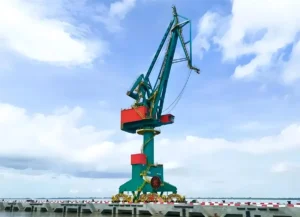
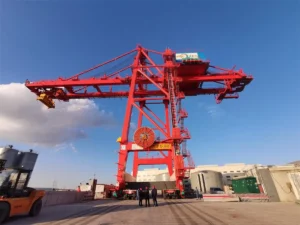
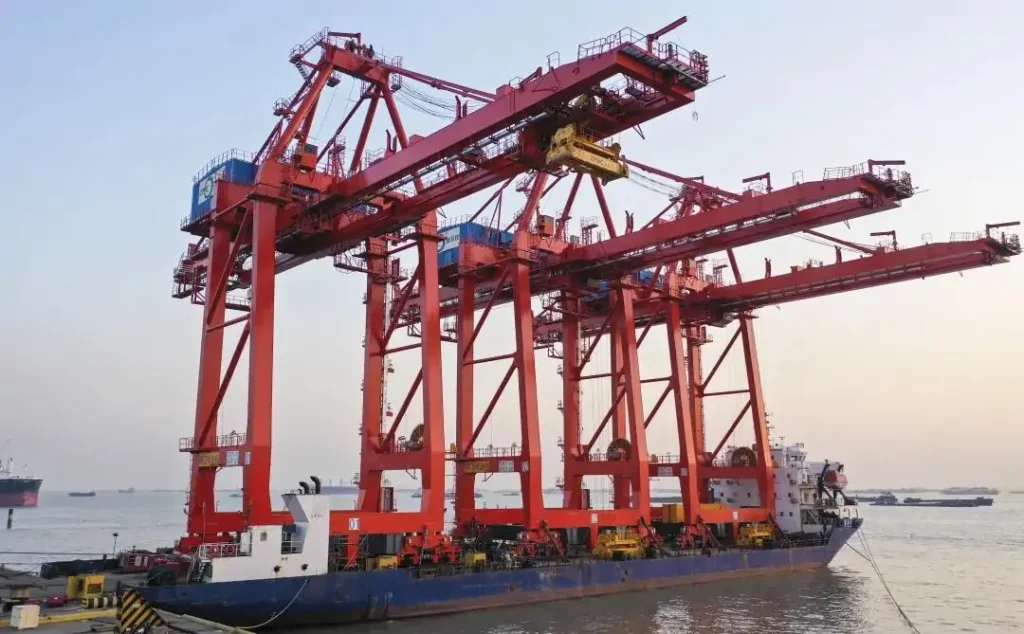
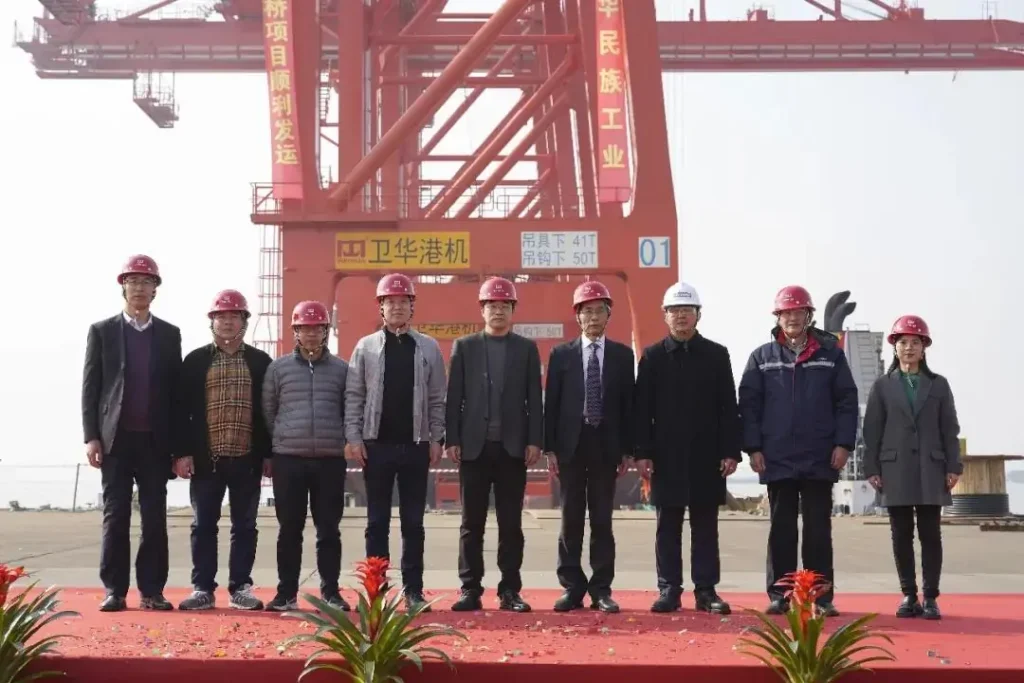
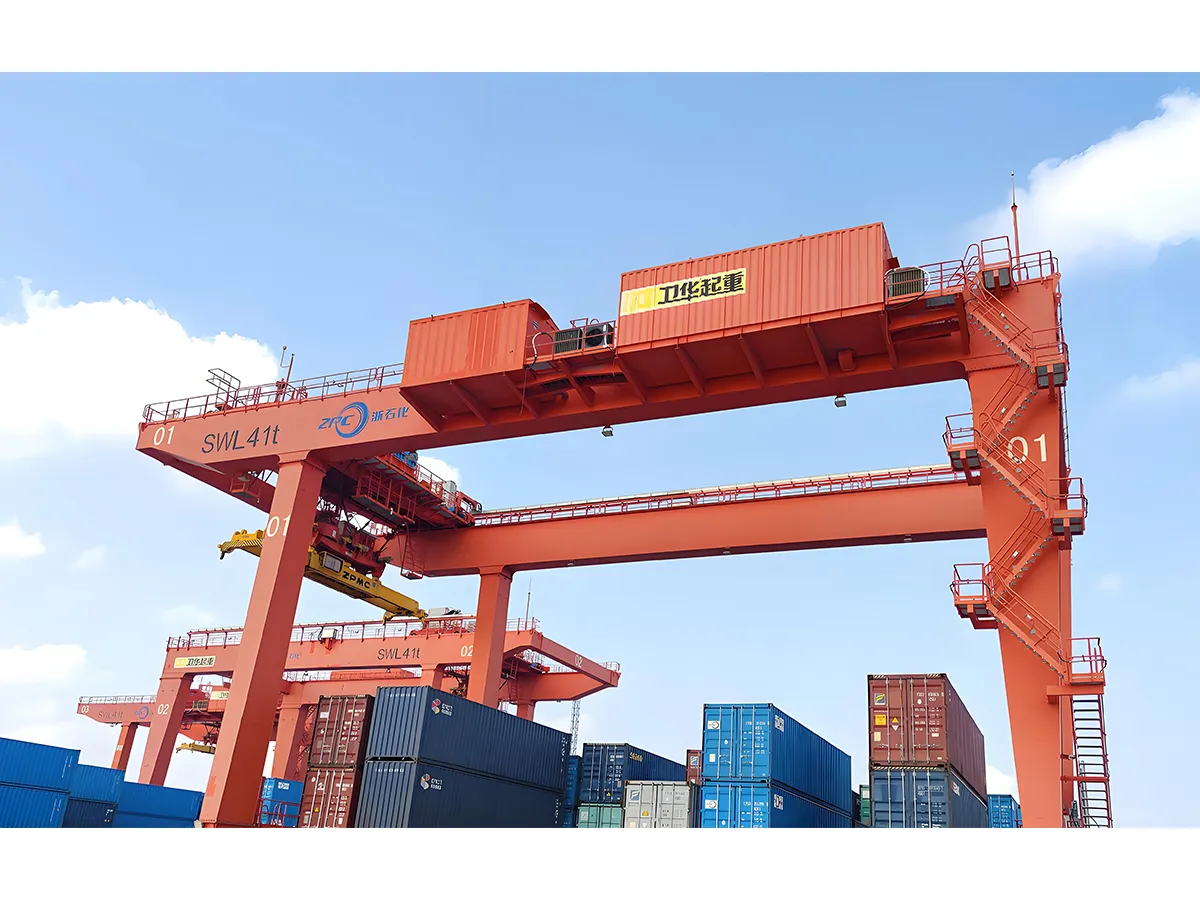
On November 26, 2021, the first batch of three remote-control automated STS (Ship-to-Shore) cranes was officially dispatched from the Jiangsu manufacturing base to the smart terminal project of Zhejiang Petrochemical Co., Ltd. at Yushan Island.
This project involves a total of six fully customized automated quay cranes, specifically engineered to meet the high standards of a large-scale intelligent petrochemical terminal. The cranes feature high lifting capacity, long outreach, compact rail gauge, and full automation capability, making them one of the few high-end automated STS crane solutions developed domestically at the time.
- Modèle Automated STS Cranes
- Total Length: 85 m
- Capacité de levage 41 tons (under spreader)
- Lieu : Chine
- Date : December 2021
Contexte client
Zhejiang Petrochemical (ZPC) is a large-scale integrated petrochemical enterprise with a strong focus on building intelligent and efficient port operations. To support its smart terminal strategy, the company places high demands on container handling efficiency, automation level, equipment reliability, and system integration. Therefore, ZPC required a customized solution featuring remote-control automated STS cranes capable of delivering high-performance operation, stable performance, and seamless integration with terminal management systems.
Project Challenges
This project involved several technical and engineering challenges:
- High automation requirements with remote-control capability
- Large lifting capacity combined with compact rail gauge
- Long outreach design for extended vessel coverage
- High-speed operation with strict safety standards
- Integration with terminal management systems
Solution Weihua
To address the complex operational requirements of the ZPC smart terminal, a fully customized solution of 6 remote-control automated STS cranes was engineered and manufactured, with the first 3 units delivered and commissioned in the initial phase.
The solution was not only focused on equipment supply, but also on integrating automation, intelligent control, and terminal system compatibility, ensuring the cranes could operate efficiently within a high-throughput petrochemical port environment. The design specifically optimized lifting performance, structural stability, and automation accuracy under demanding working conditions.
Technical Specifications
- Total Length: 85 m
- Lifting Capacity: 41 tons (under spreader)
- Lifting Height: 46 m
- Working Height: 58 m (79 m after boom raising)
- Outreach: 38 m
- Rail Gauge: 12 m
Technologies & Features
- Fiber Optic Communication System: Offers high-speed, stable, and real-time data transmission between equipment and control systems.
- Laser Scanning & Container Profiling: Enables accurate container contour detection for precise positioning and safe handling.
- CNC Control System: Provides high-precision, automated crane operation with improved stability and repeatability.
- Anti-Sway Control Technology:Minimizes load swing during lifting to enhance safety and operational efficiency.
- Automatic Container Alignment: Ensures fast and accurate container positioning, reducing handling time and human intervention.
- OCR Container Recognition: Automatically identifies container numbers to support digitalized terminal operations.
- Truck Positioning & Anti-Lifting Protection: Improves coordination with terminal trucks while preventing unsafe lifting actions.
- Intelligent Remote Management System: Integrates data collection, real-time monitoring, fault diagnosis, and predictive maintenance into a unified platform.
- Centralized Remote Operation: Allows a single operator to monitor and control multiple cranes simultaneously, significantly improving efficiency and reducing labor costs.
Commentaires des clients
The customer spoke highly of the overall project execution and equipment quality, especially the engineering capability and customization delivered throughout the process. The cranes have performed reliably in operation, with stable automation performance meeting the expectations of a smart terminal. This project also helped build stronger trust between both sides and laid a solid foundation for future cooperation.
Conclusion
The application of these remote-control automated STS cranes has effectively improved container handling efficiency while reducing reliance on manual operation. At the same time, overall safety, operational stability, and system coordination have been noticeably enhanced, with smooth integration into the terminal’s intelligent management system.
From project delivery to actual operation, this case reflects Weihua’s practical experience in automated port equipment. It also shows how automation and system integration can support more efficient, stable, and intelligent port operations.
Looking to upgrade your port equipment? Contactez-nous for a tailored solution and technical support.


 English
  Русский
  العربية
  Français
  Português
  Español