


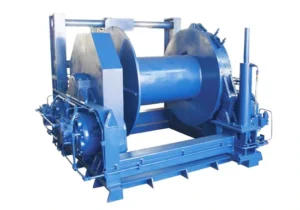






Does your facility actually need an explosion proof wire rope hoist — or are you being oversold on one? That is the first question we ask every procurement team before we talk specs. The honest answer: if any part of your lifting operation sits inside a Zone 1, Zone 2, Zone 21, or Zone 22 classified area, there is no alternative. A standard electric hoist in a classified zone is not a budget decision — it is a compliance violation and a safety liability. But once you have confirmed the need, the real challenge shifts to selecting the right explosion proof grade, the right capacity, and the right certifications for your destination market.
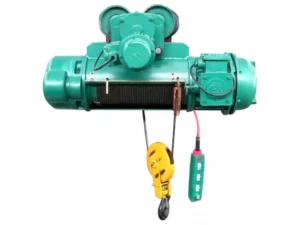
This guide walks through the specifications, zone classification logic, IIB vs. IIC selection rules, and the certification documents you should require from any supplier before issuing a purchase order. All specifications below reflect Weihua’s HB(BCD) series explosion proof wire rope hoist.
Quick Reference: Weihua Explosion Proof Wire Rope Hoist at a Glance
| Paramètre | Spécification |
|---|---|
| Capacité de levage | 0.5 t / 1 t / 2 t / 3 t / 5 t / 10 t |
| Hauteur de levage | 6–30 m (0.5 t max 18 m; custom available) |
| Explosion-Proof Grade | Ex dⅡBT4 / Ex dⅡCT4 |
| Temperature Class | T1 – T4 |
| Indice de protection | IP65 / IP66 |
| Qualité de travail | M3 (customizable) |
| Application Zones | Gas: Zone 1 / Zone 2 · Dust: Zone 21 / Zone 22 |
| Vitesse de levage | 8 m/min (0.5–5 t) / 7 m/min (10 t) |
| Vitesse de déplacement du chariot | 20 m/min (0.5–5 t) / 12 m/min (10 t) |
| Working Temperature | −25°C to +40°C |
| Altitude Limit | ≤ 1,000 m |
| Certifications | ATEX · IECEx · CE · CCC · Mining Safety |
What Makes an Explosion Proof Wire Rope Hoist Different

The Core Engineering Principle: Containment and Spark Elimination
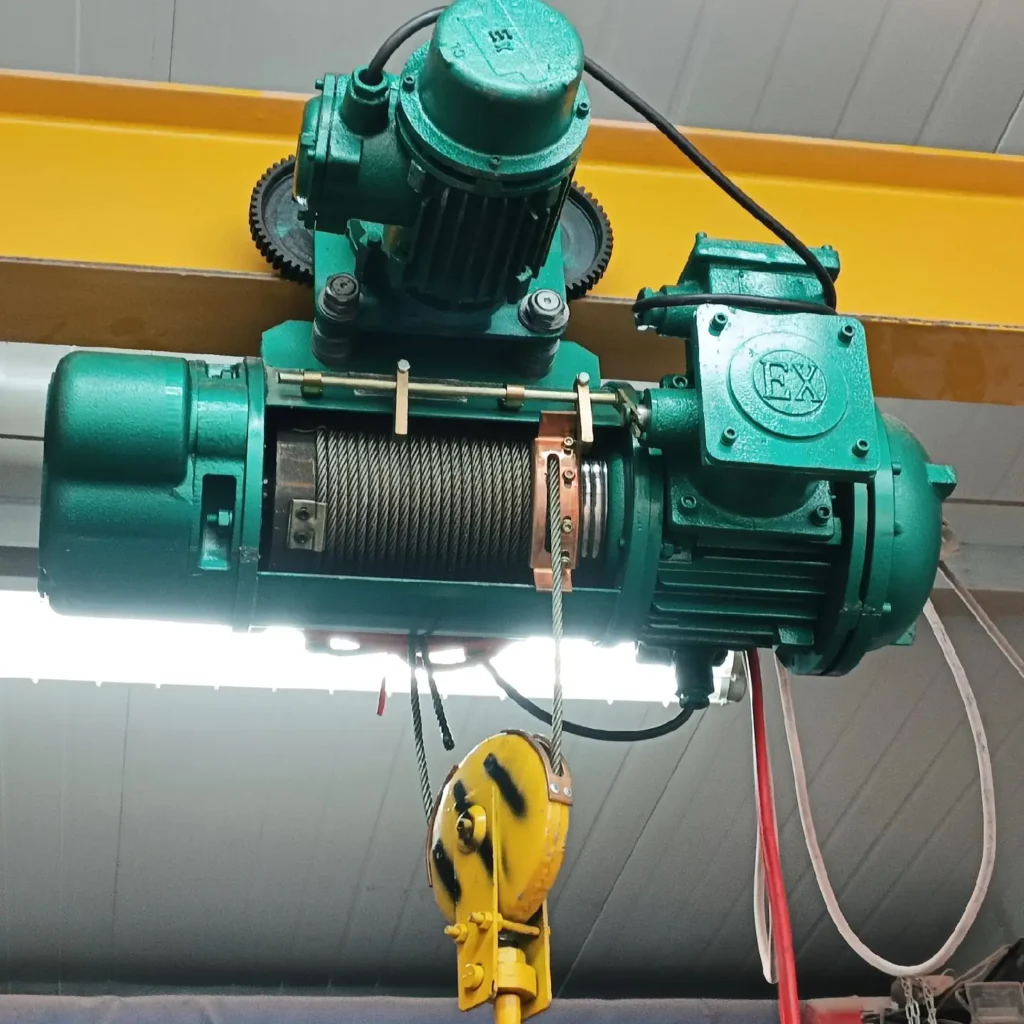
An explosion proof wire rope hoist is rated safe for hazardous areas not because it produces no energy, but because it is engineered to prevent that energy from reaching the surrounding atmosphere. Every electrical component — the motor, brake, control pendant, limit switches, and junction box — sits inside a flameproof (Type d) enclosure. If an internal fault generates heat or an arc, the enclosure contains it. The sealed housing also means combustion gases produced internally cannot escape at sufficient pressure or temperature to ignite the surrounding explosive atmosphere.
The mechanical side works differently. There is no enclosure around the wire rope, drum, or hook — these are open to the environment by necessity. Instead, all external moving components are manufactured from spark-resistant materials: copper alloy, aluminum bronze, and stainless steel. The wire rope itself is a non-sparking grade. The logic is straightforward: remove the ignition source rather than contain it.
The result is a lifting device that addresses both electrical and mechanical ignition risk simultaneously — which is why a standard IP55-rated hoist with “added protection” is never an acceptable substitute in a classified zone.
IIB vs. IIC: The Selection Decision That Most Buyers Get Wrong
The explosion proof grade printed on the nameplate — Ex dⅡBT4 or Ex dⅡCT4 — is not just a certification tier. It defines which gas atmospheres the hoist can safely operate in, and selecting the wrong one is a compliance failure regardless of how robust the unit looks.
Group IIB covers the majority of industrial hazardous gases: propane, ethylene, ammonia, hydrogen sulfide, and most common petrochemical vapors. For refineries, chemical plants, paint lines, and pharmaceutical solvent areas, IIB is typically the correct specification.
Group IIC is required for facilities handling hydrogen or acetylene — the most hazardous gas subgroup. IIC equipment meets the more stringent ignition gap and pressure requirements that IIB equipment does not. If your site risk assessment identifies hydrogen (common in electrochemical plants, fuel cell facilities, and certain refinery units) or acetylene, the IIC rating is mandatory, not optional.
A practical rule we apply: when in doubt between IIB and IIC, specify IIC. The additional cost at sourcing is minor. Retrofitting or replacing a hoist after a compliance audit is not.
Technical Specifications in Depth
Capacity, Lifting Height, and Why the 0.5 t Limit Matters
The Weihua HB(BCD) series covers 0.5 to 10 tons across six standard capacity steps, with lifting heights from 6 to 30 meters. One specification that buyers sometimes overlook: the 0.5-ton model has a maximum standard lifting height of 18 meters, not 30. This is a structural constraint related to drum size and wire rope layer count at that capacity — it is not a manufacturing limitation that can be waived without a custom engineering review. If your application requires the 0.5-ton capacity but a lifting height above 18 meters, raise this explicitly at the quotation stage.
For the 1-ton through 10-ton range, all standard heights up to 30 meters are achievable, and custom heights beyond 30 meters are available on request.
Duty Class M3: What It Means for Your Application
The working grade M3 (as classified under FEM 1.001 / ISO 4301 duty classification) indicates the hoist is designed for light to moderate duty cycles — typically facilities where lifting operations occur intermittently and the hoist is not running continuously across full shifts.
M3 covers most maintenance, installation, and intermittent process lifting applications: oil and gas platform maintenance, chemical plant equipment overhaul, pharmaceutical batch handling. It is the standard specification for the majority of hazardous area lifting requirements.
If your application involves higher cycle frequencies — for example, continuous production line lifting with duty cycles closer to M4 or M5 — this should be specified in writing at the enquiry stage. We can advise on whether a custom duty class configuration is appropriate for your workload.
IP65 vs. IP66: Outdoor and Washdown Environments
Both IP ratings provide complete dust protection. The distinction is water ingress resistance: IP65 protects against sustained low-pressure water jets from any direction; IP66 protects against powerful water jets. For standard indoor hazardous area installations, IP65 is typically sufficient. For offshore platforms, tank farms, outdoor petrochemical facilities, or any environment subject to pressure washing, specify IP66. Both ratings are available within the standard HB(BCD) series without additional lead time.
Hazardous Zone Classification and Where This Hoist Is Used
Zone 1 and Zone 2: Gas and Vapor Environments
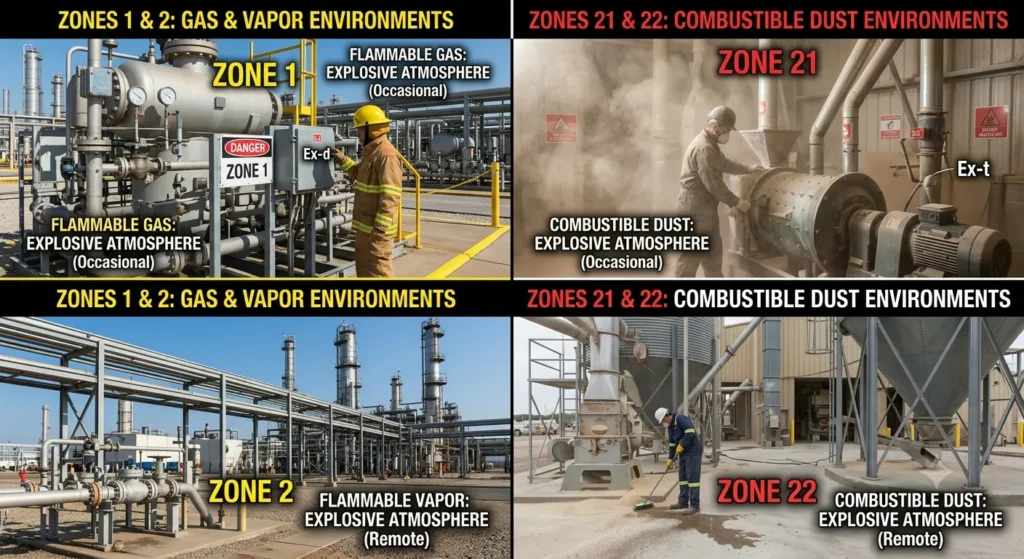
Zone 1 means the explosive gas atmosphere may be present during normal operation — refineries, active chemical process areas, paint booths during production. Zone 2 means it is unlikely during normal operation but possible in abnormal conditions — storage areas adjacent to process zones, loading bays. Both zones require ATEX/IECEx-rated lifting equipment; the difference affects how frequently the protection system must function, not whether it must be present.
The HB(BCD) series is rated for both Zone 1 and Zone 2 gas environments, covering IIA, IIB, and IIC gas groups depending on the selected explosion-proof grade.
Zone 21 and Zone 22: Combustible Dust Environments
Zone 21 and Zone 22 apply to combustible dust atmospheres — flour mills, sugar processing, grain storage, coal handling, and certain pharmaceutical powder handling operations. The dust explosion risk is governed by GB 12476.3-2007 in China and the ATEX 2014/34/EU directive in European markets. The HB(BCD) series covers Zone 21 and Zone 22 dust environments as standard.
For more information on standards for explosion-proof cranes, read the article: “Explosion Proof Crane Standards Explained: Atex, lecex & Nec”
Industry Applications
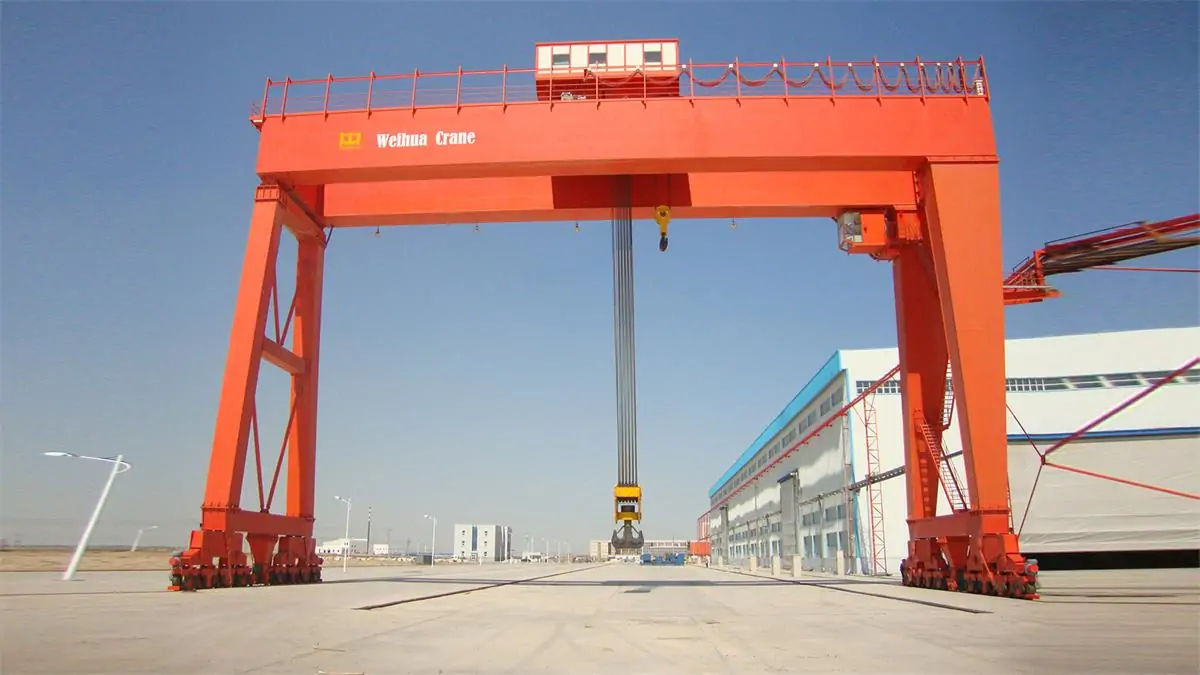
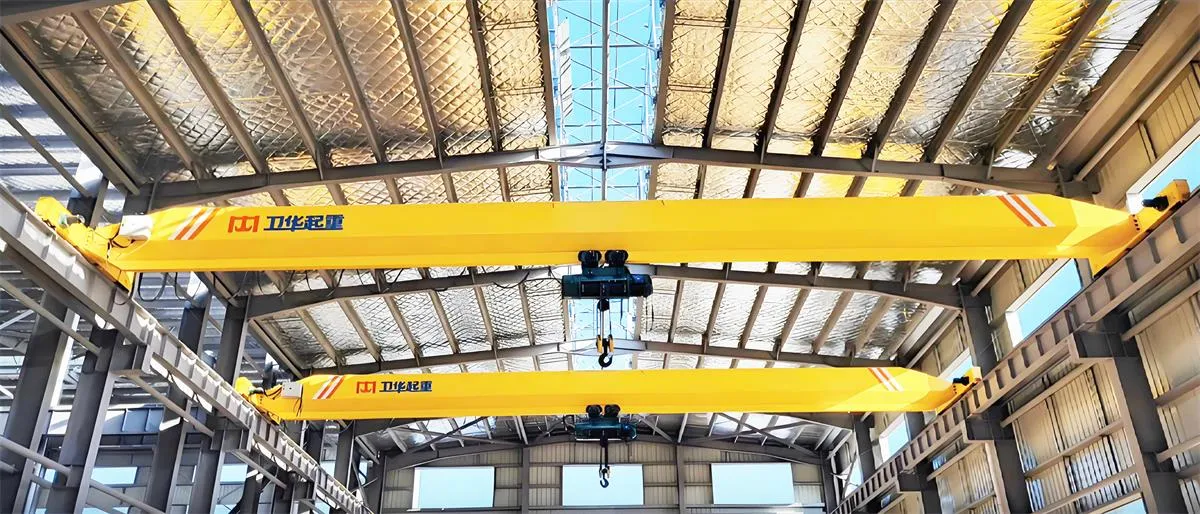
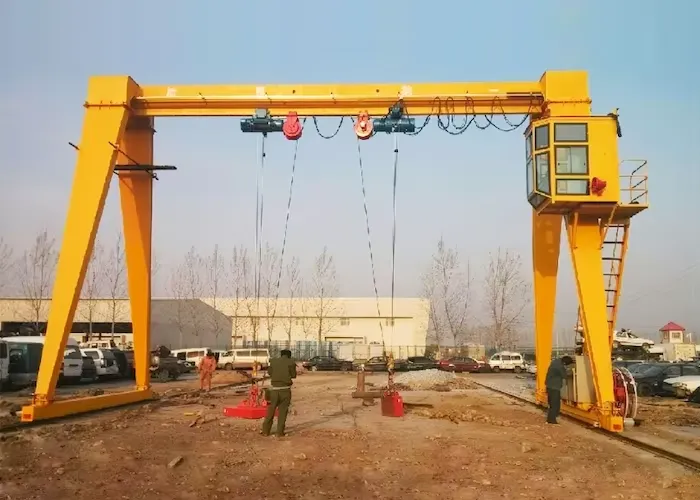
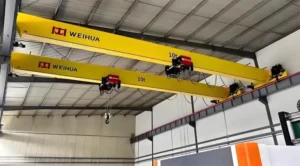
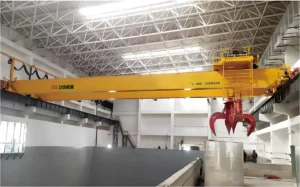
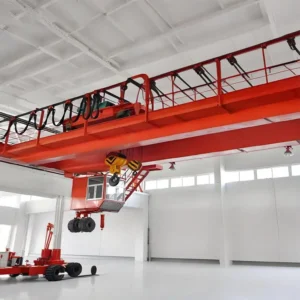
The explosion proof wire rope hoist is the standard lifting solution across oil and gas, petrochemical processing, pharmaceutical manufacturing, LPG/LNG facilities, underground and surface mining, food processing, shipyard paint shops, and wastewater biogas facilities. For facilities where the explosion proof hoist needs to be integrated into a full crane system — for example, mounted on an overhead crane bridge for broader coverage — Weihua also supplies complete explosion proof overhead cranes with matched Ex-rated components throughout.

Certifications and Compliance: What to Require Before You Sign a PO
The Certificates That Apply — and Why Each One Matters
This is the section that most supplier comparison pages skip, and it is the one that causes the most problems at the customs clearance and insurance underwriting stage.
Directive ATEX 2014/34/UE is mandatory for any explosion proof equipment installed in the European Union. ATEX is not a certificate you can add retroactively — the equipment must be designed and manufactured to the directive’s requirements from the outset. An EC Declaration of Conformity signed by the manufacturer is the primary document; it must reference the specific model range, serial numbers, and the notified body that conducted conformity assessment.
IECEx is the international mutual recognition standard accepted in over 50 countries outside the EU, including Australia, the Middle East, and most of Southeast Asia. If your facility spans EU and non-EU markets, we recommend specifying dual ATEX + IECEx certification upfront. Obtaining a second certification after manufacturing is significantly more expensive than building it into the original order.
Marquage CE covers the machinery directive (Machinery Directive 2006/42/EC) requirements separately from the ATEX product directive. Both are required for EU market entry — CE alone does not satisfy ATEX obligations.
CCC (China Compulsory Certification) and the Explosion-Proof Qualification Certificate are required for equipment sold or used within China.
Mining Safety Certificate is an additional requirement for underground coal mining and surface mining applications, beyond standard ATEX/IECEx documentation.
All of these certificates are provided with every Weihua unit at delivery and are available for pre-purchase review.
How to Verify: The Document Checklist
When evaluating any supplier of explosion proof wire rope hoists, require these specific documents in writing before issuing a purchase order:
- EC Declaration of Conformity — must cite the specific model and serial number range, reference ATEX Directive 2014/34/EU, and name the notified body.
- Component-level Ex certificates — separate certificates for the hoist motor, electrical control enclosure, limit switches, pendant or wireless remote, and cable gland fittings. A system-level declaration without component certificates is incomplete compliance.
- ISO 9001 Quality Management Certificate — confirms the manufacturing quality system is independently audited.
- Factory test records — overload test certificate (typically 125% of rated load) and no-load run test records.
A supplier who cannot provide all four categories of documentation within a reasonable timeframe is a procurement risk, regardless of the quoted price.
Explosion Proof Wire Rope Hoist vs. Standard Wire Rope Hoist
| Factor | Palan à câble antidéflagrant | Standard Wire Rope Hoist |
|---|---|---|
| Motor enclosure | Flameproof Ex d, IP65/IP66 | Standard IP54/IP55 |
| Electrical components | Fully Ex-rated throughout | Standard industrial grade |
| External moving parts | Spark-resistant copper alloy / aluminum bronze | Standard carbon steel |
| Brake system | Fail-safe Ex-rated electromagnetic brake | Standard electromagnetic brake |
| Control pendant | Ex-rated enclosure | Standard pendant |
| Zone suitability | Zone 1, 2, 21, 22 | Non-hazardous areas only |
| Certifications | ATEX · IECEx · CE · CCC · Mining | CE · ISO |
| Entretien | Requires qualified Ex-rated personnel | Standard technicians |
Selection rule: Any lifting operation within a classified hazardous area requires an explosion-proof rated hoist. Using a standard hoist in Zone 1 or Zone 2 is a safety violation and regulatory non-compliance — operational precautions do not substitute for equipment classification.
Conclusion
Selecting an explosion proof wire rope hoist comes down to three decisions made in the right order: confirm your zone classification and gas group first, then match the explosion-proof grade (IIB or IIC) to your specific atmosphere, then verify the certifications match your destination market. Get those three right, and the capacity and lift height specifications are straightforward.
We recommend reaching out with your site classification drawing and load requirements — our engineering team can confirm the correct Ex grade, duty class, and certification package for your application within one working day.
FAQ
Q1: What is the difference between Ex dⅡBT4 and Ex dⅡCT4 on a wire rope hoist nameplate?
Both ratings indicate a flameproof Type d enclosure for Group II industrial atmospheres. IIB covers most common hazardous gases — propane, ethylene, ammonia, hydrogen sulfide. IIC covers the most hazardous gases: hydrogen and acetylene. If your facility handles hydrogen or acetylene in any process area, the IIC-rated model is mandatory. For most petrochemical, pharmaceutical, and paint line applications, IIB is the standard correct specification. When uncertain, specify IIC — the cost difference at procurement is small, and the compliance risk of underspecifying is significant.
Q2: Can we use this hoist in both Zone 1 gas and Zone 21 dust environments within the same facility?
Yes. The Weihua HB(BCD) series is rated for Zone 1/Zone 2 gas environments and Zone 21/Zone 22 dust environments as standard. If your facility has both gas and dust classified areas at different lifting points, the same hoist model covers both classifications. Confirm the specific zone map with your certifying engineer before finalizing installation positions.
Q3: Which certifications do we need for import into the EU versus non-EU markets?
For EU market entry: ATEX Directive 2014/34/EU (EC Declaration of Conformity + notified body certification) plus CE Marking under the Machinery Directive 2006/42/EC — both are required. For non-EU markets including Australia, the Middle East, and Southeast Asia: IECEx is the standard accepted certification. If your operations span both markets, request dual ATEX + IECEx certification in your original order — adding a second certification after manufacturing is significantly more expensive.
Q4: What does working grade M3 mean, and is a higher duty class available?
M3 under FEM 1.001 / ISO 4301 indicates light to moderate intermittent duty — suitable for maintenance lifting, process overhauls, and batch material handling in hazardous areas. It is the standard specification for the majority of oil and gas, chemical, and pharmaceutical applications. For higher cycle frequency applications requiring M4 or M5 duty class, custom configurations are available. Specify your estimated daily lift cycles and load spectrum at the enquiry stage so we can recommend the appropriate duty class.
Q5: What is the price range for an explosion proof wire rope hoist?
Market reference pricing for explosion proof wire rope hoists in this class typically ranges from approximately $3,000 to $15,000+ depending on capacity, lifting height, trolley configuration, and certification package. IIC-rated models and dual ATEX + IECEx certified units carry a premium over standard IIB/ATEX-only configurations. Contact our sales team with your specific capacity and certification requirements for an accurate factory-direct quotation.