
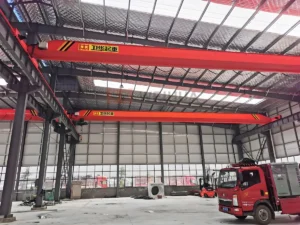
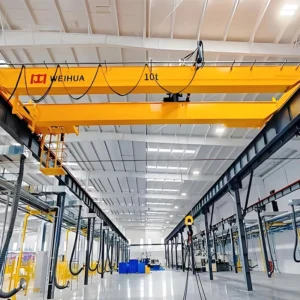
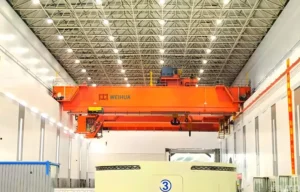
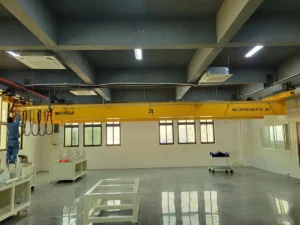








You’re equipping a workshop with an 8-meter eave height and a steel-frame roof structure. An overhead crane seems straightforward — until the structural engineer hands back the load assessment and tells you the roof trusses won’t carry a top-running system without reinforcement work that adds months and budget you don’t have. That’s the scenario where most procurement managers first encounter the underslung overhead crane: a system whose end trucks run on the bottom flange of existing structural beams rather than on top of dedicated runway rails, removing the need for support columns or structural upgrades in many retrofit situations.
Underslung cranes won’t handle every application. For loads within 0.5–20 tons in facilities with limited headroom or existing beam structures, though, they deliver the same core lifting function at significantly lower installation cost and a shorter commissioning timeline. The market reference range for Weihua’s configurations runs from approximately $3,500 for a basic single-girder unit up to $45,000+ for a heavy-spec double-girder system.
This guide covers Weihua’s underslung overhead travelling crane range — single-girder and double-girder variants, key specifications, headroom requirements, and the certifications your team needs to verify before committing to an order.
Table des matières
Quick Reference: Weihua Underslung Crane Range
| Single Girder Underhung | Double Girder Underslung | Top-Running (Single Girder)* | |
|---|---|---|---|
| Capacité de levage | 0,5–10 t | 1-5 t | 1–32 t |
| Span | 5–15 m | 10–20 m | 7.5–31.5 m |
| Classe de service | A3–A5 | A4 | A3–A5 |
| Headroom Demand | Low — hangs below beam | Low-medium | Higher — needs rail above beam |
| Structure Requirement | Existing lower flange | Existing lower flange | Dedicated runway on top of beam |
| Meilleure adaptation | Warehouse, light assembly, maintenance bays | Production lines, higher-frequency ops | General factory, loads above 10 t |
| Market Reference | ~$3,500–$20,000 | ~$10,000–$30,000+ | Per configuration — contact Weihua |
*Weihua Single Girder Overhead Travelling Crane, listed for context where underslung capacity is exceeded.
Request a Weihua Configuration Quote
Obtenez un devis personnalisé dès maintenantWhat Is an Underslung Overhead Crane?
How the System Works
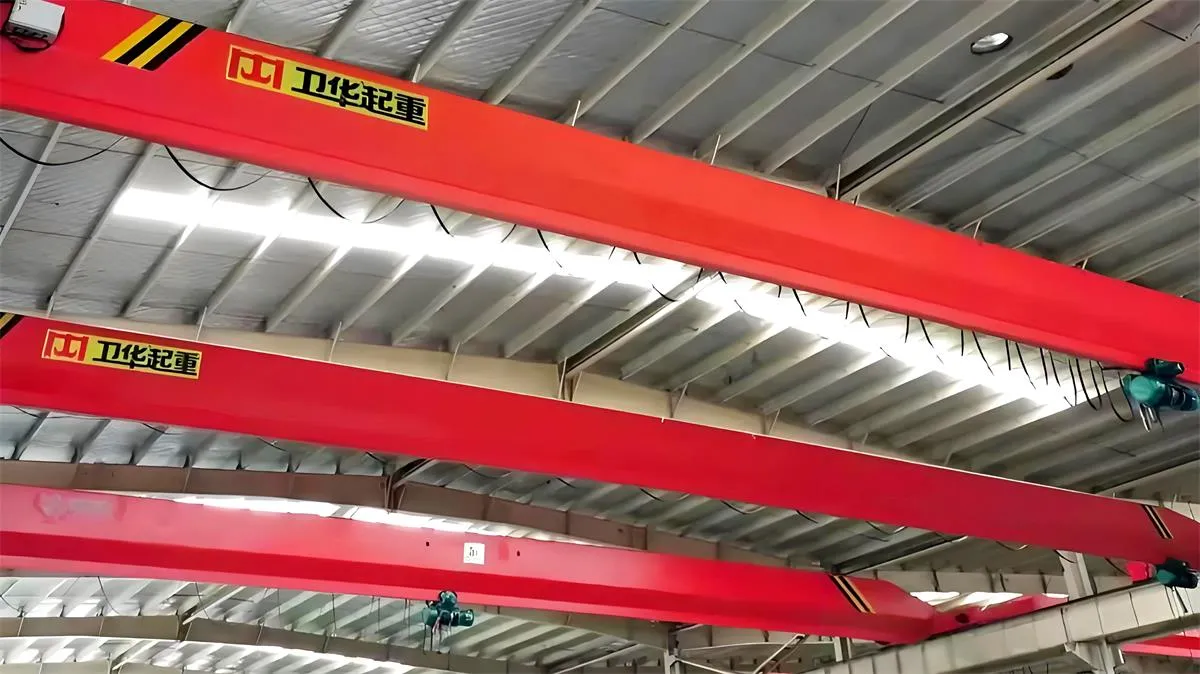
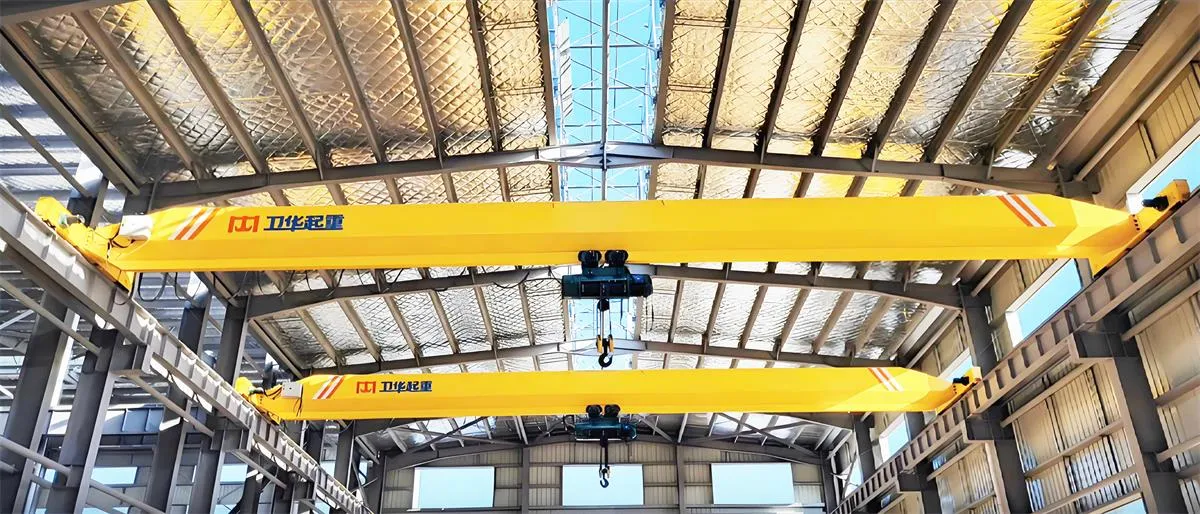
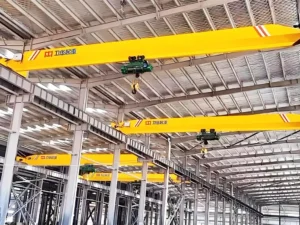
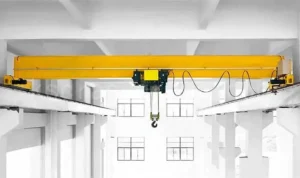
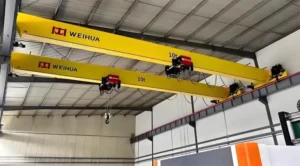
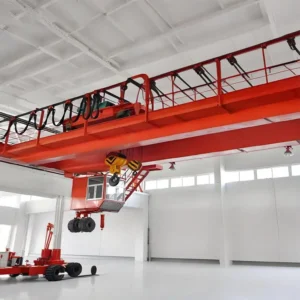
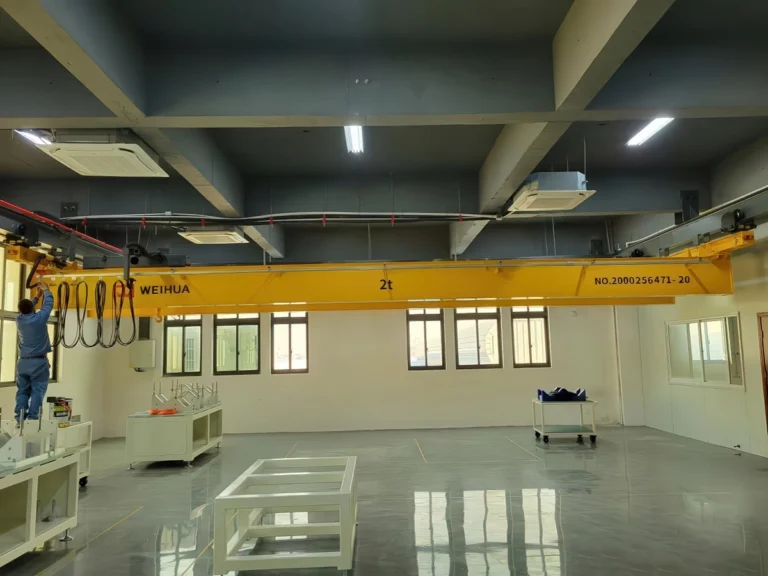
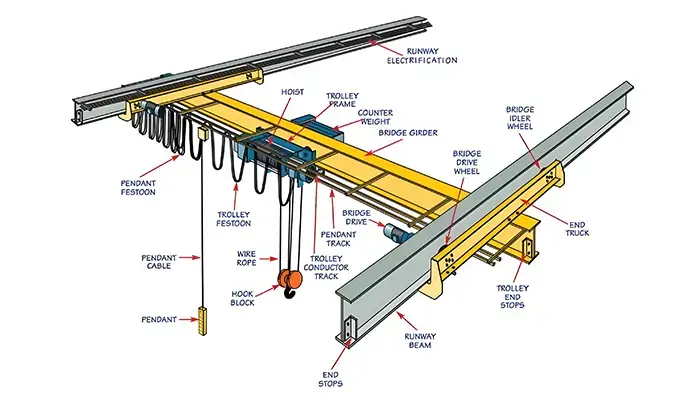
Un underslung overhead crane — also called an underhung or under-running crane — is a bridge crane whose end trucks travel along the bottom flange of the structural runway beam rather than on a rail sitting above it, as classified under ISO 4301 overhead crane design principles.
The structural logic is direct. Because the crane hangs from the underside of your building’s existing beams, it doesn’t require additional support columns or elevated rail beds to be built from scratch. The end trucks grip and ride the lower flange; the hoist and trolley traverse the bridge girder below them; the whole assembly travels longitudinally through the bay. In facilities where the structure can carry the combined crane and load weight, installation is measured in days, not months — and the civil engineering scope stays minimal.
The trade-off is load path. Every kilogram the crane lifts passes through the existing building structure. That’s why a structural engineering verification of the lower-flange capacity is mandatory before specifying underslung in any application. Skipping this step — or relying on a verbal assurance from the building contractor that “the beams are rated at X tons” — is the most common cause of installation hold-ups and rework costs on underslung projects in our experience.
Underslung vs Top-Running: When Each Makes Sense
The choice between an underslung and a top-running crane comes down to four variables: headroom, load, structure, and duty cycle.
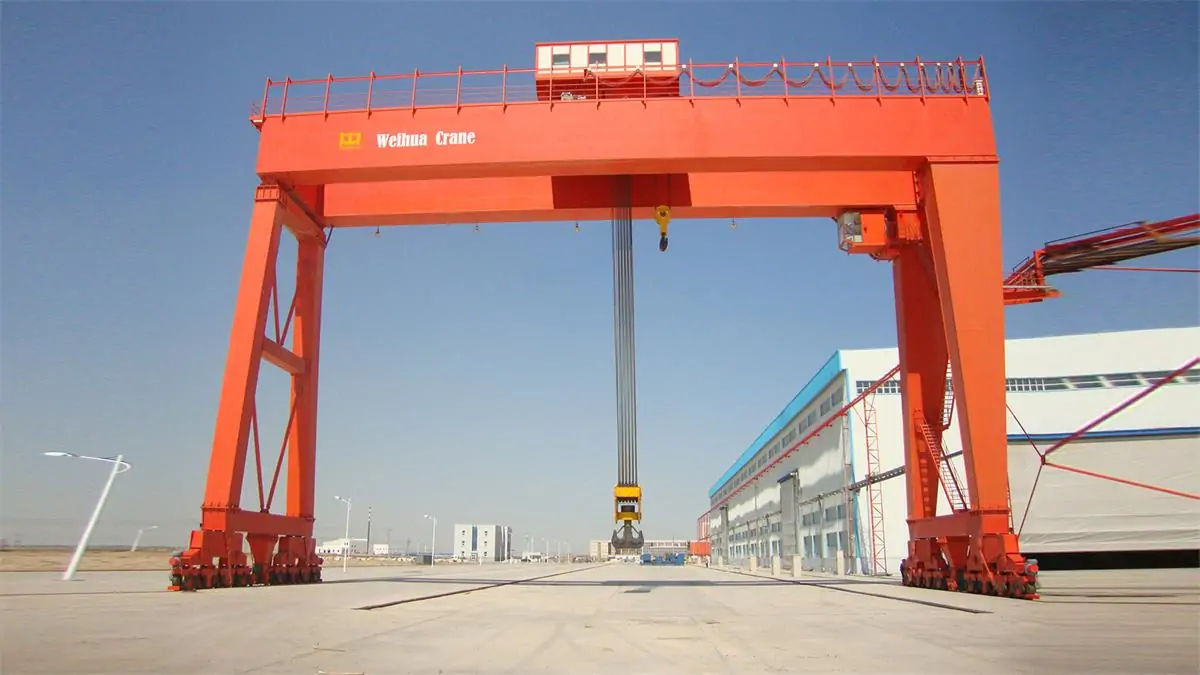
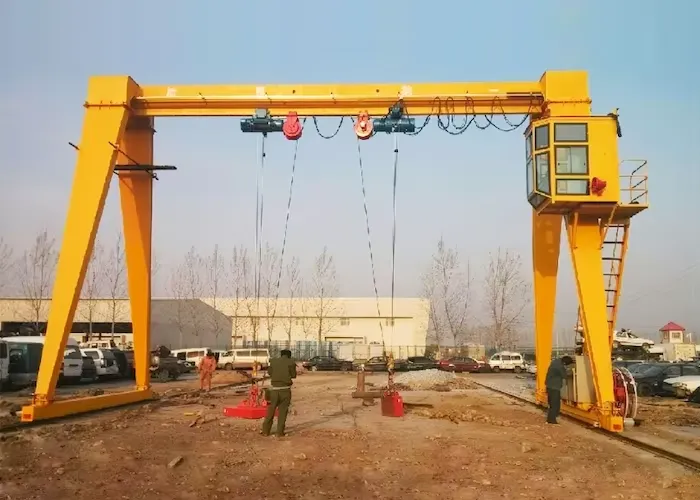
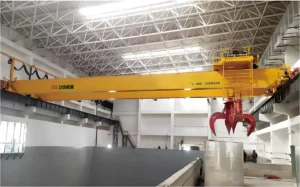
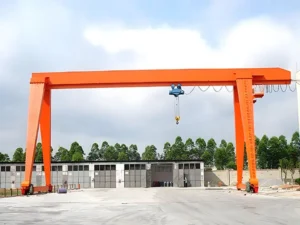
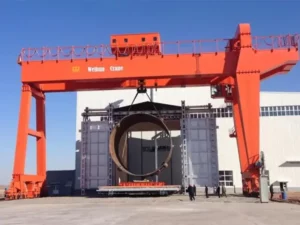
Weihua’s underslung range covers 0.5–20 t in standard configurations. The top-running Single Girder Overhead Travelling Crane handles 1–32 t and the Double Girder Overhead Travelling Crane scales to 500 t. For loads above 20 t, duty class A6 and above, or spans beyond 20 meters, the underslung design reaches its structural ceiling — and a top-running configuration becomes the correct specification.
| Factor | Underslung | Top-Running (Weihua) |
|---|---|---|
| Headroom constraint | Ideal — runs below beam | Needs dedicated rail height above beam |
| Max standard capacity | 20 t | 500 t (double girder) |
| Retrofit to existing building | Often no structural modification | Usually requires runway upgrade |
| Duty class A6+ availability | Not standard | A5–A8 available |
| Span >20 m | Outside typical range | Up to 40 m+ |
| New build, heavy ops | Undersized for intensive cycles | Designed for it |
Specify underslung when: headroom is limited, the building structure is verified, and lifting cycles fall within A3–A5. If any of those conditions isn’t met, Weihua’s top-running range is the appropriate direction.
Single Girder vs Double Girder Underslung Crane
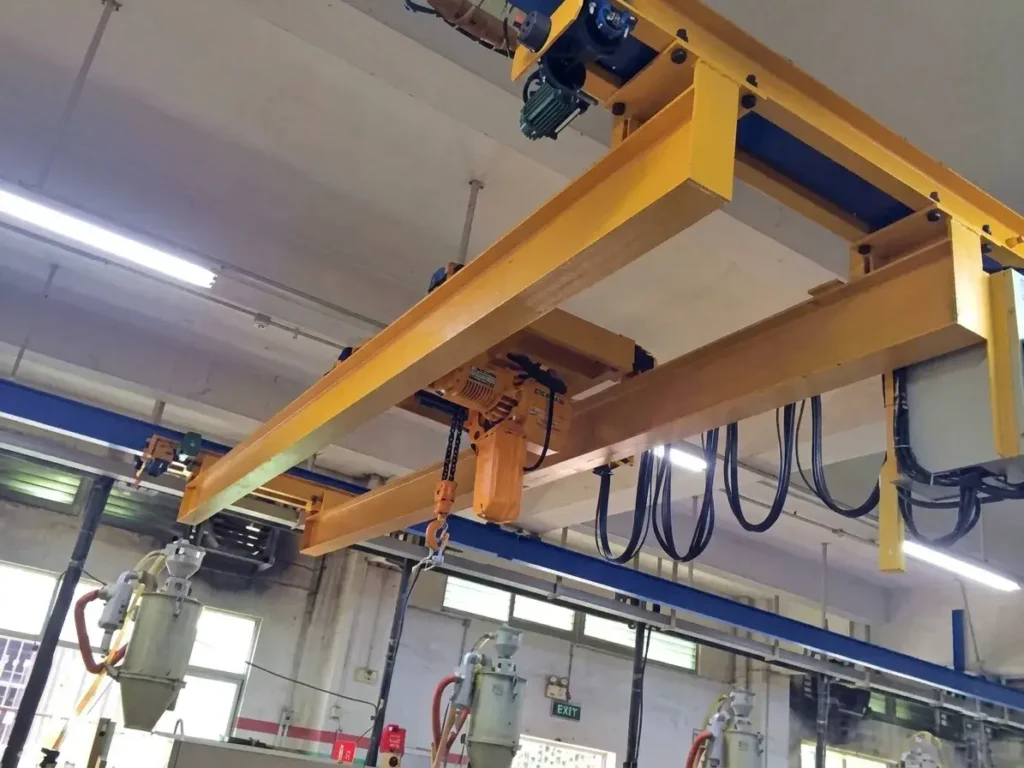
Once you’ve confirmed that underslung is the right system, the next decision is single girder versus double girder. Most buyers ask this after the RFQ has gone out — but it should be settled before it.
Single Girder Underhung Crane — Light-Duty Applications and Retrofit Priority
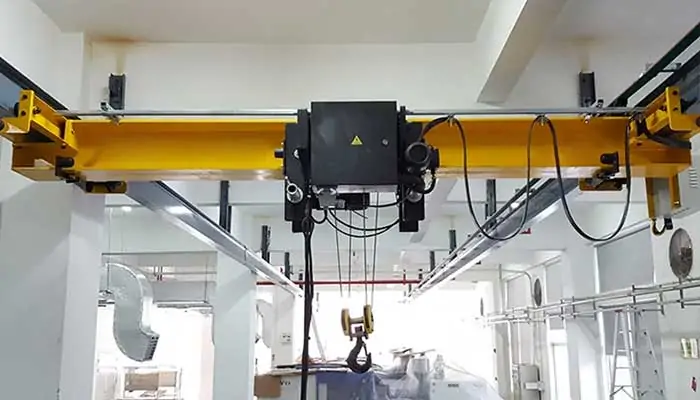
Single-girder underhung cranes are the standard entry point for underslung applications, covering 0.5–10 tons across spans of 5–15 meters at working class A3–A5.
The key advantage is weight. A single-girder design places less load on the building’s lower flange than a double-girder unit of equivalent capacity, which often simplifies the structural verification step and reduces the risk of needing building modifications. The hoist runs on the bottom flange of the main girder, keeping effective hook height as high as possible within the available building clearance.
For warehouses, light assembly lines, maintenance bays, and logistics sorting areas where lifts are under 10 tons and frequency is moderate — not continuous — single-girder configurations consistently offer the strongest cost-to-performance ratio. A standard 3-ton single-girder unit with pendant control typically sits in the $5,000–$10,000 market reference range depending on span and hoist selection.
The A3–A5 duty class deserves a practical note. A3 is designed for light, infrequent use — a maintenance bay doing a handful of lifts per shift. A5 handles moderate production frequency. If your crane will run 20 or more lift cycles per hour on a sustained basis, single-girder duty class may be insufficient. That’s the threshold where double-girder becomes the more reliable long-term specification, not because of capacity, but because of cycle endurance.
Double Girder Underslung Crane — Higher Capacity and Operational Frequency
Double-girder underslung cranes cover 5–20 tons across spans of 10–20 meters at working class A4–A5, with meaningfully different structural capability for the same ceiling-mounted premise.
Two parallel main girders distribute load across a wider section, improving rigidity and reducing deflection under full load. This matters in applications where precise load positioning is required — electronic assembly lines, tooling installations, and fabrication processes where a swinging or deflecting load creates quality or safety issues. Higher utilisation rates are also better supported by double-girder configurations; the duty class overlap with single-girder at A4–A5 masks the fact that double-girder designs are structurally more suited to sustained production cycles.
One headroom cost to account for upfront: two parallel main girders occupy more vertical space below the runway beam than a single girder. In workshops with genuinely tight clearance — say 6–7 meters from floor to lower flange — this can reduce effective hook height below what the application requires. Calculate available hook travel carefully before specifying double-girder in low-ceiling environments. The formula: floor-to-lower-flange clearance, minus main girder assembly depth, minus hoist body height equals your usable lift height.
Market reference for a double-girder unit at 10 tons and 15-meter span typically falls in the $20,000–$35,000 range.
Side-by-Side Summary
| Single Girder | Double Girder | |
|---|---|---|
| Capacité | 0,5–10 t | 5–20 t |
| Span | 5–15 m | 10–20 m |
| Classe de service | A3–A5 | A4–A5 |
| Below-beam depth | Smaller | Larger |
| Hook height impact | Minimal | Moderate — check clearance |
| Best application | Warehouse, light assembly, maintenance | Production line, higher-frequency ops |
| Market reference | ~$3,500–$20,000 | ~$15,000–$45,000+ |
Choose single girder when capacity stays under 10 t, lifts per shift are moderate, and minimising structural load on the building matters.
Choose double girder when capacity reaches 5–20 t, operational frequency is high, or load positioning precision is a requirement.
→ Contact Weihua Engineering for a Configuration Recommendation
Obtenez un devis personnalisé dès maintenantKey Specifications to Confirm Before Ordering
Load Capacity, Span, and Duty Class
Three numbers define whether an underslung crane procurement goes well or badly: capacity, span, and duty class.
Capacity must reflect the maximum lift including rigging and all lifting attachments — not just net product weight. Underspecifying by 15–20% is common when buyers quote product mass alone without adding hook, sling, and spreader bar weight. Weihua’s underslung standard range covers 0.5 t to 20 t, with custom configurations available beyond these limits on request.
Span is the distance between runway beam centerlines. Standard Weihua underslung spans run 5–15 m (single girder) and 10–20 m (double girder). For wider bays, a top-running configuration typically becomes the more economical and structurally sound solution.
Duty class under ISO 4301 / FEM 1.001 determines the crane’s design life in terms of total lift cycles and average load ratio. Confirm your lift cycles per hour, operating hours per day, and average load relative to SWL before finalising duty class. This specification has more long-term reliability impact than almost any other — and it’s the one most commonly left to the supplier’s assumption rather than confirmed in the inquiry.
Headroom and Building Structure Requirements
Headroom calculation for underslung installations requires more precision than most buyers apply at the inquiry stage.
Usable hook height equals: floor-to-lower-flange clearance, minus main girder depth, minus hoist body height. In a workshop with 8-meter floor-to-lower-flange clearance, a single-girder underslung unit typically delivers 5.5–6 meters of effective hook travel depending on hoist model. If you’re lifting above work platforms or mezzanine levels inside that building, confirm the arithmetic before the purchase order is raised.
Building structure verification is not optional and cannot be treated as a post-order activity. The lower flange of the runway beam must be assessed for the combined dead load of the crane and the rated dynamic live load, including impact factors. Weihua supplies full load data and technical documentation to support that structural assessment. The sign-off, however, must come from a qualified structural engineer with knowledge of your specific building.
Certifications & Import Compliance
For most importing markets, CE marking is not a preference — it’s an entry condition. Underslung overhead cranes are safety-critical equipment under the European Machinery Directive (2006/42/EC), which means the manufacturer must demonstrate conformity against harmonised standards including FEM 1.001 design rules and ISO 4301 crane classification before attaching the CE mark.
Weihua holds CE marking across its crane product range and ISO 9001 certification for its manufacturing quality management system. When evaluating any supplier for underslung overhead crane supply, we recommend treating the following as required pre-order documentation, not post-shipment paperwork.
What Standards Apply
The core compliance framework for underslung overhead cranes in most major importing markets covers:
- CE Marking + Machinery Directive 2006/42/EC — required for the EU, and referenced by many Middle East and Southeast Asian procurement specifications. Covers design, safety devices, and testing.
- FEM 1.001 design rules — underpins structural and mechanical design classification; aligned with ISO 4301 crane duty classification.
- ISO 9001 — quality management system for the manufacturing facility; not product-specific, but a baseline indicator of manufacturing process control.
- EAC (TR CU) — mandatory for Russia, Kazakhstan, Belarus, and other Eurasian Customs Union markets; separate conformity assessment from CE.
- OSHA 1910.179 — governs overhead crane operation for US-market facilities; covers inspection, operation, and maintenance requirements rather than design certification.
How to Verify Before You Order
Requesting certifications verbally — or accepting a general statement that the equipment “meets CE” — is insufficient. Ask your supplier for the following in writing before production begins:
- EC Declaration of Conformity — must name the specific product type, applicable EU directives, and the harmonised standards used. A generic company-level document is not equivalent.
- Load test certificate — confirms the crane was proof-tested at 125% of rated SWL before shipment; should include test date and test load value.
- ISO 9001 certificate — issued by an accredited third-party certification body (not self-certified), current, and with manufacturing scope that covers crane production.
If any of these three documents cannot be provided before production start, treat that as a compliance risk. Receiving non-compliant equipment creates customs clearance delays, insurance complications, and in some jurisdictions, mandatory re-certification at the buyer’s cost.
Conclusion
For workshops where headroom is limited, the existing building structure is adequate, and lifting requirements fall within 0.5–20 tons at moderate duty cycles, the underslung overhead crane is one of the most cost-efficient and installation-friendly solutions in the overhead lifting category. The key decision after confirming underslung is right for your facility is single girder versus double girder — and that choice turns on three numbers: capacity, frequency, and available headroom.
Weihua’s underslung overhead travelling crane range covers both single-girder (0.5–10 t, 5–15 m span) and double-girder (5–20 t, 10–20 m span) configurations, with full customisation available for capacity, span, hoist type, control method, and operating speed. All equipment is CE and ISO 9001 certified. For applications where load requirements exceed underslung capacity limits, the Single Girder or Double Girder Overhead Travelling Crane range provides the direct upgrade path within the same product family.
If you have a building structural assessment and your required capacity and span confirmed, contact Weihua’s engineering team for a configuration-specific quotation.

FAQ
What is an underslung overhead crane and how does it differ from a standard overhead crane?
An underslung overhead crane runs its end trucks on the bottom flange of existing structural beams, suspending the entire crane below roof level. A standard top-running overhead crane sits on rails mounted above the runway beam. The practical difference: underslung cranes need less headroom and can often use the existing building structure without modification, but they’re limited to lighter loads and moderate duty cycles compared to top-running systems.
How much does an underslung overhead crane cost?
Market reference pricing for Weihua configurations runs approximately $3,500–$20,000 for single-girder units (0.5–10 t) and $15,000–$45,000+ for double-girder units (5–20 t). Exact pricing depends on span, capacity, hoist type, and control specification. Contact Weihua directly for a quote based on your confirmed parameters.
What is the maximum capacity available for underslung overhead cranes?
Weihua’s standard underslung range reaches 20 tons in double-girder configuration. For loads above 20 tons, or where duty class A6+ is required, the top-running Single Girder Overhead Travelling Crane (1–32 t) or Double Girder Overhead Travelling Crane (up to 500 t) is the appropriate specification within the Weihua product range.
What certification documents should I request before placing an order?
Request three documents before production begins: (1) EC Declaration of Conformity naming the specific product and applicable EU directives, (2) load test certificate confirming proof testing at 125% SWL, and (3) a current ISO 9001 certificate from an accredited third-party certification body. For EAC markets (Russia, Kazakhstan, Belarus), separate EAC conformity documentation is additionally required.
Does my building need to be modified to install an underslung overhead crane?
Not necessarily — but a structural verification is always required. If your existing beams can carry the combined weight of the crane and its rated load (including dynamic impact factors), no structural modification may be needed. Weihua provides full load data and technical documentation to support your structural engineer’s assessment. Whether modification is needed is determined by that assessment, not by a general assumption.