








Choosing between a rail transfer cart and a trackless transfer cart is one of the most impactful equipment decisions a factory buyer will make. The wrong choice doesn’t just cost money upfront — it creates workflow bottlenecks, expensive floor retrofits, and equipment that underperforms within the first operating year.
Here’s the core conclusion upfront: عربات نقل السكك الحديدية are built for fixed, high-load, high-frequency routes where mechanical precision and long-term reliability matter most. Trackless transfer carts are the right fit when your routes vary, your floor can’t take embedded rails, or you need fast deployment across multiple zones.
Both systems move heavy loads across a factory floor. But they do it differently — and that difference shapes your total cost, your maintenance schedule, and how well the cart fits your production rhythm. This guide walks through the technical structure of each product, the key differences, and how to evaluate which system fits your real operating conditions.
جدول المحتويات
1. What Is a Rail Transfer Cart — and How Is It Built?
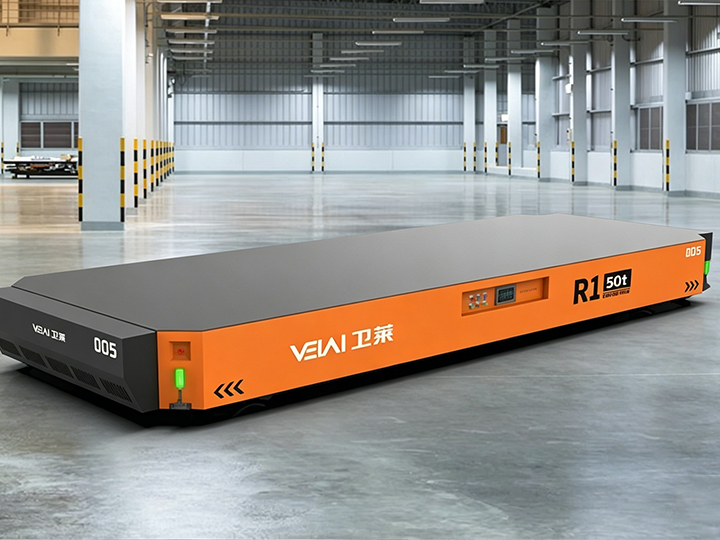
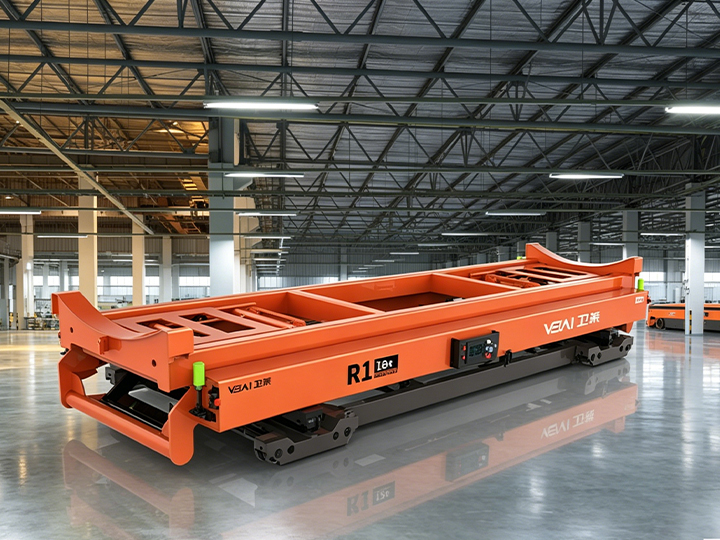
A rail transfer cart is a motorized platform that travels along steel rails fixed permanently to the factory floor. The entire system is built around one goal: stable, repeatable movement of heavy loads between fixed points.
Structure and Drive Mechanism
The cart body is a welded heavy-gauge steel frame with a flat or customized deck on top. Flanged steel wheels grip the rail and keep the cart on track without any steering system. A motor-gearbox-drive shaft assembly powers the axle. Most industrial units use dual motors — one per driven axle — to distribute load evenly and reduce drivetrain wear under heavy payloads.
Rail profiles are standardized. Common options include A45, A55, A75 for lighter applications, and crane rail profiles such as QU70, QU80, or QU100 for loads exceeding 100 tons. The wheel flange geometry must match the rail profile — this is a specification step that should be confirmed with the supplier before ordering.
خيارات إمدادات الطاقة
How the cart gets its power matters for both operating cost and installation scope. The main options are:
| Power Type | نطاق السفر النموذجي | الأفضل لـ |
|---|---|---|
| Conductor Rail (Busbar) | غير محدود | High-cycle, 24/7 operations |
| بكرة كابل | Up to ~80 m | Medium-frequency, fixed route |
| Battery (Lead-Acid / Li-ion) | Varies by capacity | Shorter routes, easier installation |
| Festoon (Overhead Cable) | Long runs | Clean environments with overhead structure |
Reference: Power supply classifications per FEM 9.811 (European Materials Handling Federation), reviewed 2022–2024.
Busbar systems are the most reliable for non-stop production lines because they eliminate charging downtime entirely. Battery-powered rail carts are a practical option when busbar installation is not feasible.
Deck Configuration Options
The top surface of a rail transfer cart is not always a flat plate. Common configurations include:
- Flat deck — general loads, pallets, skids
- V-block / saddle deck — cylindrical loads like coils, pipes, or drums
- Turntable deck — rotates the load without moving the cart; useful at corners
- Scissor-lift deck — hydraulic height adjustment for ergonomic loading or station height matching
- Custom fixture deck — machined mounts for specific tooling or mold carriers
Specifying the right deck type early avoids expensive retrofits after delivery.
2. What Is a Trackless Transfer Cart — and How Does It Navigate?
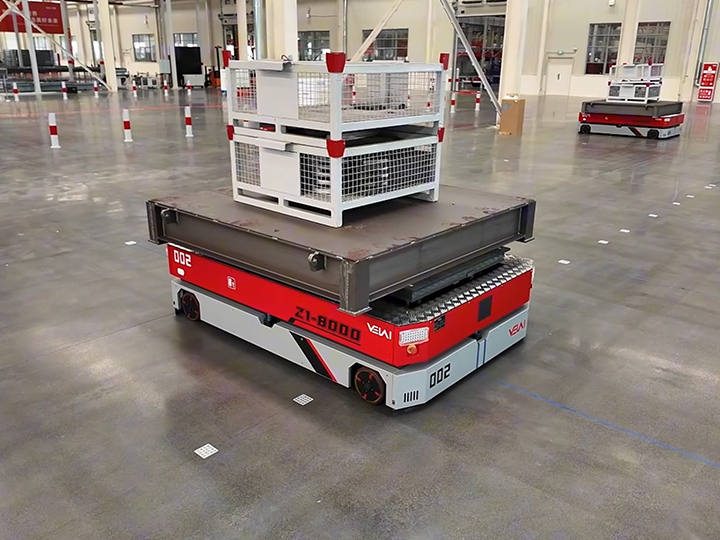
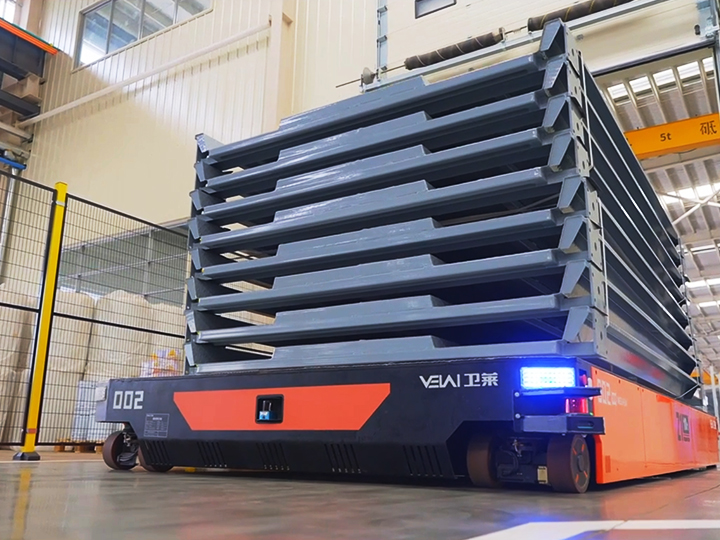
A trackless transfer cart moves heavy loads across a facility floor without any fixed rail. The cart steers itself — or is steered by an operator — using one of several navigation technologies. Battery power is standard since there is no conductor rail to draw from.
Navigation Technology Comparison
The guidance system is the most consequential specification decision for a trackless cart. Each technology carries different accuracy levels, infrastructure requirements, and maintenance demands.
| Navigation Type | Positioning Accuracy | Floor Work Required | الأنسب لك |
|---|---|---|---|
| Wire Guidance | ±10–20 mm | Shallow wire channel (3–5 mm) | Fixed-path, high repeatability |
| Remote Control (Manual) | Operator-dependent | لا أحد | Variable routes, low frequency |
| Laser Navigation (LGV) | ±5–15 mm | Reflectors on walls/columns | Semi-flexible routes, clean environments |
| Magnetic Tape / QR Path | ±10–25 mm | Surface tape (replaceable) | Light duty, frequent route changes |
| Inertial Navigation | ±15–30 mm | Transponder grid in floor | Complex multi-path layouts |
Reference: Navigation system specifications per ISO 3691-4 (Industrial trucks — Safety requirements), 2022–2024.
Wire guidance is the most widely used option for heavy industrial trackless carts. It delivers consistent positioning without depending on lighting conditions, reflector cleanliness, or floor marking integrity. Laser navigation is gaining adoption in cleaner manufacturing environments where semi-flexible routing is also needed.
Steering Architecture
Trackless carts require an active steering system — unlike rail carts, which are guided mechanically.
Differential steering varies speed between left and right drive wheels to turn the cart. It is mechanically simple and suitable for straight-line runs with wide turning arcs. Common on smaller, lower-capacity units.
Articulated / independent wheel steering uses a dedicated servo-motor or hydraulic actuator to physically redirect wheels. This enables tighter turning radii and is required for carts navigating narrow aisles or multi-turn routes. If your aisle width is under 4 meters, confirm the minimum turning radius with the supplier.
Battery System Options
Battery selection directly affects operating cost and shift planning for trackless carts:
| Battery Type | Charge Time | Cycle Life | Best Application |
|---|---|---|---|
| Lead-Acid (Flooded) | 8–10 hours | 500–800 cycles | Single-shift, low upfront cost |
| Lead-Acid (AGM/Gel) | 6–8 hours | 600–1,000 cycles | Cleaner environments |
| Lithium Iron Phosphate (LFP) | 1–3 hours (opportunity charging) | 2,000–3,500 cycles | Multi-shift, long-term TCO focus |
Reference: Battery performance data per IEC 62660 and manufacturer technical documentation, 2022–2024.
Lithium iron phosphate (LFP) batteries have become the preferred upgrade for multi-shift operations. Their tolerance for partial charging and fast opportunity charging removes the 8-hour charging window that lead-acid systems impose. The higher upfront investment is typically recovered within 3–4 years.
3. Side-by-Side Technical Comparison
Before committing to either system, evaluate these parameters across your specific application:
| مُعامل | عربة نقل السكك الحديدية | Trackless Transfer Cart |
|---|---|---|
| Typical Load Capacity | 1 ton – 300+ tons | 1 ton – 150 tons (typical) |
| Travel Path | Fixed, rail-guided | Flexible, multi-path |
| Positioning Accuracy | ±5–10 mm | ±5–50 mm (varies by guidance) |
| Floor Modification | Required (rail embedding) | Minimal to none |
| مزود الطاقة | Busbar, cable reel, battery | Battery |
| سرعة السفر | 5–45 m/min | 5–30 m/min |
| Installation Timeline | 4–10 weeks | 1–3 weeks |
| Long-Term Reliability | Very high | Moderate–High |
Reference: FEM 9.811, ISO 22915, and supplier technical specifications reviewed 2022–2024.
Load capacity is the first filter. For consistent payloads above 80–100 tons, rail systems are typically the only proven option. The rail provides continuous structural support that trackless wheel-and-chassis designs cannot replicate at extreme weights.
4. Floor and Facility Requirements
Floor conditions often determine the decision — not the spec sheet.
What Rail Installation Involves
Rail embedding requires cutting channels into the concrete floor, setting rail sections in epoxy or concrete, and aligning precisely over the full travel path. Surface-mounted options reduce cutting but introduce tripping hazards and restrict cross-traffic.
Civil preparation typically takes 2–6 weeks, depending on rail length and floor condition. For new facilities, integrating rails into the initial floor pour is the most cost-effective approach. One key trade-off: a rail system locks in your floor plan. Relocating the route later means repeating most of the original installation.
What Trackless Carts Require
Trackless carts need a flat, smooth, load-rated floor — typically minimum 4,000 PSI (≈27.5 MPa) compressive strength concrete in good condition. Slope, expansion joints, floor drains, and surface coatings all need assessment before deployment.
Wire-guided systems require a shallow wire channel (3–5 mm deep) — far less invasive than full rail embedding, but still floor work. For facilities with aging concrete, leased space, or layouts that change regularly, the trackless option removes most of the installation friction.
5. Total Cost of Ownership
The 5-year cost picture often looks very different from the purchase price alone.
| Cost Category | عربة نقل السكك الحديدية | Trackless Transfer Cart |
|---|---|---|
| Equipment Purchase | Moderate–High | معتدل |
| Installation & Civil Works | عالي | Low–Moderate |
| Annual Maintenance | Low–Moderate | Moderate (battery cycle) |
| Downtime Risk | قليل | معتدل |
| Layout Change Cost | عالي | قليل |
Reference: MHI Annual Industry Report 2022–2023; equipment lifecycle cost analyses. Figures are indicative and vary by region, load rating, and operating conditions.
The most significant recurring cost for trackless carts is battery replacement. Lead-acid packs under multi-shift operation typically last 2–4 years. LFP packs extend to 4–7 years with proper management. Rail systems have lower recurring costs — wheel wear and occasional rail inspection are the primary maintenance items.
Procurement Decision Summary
Choose a rail transfer cart if:
- Payload consistently exceeds 80–100 tons
- The route is fixed and high-frequency (50+ cycles/shift)
- Precise, repeatable docking at stations is required
- Floor installation is feasible during a greenfield build or planned shutdown
Choose a trackless transfer cart if:
- Routes vary by shift, season, or production mix
- Floor modification is restricted (leased facility, existing infrastructure)
- Payload is under 50–80 tons
- Deployment speed is a priority
When the decision is not clear-cut, bring your floor plan, payload data, and cycle frequency to a qualified equipment supplier. A site-specific assessment will surface constraints that a spec sheet comparison cannot.
أسئلة شائعة
Q1: Can a trackless transfer cart carry the same loads as a rail transfer cart?
In most heavy industrial applications, no. Rail transfer carts handle loads from under a ton to well over 300 tons because the rail itself carries and distributes the load continuously. Trackless carts are limited by their wheel geometry, chassis strength, and the floor’s ability to handle concentrated point loads without rail support. Most commercially available trackless heavy-duty carts are rated up to 100–150 tons in practice. For payloads above 80 tons that run consistently, a rail system is the more proven and structurally reliable choice.
Q2: How long does installation take for each system?
A trackless transfer cart can typically be operational within 1–3 weeks of delivery — primarily involving battery setup, wire channel installation (if applicable), and operator training. A rail transfer cart installation, including civil floor work, rail embedding, curing, alignment, and commissioning, typically takes 4–10 weeks. If your facility has a planned maintenance shutdown, that window can often absorb rail installation with minimal production impact. For urgent deployment, trackless systems have a clear time advantage.
Q3: What floor condition does a trackless transfer cart require?
The floor must be flat, smooth, and structurally sound — typically minimum 4,000 PSI (approximately 27.5 MPa) compressive strength. Slope tolerance for standard models is generally within 1–2 degrees. Expansion joints, surface coatings, floor drains, and significant cracks all need assessment before deployment. Wire-guided systems require a shallow guidance channel (3–5 mm deep, 3–5 mm wide) cut into the floor — minor compared to rail embedding, but not zero. A floor condition survey before procurement avoids surprises during installation.
Q4: Which navigation type is most reliable for heavy industrial trackless carts?
Wire guidance is the most widely deployed option for heavy industrial applications because it delivers consistent, repeatable positioning regardless of lighting, dust levels, or reflector condition. It requires a shallow wire channel in the floor, but offers positioning accuracy of ±10–20 mm — sufficient for most industrial docking requirements. Laser navigation (LGV) is a strong alternative for cleaner environments where some route flexibility is also needed, with accuracy of ±5–15 mm. Remote control operation is the simplest but introduces operator-dependent variability in positioning and cycle time.
Q5: How do I calculate whether a rail or trackless cart makes more financial sense over five years?
Start with four numbers: equipment purchase cost, installation cost (including civil works for rail), estimated annual maintenance, and planned layout change frequency. For rail systems, installation costs are higher upfront but annual maintenance is lower and more predictable. For trackless carts, lower installation cost is offset by battery replacement cycles (every 2–5 years depending on chemistry) and guidance system upkeep. If your layout changes every 2–3 years, the rail system’s reconfiguration cost becomes a significant recurring factor. A simple 5-year TCO model using your actual cycle volumes and shift patterns will typically make the right answer clear.