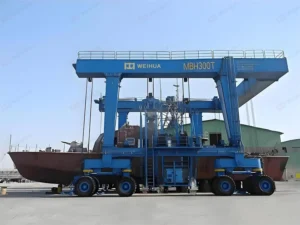
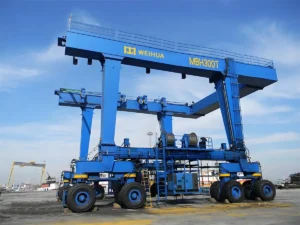

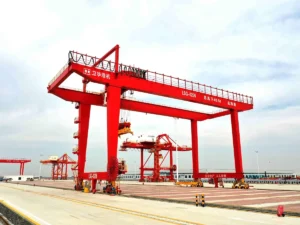
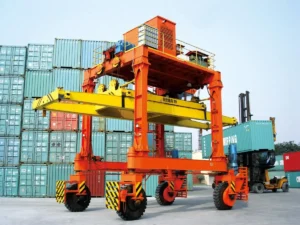
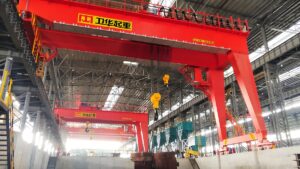
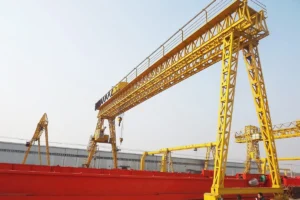

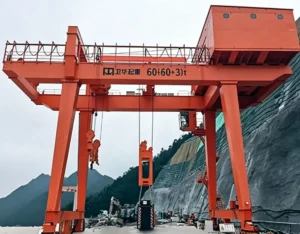
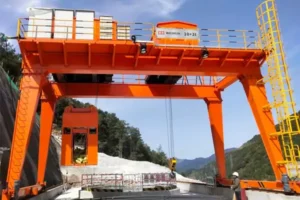







أن رافعة STS handles vessel loading and discharge at the berth. An رافعة RTG stacks and retrieves containers in the yard — on rubber tyres, so it can move between lanes. An رافعة RMG does the same yard job on fixed rails, with higher stacking density and stronger automation capability. The three types do not compete directly: most container terminals use all three in sequence, each covering a distinct operational zone.
Where the comparison matters is in configuration decisions — how many of each type to deploy, which specification to order, and where the trade-offs between flexibility and automation fall. Those decisions involve real capital and 20-plus years of operating cost. The sections below break down each crane type, map the differences that matter at the procurement stage, and give you a selection framework based on terminal throughput and layout.
What Each Crane Type Actually Does

Before comparing specifications, it helps to be precise about function. These three crane categories operate in different zones of a container terminal and are not interchangeable.
STS Crane: The Berth Interface
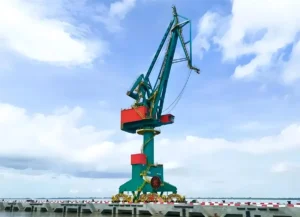
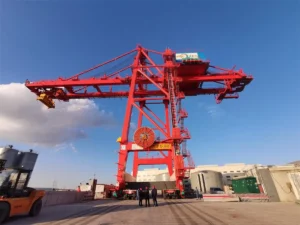
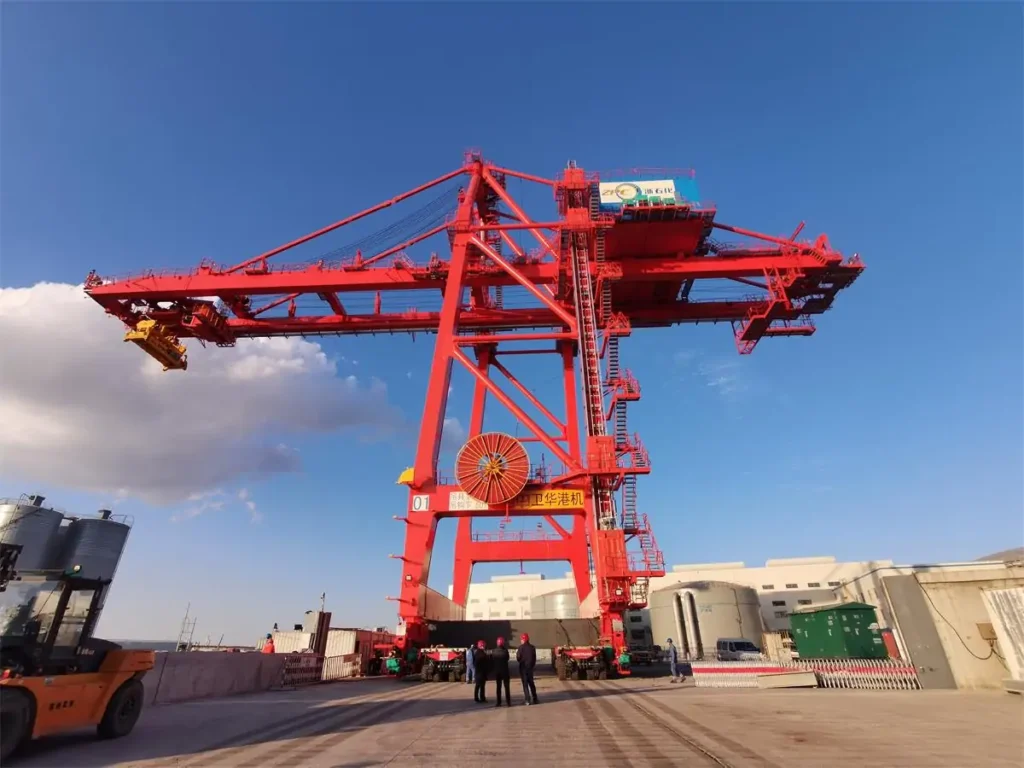
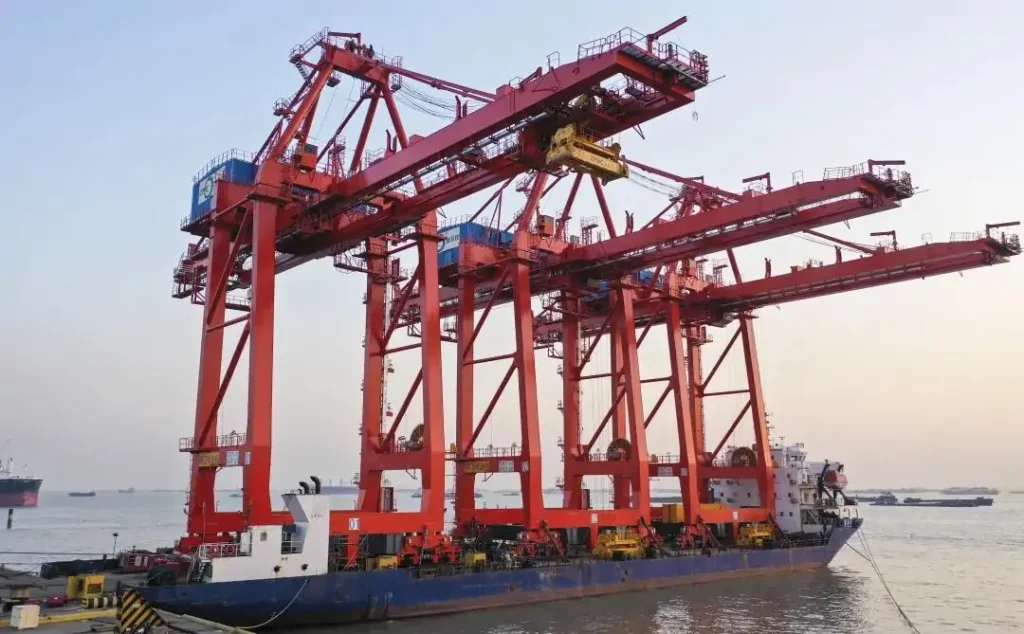
An STS crane — ship-to-shore crane — is fixed to the quayside and works exclusively at the vessel interface. Its boom extends over the ship’s deck, the spreader picks a container from the hold or deck stack, and the box transfers to a waiting vehicle in the landside transfer zone. The STS crane does not move containers into the yard; it hands them off at the apron.
Everything about an STS crane’s specification is driven by vessel size. Outreach — the distance the boom extends over the ship — determines which vessel classes the crane can serve. A Post-Panamax STS crane with 52 m outreach covers vessels up to 18 container rows wide; a Neo-Panamax unit at 65 m reaches 24-row Ultra Large Container Vessels. Lift capacity under the spreader runs 40–100 t depending on crane class. Purchase price ranges from $1.2M for a standard Panamax unit to $4.4M or more for a fully specified ULCV-capable configuration.
For details and considerations regarding STS crane selection, refer to the article: How To Choose The Right STS Crane For Your Port?
RTG Crane: Flexible Yard Stacking
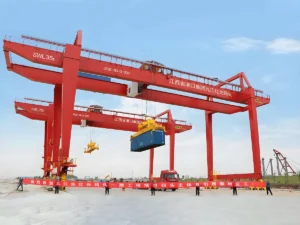
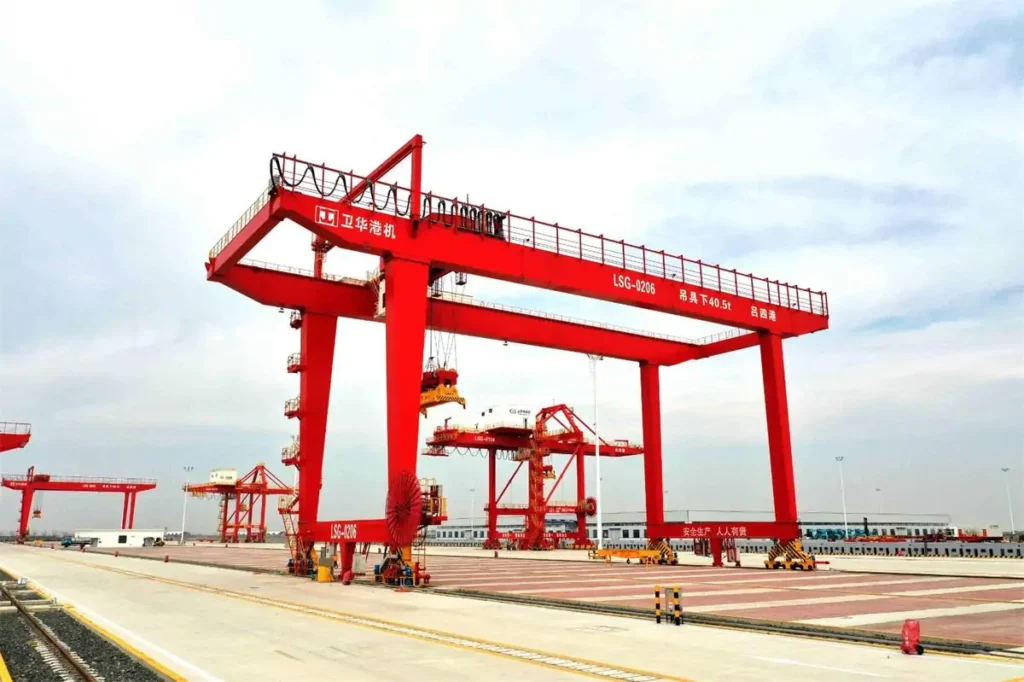
A rubber-tyred gantry crane — RTG crane — operates in the container yard, stacking and retrieving boxes in defined block lanes. The defining characteristic is mobility: RTG cranes travel on rubber tyres, steer at 90 degrees to change lanes, and can be reassigned between yard blocks without civil infrastructure changes. This flexibility makes the RTG crane the dominant yard equipment choice at terminals with variable throughput patterns or constrained capital budgets for civils.
Standard RTG cranes stack containers 1-over-5 or 1-over-6 high and span six or seven container rows plus a truck lane. Lifting capacity is typically 35–50 t under the spreader. Indicative purchase price ranges from $0.70M to $1.50M per unit depending on stack height, span, and drive configuration. Energy source options include diesel-electric, hybrid, and fully electric (cable-reel or busbar) — an increasingly important procurement decision given port decarbonisation targets.
RMG Crane: High-Density Automated Yard
A rail-mounted gantry crane — RMG crane — performs the same yard stacking function as an RTG crane but travels on fixed ground rails. The rail-mounted configuration allows tighter positional accuracy, higher stacking — 1-over-6 to 1-over-8 in automated configurations — and the structural consistency required for fully automated terminal operation. The trade-off is inflexibility: an RMG crane cannot change lanes, and the rail foundation and yard layout must be engineered before the cranes arrive.
RMG cranes are the standard equipment choice for automated container terminals (ACTs). Their deterministic travel path makes them compatible with automated guided vehicle (AGV) or automated straddle carrier (AutoStrad) transfer systems at the landside interface. Purchase price ranges from $0.60M to $1.20M or more depending on span, stack configuration, and automation specification.
For more solutions for port gantry cranes, visit the page: Port Gantry Crane Manufacturer for Container Handling and Port Operations
STS Crane vs RTG Crane vs RMG Crane: Head-to-Head Comparison
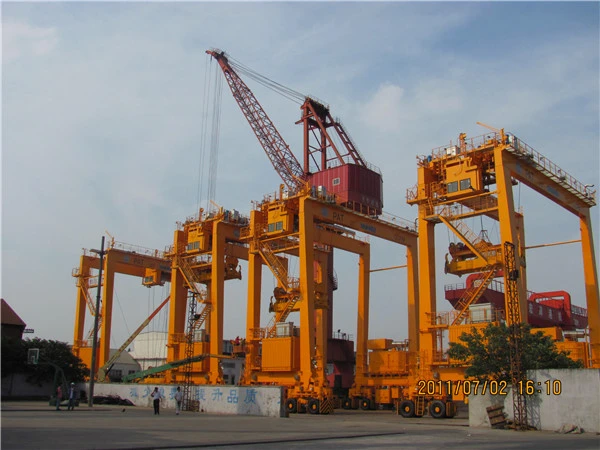
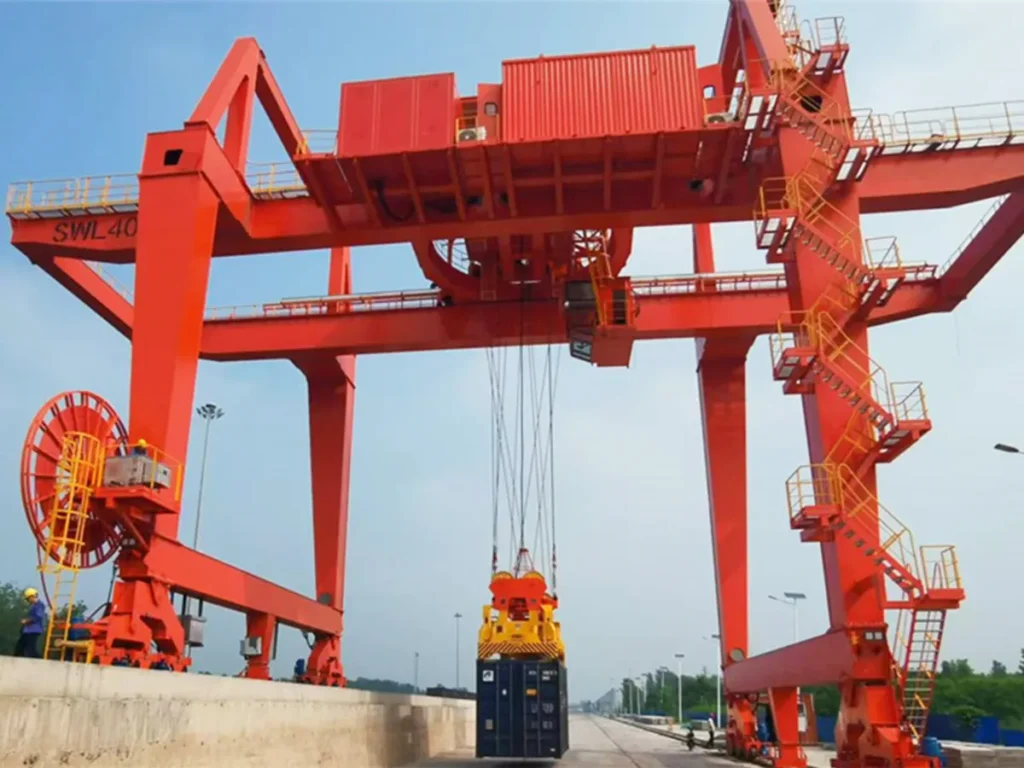
The table below maps the key differences across the parameters that drive procurement and operational decisions.
| مُعامل | رافعة STS | رافعة RTG | رافعة RMG |
|---|---|---|---|
| الوظيفة الأساسية | Vessel loading/discharge | Yard stacking, flexible | Yard stacking, high-density |
| Operating zone | Quayside berth only | Yard block lanes | Fixed yard rail lanes |
| قدرة الرفع | 40–100 t | 35–50 t | 35–60 t |
| Stack height | N/A (berth function) | 1-over-5 to 1-over-6 | 1-over-6 to 1-over-8 |
| المحمولة | Fixed rail, quayside | Rubber tyres, steerable | Fixed ground rail |
| Lane flexibility | None — fixed berth | High — cross-lane travel | None — rail-fixed |
| جاهزية التشغيل الآلي | Semi / full | Manual / semi | Full automation standard |
| Civil infrastructure | Crane rail + berth apron | Paved yard surface | Ground rail + precision civils |
| Indicative unit price | $1.18M – $4.41M+ | $0.70M – $1.50M | $0.60M – $1.20M |
| مصدر الطاقة | Grid electric | Diesel-electric/hybrid / electric | Grid electric |
| Typical application | All container terminals | General-purpose terminals | Automated / high-throughput terminals |
مصدر: FEM 1.001 duty classification; ISO 4301 crane classification; PIANC Working Group 135. All prices are indicative FOB factory market reference values.
RTG cranes and STS cranes are the mainstays of container handling in ports, but their operating environments and requirements differ. Learn more about the specific differences: STS Crane vs. RTG Crane: What Is the Difference?
RTG cranes and STS cranes are the mainstays of container handling in ports, but their operating environments and requirements differ. Learn more about the specific differences: STS Crane vs. RTG Crane: What Is the Difference?
Key Differences That Drive the Selection Decision
Specifications alone don’t tell you which crane belongs where. The purchase price of an RTG crane is a fraction of an STS crane’s, but the two machines never compete for the same job — one works the berth, the other works the yard. The decisions that actually matter are narrower: whether yard equipment should be rail-mounted or rubber-tyred, and whether the terminal’s automation roadmap justifies the civil investment an RMG crane requires. Three dimensions drive those calls.
Mobility vs Density: The Core RTG–RMG Trade-Off
The RTG crane and RMG crane are direct alternatives for yard stacking, and the choice between them is fundamentally a trade-off between operational flexibility and stacking density. An RTG crane can be redeployed between yard blocks in hours — useful when berth patterns shift seasonally or when the terminal handles multiple cargo types in different zones. An RMG crane cannot move between rail lanes, but its fixed travel path allows positioning accuracy of ±5–10 mm, which is a prerequisite for automated horizontal transport integration.
Stacking density matters because yard space is often the binding constraint on terminal throughput. An RTG crane stacking 1-over-5 in a 6-wide lane delivers approximately 800–900 TEU per hectare of yard. An RMG crane stacking 1-over-7 in an 8-wide automated block can exceed 1,400–1,600 TEU per hectare. For terminals in land-constrained port cities — Rotterdam, Singapore, Hong Kong — the RMG crane’s density advantage justifies the higher civil investment and reduced flexibility. For terminals with available land and variable cargo flows, the RTG crane’s adaptability is the stronger argument.
Automation: Why RMG Crane Dominates Automated Terminals
Fully automated container terminals almost universally use RMG cranes rather than RTG cranes for yard operations. The reason is positional precision. Automated horizontal transport systems — AGVs, ALVs, and automated straddle carriers — require the yard crane to place containers at a defined pickup point within a tight tolerance window. The RTG crane’s rubber-tyred travel introduces positional variation that is difficult to eliminate fully through guidance systems alone. The RMG crane’s rail travel eliminates this variable, delivering the repeatability that automation requires.
Several manufacturers offer automated RTG systems (ARTGs) that address this through laser and DGPS guidance, and these are deployed at a number of terminals. However, the consensus in container terminal engineering is that the RMG crane remains the more reliable automation platform — lower maintenance overhead on the guidance system, higher positioning accuracy, and a longer operating history at scale.
The STS crane automation picture is separate: semi-automated and fully automated ship-to-shore cranes are increasingly common at new-build terminals, with remote operation from a centralised cabin replacing the in-crane operator cab. This affects the STS crane specification independently of the yard crane choice.
Cost Structure: Where the Real Comparison Sits
Unit purchase price comparisons between the three crane types are misleading without the full infrastructure and lifetime cost picture.
An RTG crane costs $1.5M–$3.5M per unit, but the terminal needs more units per TEU of throughput than an RMG crane configuration delivers at the same land footprint — and diesel-electric RTG cranes carry significant fuel and emissions costs that electric RMG cranes do not. A 500,000 TEU per year terminal might deploy 12–16 RTG cranes where an equivalent automated RMG crane layout uses 6–8 machines.
An RMG crane costs $2.5M–$6M per unit but requires $3M–$8M per crane in rail and civil infrastructure investment that the RTG crane does not. The civils investment is irreversible — once built, the yard layout is fixed for the crane’s service life.
The STS crane is not a substitute for either yard crane type. Its cost stands alone as the berth interface investment, and the number of STS cranes required is driven by vessel call volume and berth occupancy targets, independent of the yard equipment choice.
احصل على عرض أسعار مخصص الآن
Which Crane Type Is Right for Your Terminal?
No single crane type is universally superior. The right answer depends on four site-specific factors.
Throughput Volume and Growth Trajectory
For terminals handling below 300,000 TEU per year with moderate growth projections, RTG cranes typically deliver the best capital efficiency: lower unit cost, no precision civil investment, and the flexibility to scale equipment incrementally. Terminals targeting 500,000 TEU or above — or those with land constraints that require stacking above 1-over-5 — should model the RMG crane case seriously, particularly if automation is in the 5–10 year plan.
Land Availability and Yard Layout
RTG cranes work on standard paved yard surfaces. RMG cranes require engineered rail foundations with settlement tolerances measured in millimetres — a significant civil cost in poor soil conditions. If the terminal site has geotechnical challenges, the RTG crane’s surface flexibility avoids a substantial foundation engineering problem that an RMG crane layout would create.
Automation Roadmap
If the terminal’s 10-year strategy includes full automation, specifying RMG cranes from the outset avoids a costly conversion from RTG crane infrastructure later. Automated RTG upgrades exist but are expensive and operationally disruptive. Building toward automation with a conventional RTG crane fleet is possible; it is rarely the lowest-cost path.
Decarbonisation Targets
Electric RMG cranes running on grid power produce zero direct emissions in operation. RTG cranes on diesel-electric drives do not, and while hybrid and fully electric RTG variants are now available, the electrification cost per unit ($200,000–$500,000 premium) and infrastructure requirements vary. For ports operating under strict emissions regulation — increasingly common in European and East Asian jurisdictions — the RMG crane’s inherent grid-electric architecture is a procurement argument in its own right.
خاتمة
An STS crane handles the vessel interface; an RTG crane offers flexible yard stacking; an RMG crane delivers high-density automated storage. The three types are complementary, not competing, and most container terminals deploy all three. The meaningful selection decision is the RTG-versus-RMG question for yard equipment — and that choice turns on four variables: throughput volume, land availability, automation timeline, and emissions requirements.
If you are specifying yard equipment for a new terminal or fleet replacement project, the right starting point is a yard simulation model using your actual TEU projections, land polygon, and operating hours — not a unit price comparison. Our engineering team can support that analysis.
احصل على عرض أسعار مخصص الآن
أسئلة شائعة
Q1: What is the main difference between an RTG crane and an RMG crane?
Both RTG and RMG cranes are yard stacking equipment, but they differ in mobility and application. An RTG crane travels on rubber tyres and can steer between yard lanes, giving terminal operators flexibility to redeploy equipment as cargo patterns change. An RMG crane travels on fixed ground rails, which limits lane flexibility but enables tighter positional accuracy, higher stacking heights, and full automation integration. The RTG crane is the standard choice for general-purpose terminals with variable throughput; the RMG crane is the preferred platform for automated, high-density container yards. The decision between the two is primarily driven by land availability, throughput targets, and whether the terminal plans to automate within its planning horizon. Most new automated terminal projects built since 2010 specify RMG cranes for these reasons.
Q2: Can an STS crane be used for yard stacking?
No. An STS crane — ship-to-shore crane — is engineered specifically for the quayside berth interface: it transfers containers between a vessel and the terminal apron. Its outreach boom, rail gauge, and structural design are not suited to yard stacking, and its fixed quayside rail location makes yard deployment physically impossible. Yard stacking is the function of RTG and RMG cranes. The STS crane hands containers to a horizontal transport vehicle — truck, AGV, or straddle carrier — at the apron transfer zone, and that vehicle moves the box to the yard equipment. Combining the two functions into a single machine is not a viable configuration in standard container terminal operations.
Q3: How many RTG cranes does a container terminal typically need?
A rough planning benchmark for RTG crane deployment is one RTG crane per 50,000–80,000 TEU of annual throughput, depending on yard dwell time, block configuration, and operating hours. A terminal handling 400,000 TEU per year might deploy 6–10 RTG cranes under normal dwell conditions; terminals with longer average dwell times or higher peak-to-average ratios require proportionally more equipment. This benchmark is a starting point only — accurate crane fleet sizing requires a discrete-event simulation model using the terminal’s actual berth pattern, yard layout, and horizontal transport cycle times. Under-specifying the RTG crane fleet creates yard congestion that constrains berth productivity regardless of how many STS cranes are deployed.
Q4: What is the service life of an STS crane, RTG crane, and RMG crane?
All three crane types are designed for a 25-year structural service life under their rated FEM duty class. In practice, service life depends heavily on whether the crane operates within its design duty class, how rigorously planned maintenance is executed, and whether mid-life structural and mechanical overhauls are performed at the appropriate intervals (typically years 12–15). STS cranes at high-productivity berths occasionally reach 30 years with one or two major overhauls. RTG cranes in continuous multi-shift operation tend to see more accelerated wear on tyres, drive systems, and structural connections, and realistic service life at intensive-duty terminals is 18–22 years before a major overhaul decision is required. RMG cranes, operating on fixed rails with lower positional stress on the running gear, generally match the 25-year structural design life more consistently.
Q5: Is it possible to convert an RTG crane terminal to RMG cranes later?
Technically yes, but rarely cost-effective as a direct conversion. RTG crane yards are designed with flexible paved surfaces and without the precision rail foundations that RMG crane operation requires. Converting an existing RTG crane terminal to RMG crane operation requires a full yard civil rebuild — rail installation, foundation engineering, and re-layout of yard blocks — while maintaining live terminal operations, which is operationally complex and expensive. The more practical approach is a phased greenfield expansion: building new RMG crane blocks alongside the existing RTG crane operation and migrating throughput as the new blocks commission. Terminals that anticipate an automation pathway should therefore plan the yard layout from the outset to accommodate future RMG crane infrastructure, even if the first-phase equipment is RTG cranes.