








Selecting the wrong ship-to-shore crane is not a minor procurement error — it’s a capacity constraint that can affect terminal throughput for the next 25 to 30 years. Port terminals that commission STS cranes without fully aligning outreach specifications to their vessel class mix routinely discover the gap only when the first post-Panamax vessel calls and the crane’s boom falls short.
Here’s the essential point: a ship-to-shore crane is not specified by lifting capacity alone. Outreach, backreach, lifting height above rail, and hoist speed are equally decisive — and they interact. A crane rated at 65 tonnes with 55 m outreach serves a fundamentally different operation than one rated at 50 tonnes with 45 m outreach, even if both handle 20-foot and 40-foot containers.
This guide covers the technical parameters that define STS crane performance, how to read and compare manufacturer specifications, and a structured procurement checklist that port planners and equipment buyers can use before committing to a contract. If you’re evaluating suppliers, specifying equipment for a new berth, or upgrading an existing crane fleet, the framework below is designed to reduce specification risk at the front end — where it’s still manageable.
جدول المحتويات
What Is a Ship-to-Shore Crane?
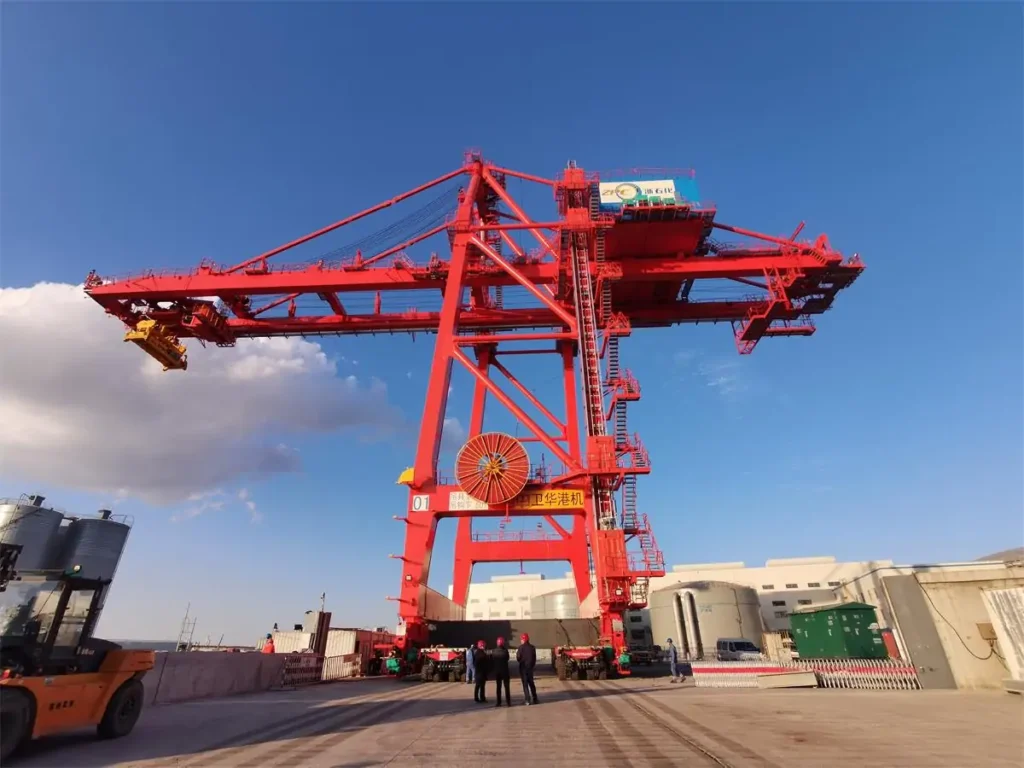
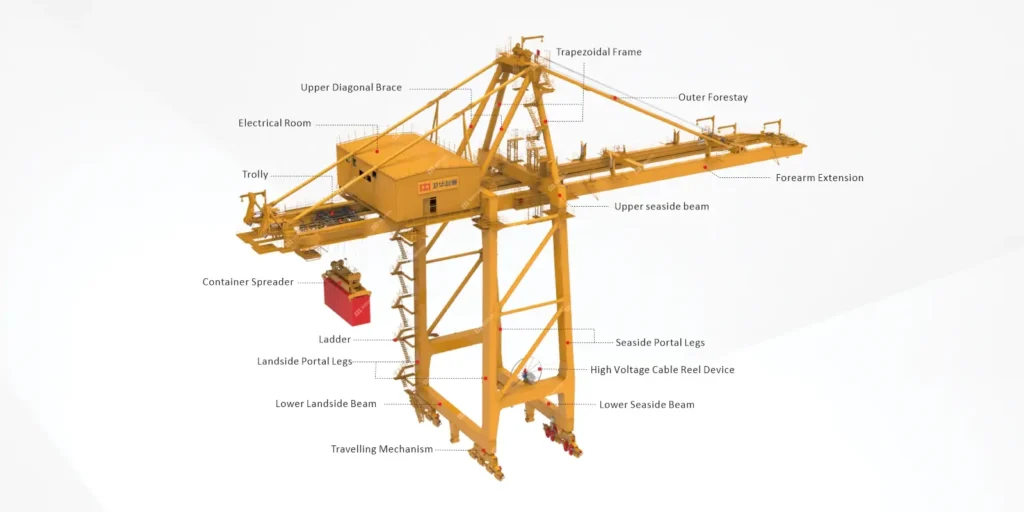
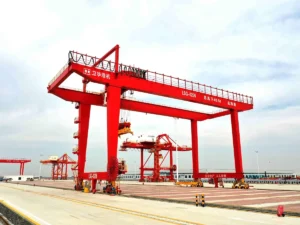
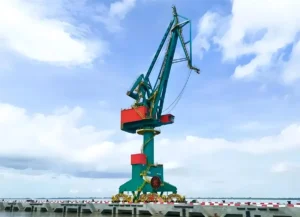
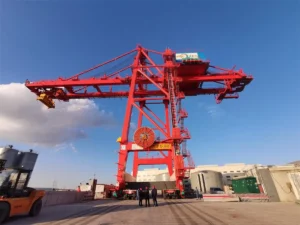
A ship-to-shore crane (STS crane) is a large rail-mounted gantry crane installed on a container terminal quayside. Its primary function is to load and unload containers between vessels and the terminal yard, transferring boxes to and from trucks, automated guided vehicles (AGVs), or horizontal transport equipment at the quay.
Unlike mobile harbor cranes or rubber-tyred gantries, a ship-to-shore crane operates on fixed rails embedded in the quay structure. This fixed rail system allows the crane to travel along the berth to position over different vessel bays, while the boom — which extends over the vessel — provides the horizontal outreach needed to reach containers across the full beam of a ship.
The STS crane category spans a wide range of configurations, from smaller Panamax-class units serving vessels up to 13 container rows wide, to ultra-large post-Panamax and neo-Panamax cranes capable of reaching 24 or more rows across the largest container ships currently in service. The right specification depends entirely on the vessel classes your terminal serves — or plans to serve.
Key Technical Specifications: What Every Buyer Must Understand
Outreach and Backreach
Outreach is the most commercially critical dimension of a ship-to-shore crane. It defines how far the boom extends over the vessel from the seaside crane rail — and therefore which vessel classes the crane can fully serve.
The relationship between outreach and vessel class is direct: larger vessels have wider beams and more container rows. A crane with 45 m outreach that cannot reach row 18 on a 400-metre neo-Panamax vessel is effectively unusable for that vessel class, regardless of its capacity rating.
Standard outreach categories in current terminal planning practice:
| Crane Class | Typical Outreach | Container Rows (approx.) | Target Vessel Class |
|---|---|---|---|
| Panamax STS | 38–42 m | 13–15 rows | Panamax vessels (≤32.3 m beam) |
| Post-Panamax STS | 45–55 m | 17–20 rows | Post-Panamax (up to ~49 m beam) |
| Neo-Panamax / ULCV | 60–73 m | 22–24+ rows | ULCV, mega-vessels (up to ~61 m beam) |
Reference: PIANC Working Group 158 — Guidelines for the Design of Container Terminals; UNCTAD Port Technology Series.
Backreach — the distance the crane extends landside behind the sea rail — determines how far into the apron area the crane can service trucks or AGVs. Standard backreach ranges from 15 m to 25 m. Terminals with deeper apron layouts or automated stacking operations may require extended backreach to clear the crane structure and allow unobstructed vehicle movement.
قدرة الرفع وتكوين الموزع
Rated lifting capacity for a ship-to-shore crane is specified at the rated load radius — typically at 65% to 75% of maximum outreach. Most modern STS cranes are rated between 40 and 80 tonnes under-spreader, with dual-hoist configurations for twin-lift or tandem-lift operations available on higher-specification units.
Key capacity parameters to confirm in any specification:
- Safe working load (SWL) at full outreach — distinct from rated capacity at reduced radius
- Twin 20-foot lift capacity — important for high-volume feeder terminals
- Tandem lift configuration — relevant for terminals targeting high berth productivity
Spreader specifications must be confirmed alongside capacity ratings. A 65-tonne STS crane fitted with a spreader rated only for single 40-foot containers cannot realise its full throughput potential in a twin-lift operating environment.
Lifting Height Above Rail
Lifting height above rail (LHAR) is the vertical distance from the top of the crane rail to the maximum hook height. As vessel sizes have increased, so have air draft requirements — the tallest container stacks on ULCV vessels can exceed 50 m above the waterline at low tide.
LHAR requirements should be calculated from the highest tidal variation at the berth, the maximum vessel air draft at the lowest tide condition, and the required clearance above the top container tier. Underspecifying LHAR creates a clearance constraint that cannot be resolved without major structural modification.
Typical LHAR ranges by crane class:
- Panamax STS: 30–36 m above rail
- Post-Panamax STS: 38–45 m above rail
- Neo-Panamax / ULCV: 48–58 m above rail
Hoist Speed and Cycle Time
Crane productivity — measured in moves per hour (MPH) — is a direct function of hoist speed, trolley travel speed, and gantry travel speed. Specification sheets frequently quote peak speeds at no-load conditions; the operationally relevant figure is loaded hoist speed, which is typically 40–60% of the no-load figure.
A standard STS crane specification for a post-Panamax unit might show:
| Motion | No-Load Speed | Loaded Speed |
|---|---|---|
| Hoist | 150 m/min | 75–90 m/min |
| السفر بالترام | 180 m/min | 120-150 متر/دقيقة |
| حركة الجسر | 45 m/min | 30-45 متر/دقيقة |
Note: Figures represent typical post-Panamax STS specifications. Actual values vary by manufacturer and configuration. Always request loaded performance data, not peak no-load figures.
Target productivity benchmarks for planning purposes: a well-specified post-Panamax STS crane with experienced operators should achieve 28–35 moves per hour under optimal conditions. Ultra-large vessel operations with longer trolley travel distances typically run at 22–28 MPH.
Ship-to-Shore Crane Configuration Options
Single vs. Dual Hoist
Single-hoist configurations are standard for most terminal operations and appropriate for the majority of post-Panamax vessel calls. Dual-hoist (twin-hoist) systems provide a significant productivity advantage in high-volume twin-lift or tandem-lift operations — effectively doubling lift capacity per crane cycle when handling two 20-foot containers simultaneously.
The productivity gain from dual-hoist is meaningful only when the operational environment supports twin-lift consistently: the terminal must have the container flow, the vessel stowage plan, and the quay transport equipment to keep both hoists productive. A dual-hoist crane under-utilised in a mixed-trade terminal rarely justifies its cost premium.
Rope Reeving and Trolley Type
Rope reeving configuration affects both hoist speed and maintenance requirements. Four-rope reeving is standard for most mid-range STS cranes; eight-rope configurations are used in heavy-lift applications but reduce hoist speed. Machinery-trolley designs are increasingly common in newer installations, consolidating the hoist machinery on the trolley itself rather than in a separate machinery house, which simplifies rope paths and reduces maintenance access complexity.
Electrification and Drive Systems
Modern ship-to-shore cranes use AC variable frequency drive (VFD) systems as standard. Key considerations for procurement include:
- Power supply: Confirm berth infrastructure can supply the required kVA. A single large STS crane typically draws 1,500–2,500 kVA at peak demand.
- Regenerative braking: Regenerative drives return energy to the grid during lowering cycles. On high-throughput terminals, regenerative systems can offset 15–25% of hoisting energy consumption.
- Cable reel vs. busbar: Cable reel power supply systems are standard for cranes travelling along a berth. Busbar systems reduce trailing cable maintenance but require a fixed installation.
Full Specification Comparison: STS Crane Parameters
The table below provides a reference specification range for procurement comparison. Request confirmed figures from each supplier for the specific model and configuration being quoted.
| مُعامل | Panamax STS | Post-Panamax STS | Neo-Panamax / ULCV STS |
|---|---|---|---|
| قدرة الرفع المقدرة | 40-50 طن | 50–65 t | 65–80 t |
| Outreach (seaside) | 38–42 m | 45–55 m | 60–73 m |
| Backreach (landside) | 15–18 m | 18–22 m | 20–25 م |
| Lifting Height Above Rail | 30–36 m | 38–45 m | 48–58 m |
| Loaded Hoist Speed | 60–75 m/min | 75–90 m/min | 80–100 m/min |
| سرعة سير العربة | 120-150 متر/دقيقة | 150-180 متر/دقيقة | 150-180 متر/دقيقة |
| سرعة حركة الجسر | 30–40 m/min | 35–45 m/min | 35–45 m/min |
| مقياس السكة الحديدية | 15.24 m (50 ft) | 15.24–18.0 m | 18.0–30.48 m |
| الطبقة العاملة | A7–A8 | A7–A8 | A8 |
| Design Life | 25–30 years | 25–30 years | 25–30 years |
Reference: EN 13001 (Crane Safety); FEM 1.001 (Rules for the Design of Hoisting Appliances); ASME B30.2 (Overhead and Gantry Cranes). Figures are industry-typical ranges; always verify against specific manufacturer documentation.
STS Crane Procurement Checklist
This checklist is structured for port planners and procurement teams evaluating ship-to-shore crane specifications before contract award. Work through each section before finalising a technical specification.
Section A — Vessel Class Alignment
- [ ] Confirm the largest vessel class (by beam) that the terminal is designed to accommodate
- [ ] Calculate required outreach based on vessel beam + clearance allowance (typically beam/2 + 2–3 m)
- [ ] Verify required LHAR against maximum vessel air draft at lowest tidal condition
- [ ] Confirm whether twin-lift or tandem-lift operations are planned — affects spreader and hoist specification
Section B — Civil and Infrastructure Compatibility
- [ ] Confirm existing or planned rail gauge matches crane specification
- [ ] Verify quay load-bearing capacity against crane wheel load and outrigger reactions under full load
- [ ] Confirm berth electrical supply capacity (kVA available) against crane peak demand
- [ ] Check portal height clearance against crane structure dimensions for berth travel
Section C — Technical Specification Verification
- [ ] Request loaded hoist speed and trolley speed data — not no-load peak figures
- [ ] Confirm SWL at full outreach (not just at rated radius)
- [ ] Verify working class rating (FEM/ISO classification) matches duty cycle requirements
- [ ] Confirm design life rating and fatigue class for structural elements
- [ ] Request rope reeving configuration and maintenance interval data
Section D — Compliance and Certification
- [ ] Confirm CE marking and declaration of conformity (Europe) or applicable local standard
- [ ] Verify structural design compliance with EN 13001 or equivalent standard
- [ ] Confirm electrical systems comply with IEC 60204-32 (Electrical equipment of machines — hoisting machines)
- [ ] Request seismic design data if terminal is in a seismic zone
- [ ] Confirm wind load design basis and rated out-of-service wind speed
Section E — Supplier Evaluation
- [ ] Request references from at least three comparable terminal installations with similar crane configurations
- [ ] Confirm manufacturing lead time and delivery schedule against terminal opening date
- [ ] Review spare parts availability and regional service support coverage
- [ ] Confirm commissioning and operator training scope included in contract
- [ ] Review warranty terms — standard is 12 months from commissioning, verify scope of coverage
Section F — Commercial and Contract Terms
- [ ] Confirm payment milestone structure aligns with project cash flow requirements
- [ ] Verify performance guarantees (MPH, availability, MTBF) are contractually binding
- [ ] Confirm factory acceptance test (FAT) and site acceptance test (SAT) procedures and criteria
- [ ] Review liquidated damages provisions for late delivery and performance shortfall
- [ ] Confirm insurance and title transfer terms for sea freight delivery
Summary and Action Steps
A ship-to-shore crane is a long-life capital investment that defines what vessel classes your terminal can serve for the next 25 to 30 years. Getting the specification right at the procurement stage costs time and engineering effort; getting it wrong costs berth capacity and throughput for decades.
The three parameters that drive the most consequential procurement decisions are outreach (vessel class compatibility), lifting height above rail (air draft clearance), and hoist speed under load (berth productivity). All three should be verified against site-specific data — vessel mix, tidal range, and throughput targets — not derived from generic industry benchmarks.
Recommended actions before issuing a tender:
- Commission a vessel traffic forecast to establish the design vessel class for the next 20 years
- Conduct a quay structural survey to confirm civil capacity for the planned crane specification
- Engage an independent port engineering consultant to review draft technical specifications before release
- Request loaded-condition performance data from at least three manufacturers for direct comparison
- Build contractual performance guarantees into the procurement documents — not just technical specifications
Weihua’s STS crane engineering team can support specification review, vessel class alignment analysis, and site-specific configuration recommendations. Contact our port crane specialists to begin a technical consultation for your terminal project.
الأسئلة الشائعة
Q1: What outreach specification do I need for post-Panamax vessels?
Post-Panamax vessels have beam widths typically ranging from 32 m to 49 m, carrying 15 to 20 container rows across the beam. To fully serve this vessel class, a ship-to-shore crane requires outreach in the range of 45 m to 55 m. A practical rule of thumb used in terminal planning is to calculate required outreach as half the vessel beam plus a working clearance of 2 to 3 m beyond the outermost container row. Always design to the largest vessel in your current and projected fleet — not the average — because a single call from an oversized vessel that cannot be fully served creates a disproportionate operational disruption.
Q2: What is the difference between lifting capacity and safe working load at full outreach?
Rated lifting capacity on an STS crane specification sheet is typically stated at a defined load radius — often 65% to 75% of maximum outreach — where the structural moment is within design limits. Safe working load at full outreach is a lower figure, because the bending moment on the boom structure increases as the load moves toward the boom tip. Always request the SWL-at-full-outreach figure explicitly when comparing crane quotations. Comparing rated capacity at different radii without normalising for load position is one of the most common specification errors in STS crane procurement.
Q3: How long does it take to manufacture and deliver a ship-to-shore crane?
Manufacturing lead time for a ship-to-shore crane is typically 18 to 24 months from contract award to factory completion, depending on the manufacturer’s order book and the complexity of the configuration. Sea freight delivery and site assembly add a further 2 to 4 months depending on origin and destination port facilities. Commissioning and operator training typically require 4 to 8 weeks on site. Total project timeline from contract award to operational readiness should be budgeted at 24 to 30 months minimum. Greenfield terminal projects that do not account for this lead time in their construction schedule frequently encounter a critical path conflict between civil completion and crane delivery.
Q4: What working class rating should a ship-to-shore crane carry?
STS cranes operating at major container terminals should be specified to FEM/ISO working class A7 or A8, which corresponds to heavy and very heavy duty cycles respectively. Class A8 is appropriate for high-throughput terminals where cranes operate continuously across multiple shifts with minimal idle time. The working class rating affects structural fatigue design, hoist machinery sizing, and component replacement intervals — specifying a lower class to reduce initial procurement cost typically results in accelerated wear and higher lifecycle maintenance expenditure in high-utilisation environments. Verify the working class rating covers both the structural classification and the hoist mechanism classification, as these are sometimes specified separately.
Q5: What performance guarantees should be included in a ship-to-shore crane contract?
A well-structured STS crane contract should include three categories of performance guarantee. First, productivity guarantees expressed as gross moves per hour under defined operating conditions — typically 28 to 35 MPH for a post-Panamax unit. Second, availability guarantees covering planned and unplanned downtime as a percentage of scheduled operating hours — 95% or above is a reasonable baseline for a new crane. Third, mean time between failure (MTBF) targets for critical systems including hoist, trolley drive, and control systems. Each guarantee should specify the measurement methodology, the test period, and the liquidated damages structure that applies if targets are not met. Guarantees stated without defined measurement criteria and contractual consequences are effectively unenforceable.