








The answer most buyers need isn’t complicated: if your team lifts loads more than 15–20 times per shift, an electric chain hoist will pay for itself within months. If lifts happen a few times a week — maintenance windows, infrequent positioning — a manual chain hoist is the smarter buy.
Where workshops go wrong is applying the wrong logic: buying electric because it “looks more professional,” or choosing manual because the upfront price is lower, without ever calculating how many lifts per day actually justify each option. This guide gives you the parameters and price references to make that call correctly. Once you’ve settled on electric, the next step is matching the right tonnage to your load. See our Electric Chain Hoist (1/2 Ton to 5 Ton) Buying Guide for capacity-specific specs and pricing.
Market price reference: Manual chain hoists typically range from $200 to $1,200 for capacities up to 10 tons. Electric chain hoists run $500 to $15,000+ depending on capacity, duty class, and control options. The gap is real — but so is the productivity difference.
Оглавление
Quick Reference: Electric vs Manual Chain Hoist
| Параметр | Ручная цепная лебедка | Электрическая цепная лебедка |
|---|---|---|
| Capacity range | 0.5 – 20 tons (typical) | 0.125 – 35+ tons |
| Lift speed | 1–3 m/min (operator pace) | 2–12 m/min (motor-controlled) |
| Duty class (FEM) | M1–M2 (light/intermittent) | M3–M5 (medium to heavy) |
| Power required | None | Single-phase or three-phase |
| Portability | High — carry to any beam | Low–moderate |
| Operator fatigue | High at >15 lifts/shift | None |
| Точность позиционирования | Умеренный | High (two-speed / VFD models) |
| Unit weight | 5–25 kg typical | 15–150 kg (varies by capacity) |
| Market price range | $200 – $1,200 | $500 – $15,000+ |
| Typical certifications | CE / ISO 4301 | CE / FEM / ISO 4301 / ISO 9001 |
Parameters are industry reference values per FEM 1.001 and ISO 4301; confirm exact specs with your supplier before ordering.
Получить индивидуальное предложение сейчасHow Each Type Works: The Mechanics Behind the Decision

Manual Chain Hoist: Gear-Multiplied Hand Power
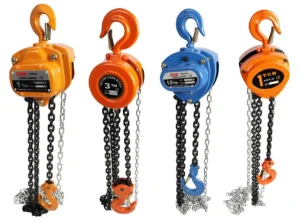
A manual chain hoist (also called a chain fall or chain block) lifts by converting an operator’s hand-pull into amplified mechanical force through an internal gear train. The operator pulls a hand chain, which drives a series of gears that multiply the input force — a well-designed 3-ton manual hoist typically requires only around 30–40 kg of pull force because the gear ratio spreads the work across multiple chain movements.
The practical consequence is speed: each pull raises the load a small increment, so lifting a heavy load by 3–4 meters requires many repeated pulls and meaningful time. A ratchet-and-pawl mechanism holds the load securely between pulls, eliminating the need for the operator to maintain tension manually.
This design requires no external power, weighs as little as 5–10 kg for a 1-ton unit, and can be deployed anywhere a structural beam or trolley is available. That portability is the manual hoist’s defining advantage — one technician carries it to the job.
Electric Chain Hoist: Motor-Driven Precision and Speed
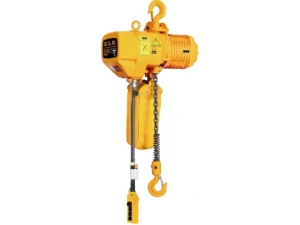
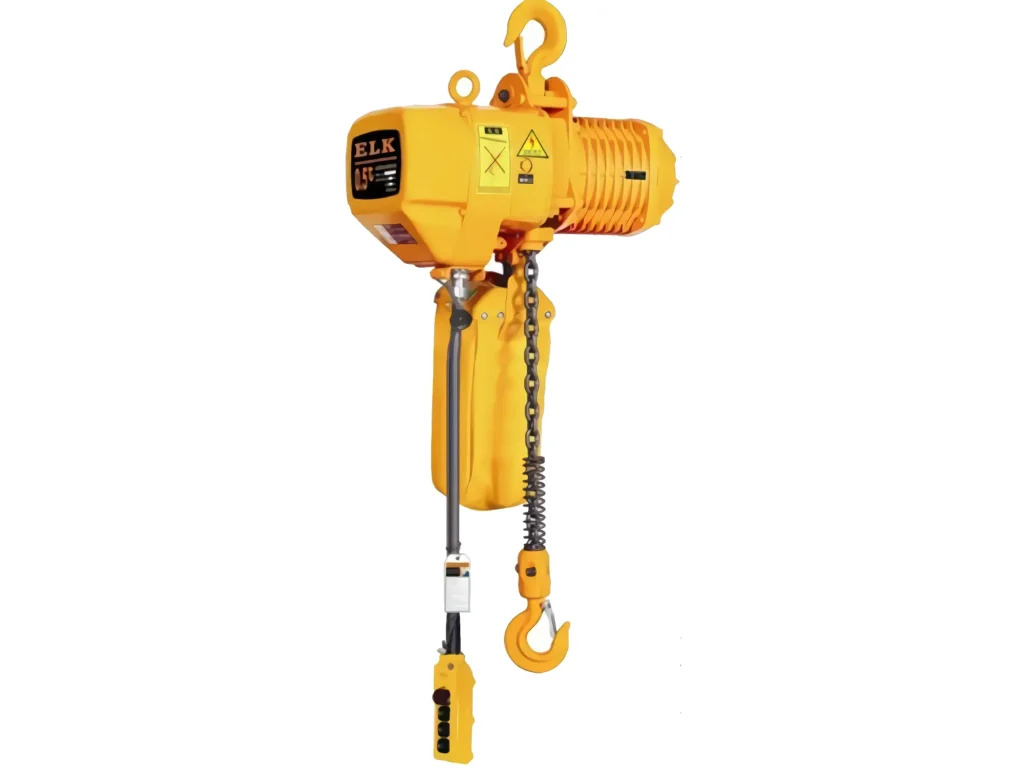
Ан электрическая цепная лебедка replaces hand effort with an induction motor that drives the load chain through a gearbox at a consistent, controllable speed. The operator uses a pendant control — or a radio remote on higher-spec units — to raise, lower, and stop the load. When the motor cuts power, an electromagnetic brake engages automatically to hold the load in place, removing human reaction time from the safety equation.
Most electric chain hoists are available in single-speed or two-speed configurations. Single-speed models suit standard pick-and-place operations; two-speed models allow slower, precise final positioning — critical when landing a component onto a fixture or mating a shaft into a housing. Variable frequency drive (VFD) models extend this further, offering smooth acceleration and deceleration that reduces load sway and wear on the lifting mechanism.
The key engineering difference: an electric hoist is designed around a duty class (FEM M3–M5 for typical production use), meaning its motor, brake, and chain are sized for sustained repeated cycling — something a manual hoist’s mechanical components cannot safely deliver.
Head-to-Head: The Parameters That Actually Drive the Decision
Duty Cycle: The Most Misread Spec in Hoist Selection
Electric chain hoists are the right call once daily lift cycles consistently exceed 15–20 per shift; below that threshold, a manual hoist is almost always the better cost-per-lift investment.
Here is the engineering reason: manual hoist mechanisms are classified under FEM duty class M1–M2 — designed for light, intermittent service. Pushing a manual hoist beyond 10–15 heavy lifts per shift causes two compounding problems: operator fatigue (which is a safety issue, not just a comfort issue), and accelerated wear on the gear and ratchet mechanism. An electric hoist in class M3 or M4 is built for exactly this repetitive load profile — the motor, gearbox, and chain are all rated for continuous cycling at rated capacity.
The threshold matters because it changes the math entirely. A workshop doing 5 maintenance lifts per week is overpaying for a powered unit. A production line cycling every 10–15 minutes throughout a shift will exhaust operators and degrade manual equipment in months.
Capacity and Lift Height: Where the Gap Widens
For loads above 5 tons or lift heights above 6 meters, electric chain hoists are the practical-only option — manual hoists can technically reach these ratings, but the operator effort and cycle time become operationally unworkable.
Manual hoists are broadly available from 0.5 to 20 tons. However, at 5 tons and above with standard lift heights, the hand-pull repetition and time required make them suitable only for infrequent, planned lifts (think: scheduled equipment overhaul, not daily production). Standard manual lift heights of 2.5–3 meters cover most maintenance applications; extended chains can be specified, but longer lifts amplify the time and fatigue penalty significantly.
Electric chain hoists cover 0.125 tons to 35+ tons with lift heights customizable to 30 meters or beyond, and they maintain consistent speed regardless of operator stamina. For any production application requiring frequent movement of loads above 2–3 tons, the electric option is not a luxury — it is the operationally viable choice.
Total Cost of Ownership: What the Purchase Price Doesn’t Show
The lower upfront price of a manual chain hoist is real, but it accounts for only part of the cost picture — labor productivity loss and maintenance frequency can close the gap within 12–18 months of production use.
A manual chain hoist at $200–$400 for a 1-ton unit looks attractive against a comparable electric hoist at $500–$1,500. Over a year of 20+ daily lifts, however, the operator time and fatigue cost per lift compounds significantly. Electric hoists also require periodic electrical inspection and motor maintenance, which adds ongoing cost — but this is predictable and schedulable, unlike the less visible cost of slowed manual productivity.
The honest comparison: for intermittent use (under 10 lifts/day), manual total cost of ownership wins clearly. For production use, the electric hoist’s labor savings typically justify the investment within a year.
Need help selecting the right duty class for your application?

Which One Fits Your Workshop? A Decision Framework
Choose a Manual Chain Hoist When:
Manual hoists are the right tool — not a budget compromise — in three specific scenarios, and buying electric instead is an unnecessary cost.
First, infrequent maintenance lifts: replacing motors, repositioning equipment during planned shutdowns, or any lift that happens a few times per week rather than multiple times per shift. The manual hoist handles these well without the installation, power supply, and maintenance overhead of a powered unit.
Second, locations without reliable power access: field maintenance sites, remote equipment rooms, outdoor worksites, or any environment where running a power supply to the lift point is impractical or expensive. A manual hoist works anywhere a structural beam exists. For a complete breakdown of specs, price ranges, and buying tips, see our manual chain hoist for sale guide.
Third, high-portability requirements: a 1-ton manual hoist weighs under 10 kg in most configurations — one technician carries it to the job. Electric units of equivalent capacity weigh 15–60 kg and require mounting infrastructure. For operations across multiple non-fixed lift points, portability matters more than speed.
Market price reference: Manual chain hoists for typical workshop use (0.5–5 tons) generally range from $200 to $800 at market pricing from Chinese suppliers.
Choose an Electric Chain Hoist When:
Electric chain hoists become the operationally necessary choice as soon as lifting frequency, load weight, or precision requirements exceed what sustained manual operation can safely deliver.
Production and assembly lines where lifts happen multiple times per hour are the core use case: automotive component handling, metal fabrication, assembly of machinery, and any repetitive pick-and-place workflow where operator fatigue is a liability risk. Two-speed and VFD models additionally serve precision placement applications — mold installation, machine alignment, and any lift requiring controlled final-inch positioning.
For loads above 5 tons or in environments where the hoist will run through multiple shifts, specifying the correct FEM duty class is not optional. An underpowered unit in the wrong duty class degrades faster and presents a safety risk — this is one of the most common specification errors in procurement (see Procurement section below).
Market price reference: Electric chain hoists range approximately $500–$2,500 for 0.5–3-ton units in standard configurations; $2,500–$15,000+ for higher capacities, explosion-proof variants, or VFD-equipped models.
Procurement Guide: Mistakes and Hidden Costs
Common Procurement Mistakes When Buying Chain Hoists
The most frequent and costly procurement error is specifying load capacity without specifying duty class — the result is a unit that meets the weight requirement but fails the frequency requirement within months.
FEM duty class (M1 through M8, or equivalently H1 through H8 per ISO 4301) defines how many hours per year and what percentage of maximum load a hoist is designed for. A hoist rated M2 (light duty) will technically lift 2 tons — but operating it as if it were M4 causes accelerated chain and gearbox wear, thermal stress on the motor, and early failure. The nameplate capacity is only half the specification.
A second common error: selecting single-phase power when three-phase is available. Single-phase electric hoists are more widely available and appear simpler to install, but for capacities above 1 ton in continuous production use, three-phase motors run cooler, draw less peak current, and last significantly longer. If your facility has three-phase supply, specifying a single-phase unit to avoid a minor installation step creates a reliability problem over the equipment’s lifetime.
Hidden Costs That Don’t Appear in the Quotation
Several cost items that routinely appear after purchase are absent from most supplier quotes — budgeting for them upfront prevents post-delivery surprises.
For electric chain hoists specifically, watch for these items that are frequently excluded from base pricing:
- Pendant control cable and plug: some suppliers quote the hoist unit only; pendant cables and industrial plugs are listed separately.
- Trolley or suspension hardware: a hook-mounted hoist and a trolley-mounted hoist are different configurations — confirm which is quoted and whether a motorized or push-type trolley is included.
- Spare load chain: a common omission in lower-priced quotes. Load chain is a wear item and should be stocked as a spare from day one. Sourcing compatible chain after delivery adds lead time and often cost.
- Installation and commissioning: for hoists above 3 tons or VFD-equipped units, first-time setup and limit switch adjustment typically require a technician visit, which is rarely included in ex-works pricing.
For manual chain hoists, the main hidden variable is lifting slings and below-the-hook attachments — the hoist hook rarely lifts directly; slings, shackles, or lifting beams are required and almost never included.
Certification and Compliance for Import Buyers
Which Certifications to Require — and Why They Are Not Optional
CE marking and the supporting technical documentation are the baseline minimum for any chain hoist imported into the European Union or countries applying equivalent standards — requesting a price before confirming certification status is a sequencing error that causes customs clearance problems downstream.
For electric chain hoists, the core compliance framework consists of:
- Маркировка CE under the EU Machinery Directive 2006/42/EC: mandatory for any powered lifting equipment placed on the EU market. This is not just a label — it requires the supplier to have completed a conformity assessment and hold a technical file.
- FEM design rules (FEM 1.001): the European standard covering design calculations and duty class verification for lifting mechanisms. Compliance with FEM gives you the engineering basis for duty class claims.
- ISO 4301 series: the international standard for crane and hoist classification, covering duty cycles and load spectra. A supplier referencing ISO 4301 for their duty class rating is using a recognized, traceable framework.
- ISO 9001 quality management certification for the manufacturing facility: this does not certify the product directly, but indicates the supplier has a documented quality system — relevant for production consistency over repeat orders.
For other markets: EAC certification (Eurasian Economic Union — Russia, Kazakhstan, Belarus, and others) is required separately from CE. OSHA compliance (United States) is regulatory rather than product-certification-based, but specifying ASME B30.16 as the applicable hoist standard provides a clear technical reference point.
How to Verify Supplier Certifications Before Ordering
Requesting certificates verbally or accepting a certificate image without checking the issuing body is the most common compliance shortcut — and it is where counterfeit or expired certifications slip through.
The correct verification process for import procurement:
- Request the EC Declaration of Conformity (for CE-marked hoists): this is a formal document — not a sticker — that names the specific product model, lists the applicable directives and standards, and is signed by an authorized representative. If a supplier cannot produce this document, the CE marking is not valid.
- Request the overload test certificate: chain hoists should be proof-tested at 125% of rated capacity before shipment. Request the test report — date, test load, test body — not just a statement that testing was performed.
- Verify the ISO 9001 certificate against the issuing registrar’s database: ISO 9001 certificates can be cross-checked on the registrar’s public verification portal. A certificate that cannot be verified is not valid.
- Confirm safety device inclusion in writing: overload protection (typically a friction clutch or load limiter), upper and lower limit switches, and electromagnetic brake should be listed as included in the order specification — not assumed.
Treat any supplier who resists providing these documents as a procurement risk, not a negotiating position.
If you’ve already decided which type fits your operation and are ready to evaluate specific models and pricing, see our complete Chain Hoist For Sale buyer’s guide.
Заключение
The decision between an electric chain hoist and a manual chain hoist comes down to three numbers: how many lifts per shift, what load, and what’s the total budget including installation and spares. For any workshop running more than 15–20 lifts per shift on loads above 1 ton, the electric chain hoist is the operationally correct choice and will deliver a positive return within 12–18 months. For infrequent, portable, or off-grid lifting, the manual chain hoist remains the right tool.
Three actions before you order:
- Count your actual daily lift cycles — not your peak requirement, your typical shift average.
- Specify duty class alongside load capacity — and get the FEM or ISO classification in writing from your supplier.
- Request the EC Declaration of Conformity and overload test certificate before finalizing the purchase order.
Ready to compare specific models for your workshop?
Часто задаваемые вопросы
Q1: How many lifts per day is the break-even point for choosing electric over manual?
The break-even point is generally around 15–20 lift cycles per shift. Below this threshold, a manual chain hoist typically offers better cost-per-lift economics. Above it, operator fatigue, slower cycle times, and increased mechanical wear on manual equipment make an electric hoist the more cost-effective choice within 12–18 months of production use.
Q2: Can I use a manual chain hoist as a temporary replacement for an electric hoist on a production line?
Only for very short periods and at reduced output — not as a sustainable substitution. Manual hoists in FEM duty class M1–M2 are not designed for the repeated cycling of a production environment. Running one at production frequency will accelerate wear, create fatigue risk for operators, and slow throughput significantly. A manual hoist is a maintenance and portability tool, not a production-line backup.
Q3: What is the typical market price difference between a 2-ton electric and 2-ton manual chain hoist?
At market reference pricing from Chinese manufacturers, a standard 2-ton manual chain hoist generally ranges from $250 to $500. A 2-ton electric chain hoist in a standard single-speed configuration typically runs $600 to $1,800, depending on duty class, control type, and motor specification. VFD-equipped or explosion-proof variants add further to the electric side of the range.
Q4: Which CE documents should I request before importing a chain hoist?
Request three documents as a minimum: the Декларация соответствия ЕС (naming the specific model and applicable directives), an overload test certificate showing proof-testing at 125% of rated capacity, and the supplier’s ISO 9001 certificate from an accredited registrar. Verify the ISO 9001 certificate on the registrar’s public database — do not rely solely on the document image.
Q5: Does an electric chain hoist require three-phase power, or can it run on single-phase?
Both options exist, but for capacities above 1 ton in production use, three-phase is strongly preferred. Three-phase motors run cooler, draw lower peak current, and have longer service life under continuous cycling. Single-phase electric chain hoists are available and suitable for light-duty applications in facilities without three-phase supply — but if your facility has three-phase available, specify it.