


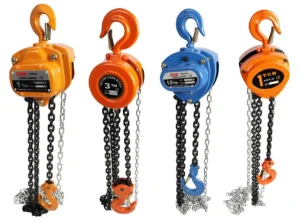






A manual chain hoist for sale typically costs between $30 and $800 and covers capacities from 0.25 to 20 tons — making it the most affordable way to lift heavy loads at sites where no electrical power is available. For most warehouses, workshops, and field jobs lifting under 20 times a day, it is also the right tool, not just the cheapest one.
If you are sourcing one, the real risk isn’t price — it’s buying the wrong capacity, the wrong headroom, or a unit without the certification documents your customs broker and insurer will ask for. A 3-ton hoist that arrives without an EC Declaration of Conformity can sit in a bonded warehouse while the paperwork is chased.
This guide gives you the numbers to decide quickly: price ranges by capacity, a full specification table, the certifications a compliant hoist must carry, and the exact documents to demand before you pay. Everything below is drawn from our own in-production range.
Оглавление
Quick Reference — Manual Chain Hoist Price & Capacity (market reference)
Вместимость Typical lift height Indicative price (USD) Typical use 0.25–0.5 t 2.5 m $30 – $90 Auto repair, light assembly 1–3 t 3.0 m $80 – $300 Machinery install, warehousing 5–10 t 3.0 m $300 – $800 Construction, equipment maintenance 20 t 3.0 m (custom) Request quote Shipyards, heavy industry Prices are market-reference ranges based on Chinese factory pricing; final cost depends on lift height, chain grade, and type.
Получить индивидуальное предложение сейчас
Manual Chain Hoist Price and Specifications at a Glance

What a Manual Chain Hoist Costs by Capacity
A manual chain hoist for sale runs roughly $30 for a 0.25-ton unit up to $800 for a 10-ton unit, with 20-ton and explosion-proof models quoted on request. Price tracks capacity, lift height, and chain grade — not brand alone.
The reason the spread is so wide is material content: a 0.5-ton hoist weighs about 3.5 kg and uses a single fall of φ6 mm load chain, while a 10-ton hoist weighs roughly 56 kg and runs four chain falls of φ11.2 mm grade-80 chain. You are paying for steel and hardened gearing, so heavier-rated units cost proportionally more. Two cost drivers are easy to miss at the quote stage: non-standard lift height (anything above the standard 3 m is a surcharge) and chain grade (grade-80 vs grade-100). Both are covered in the certification and hidden-cost sections below.
Standard Manual Chain Hoist — Full Specification Table
For most buyers the standard HS-series below covers 0.25 t to 10 t at a standard 3 m lift; capacities to 20 t and lift heights to 12 m are available on request.
| Модель | Номинальная грузоподъемность (т) | Std. Lift (m) | Минимальное расстояние между крючками (мм) | Hand Pull Force (N) | Диаметр грузовой цепи (мм) | Чейн-Фоллс | Вес нетто (кг) |
|---|---|---|---|---|---|---|---|
| HS-0.25 | 0.25 | 2.5 | 265 | ≤160 | φ5 | 1 | 2.5 |
| HS-0.5 | 0.5 | 2.5 | 290 | ≤190 | φ6 | 1 | 3.5 |
| HS-1 | 1 | 3.0 | 320 | ≤210 | φ7.1 | 1 | 7.2 |
| HS-1.5 | 1.5 | 3.0 | 340 | ≤230 | φ8 | 1 | 9.5 |
| HS-2 | 2 | 3.0 | 370 | ≤250 | φ9 | 1 | 13.0 |
| HS-3 | 3 | 3.0 | 400 | ≤320 | φ9 | 2 | 17.5 |
| HS-5 | 5 | 3.0 | 470 | ≤370 | φ10.6 | 2 | 28.0 |
| HS-10 | 10 | 3.0 | 590 | ≤400 | φ11.2 | 4 | 56.0 |
The single most useful number here is hand pull force: even at 10 tons it stays at or below 400 N (about 40 kg of pull) because the gear train delivers a 20:1–40:1 reduction. That means one operator can lift the rated load — but it also means a higher-capacity hoist needs more chain pulled per metre of lift, which is why 5–10 t lifts are slow. Custom lift heights of 5 / 6 / 9 / 12 m are available, with weight and price rising accordingly.
Choosing the Right Type for Your Environment
Pick the type by your environment first, then capacity — the wrong build voids your safety case no matter how the tonnage is sized. All four types below are in production and can be quoted against the same capacity table.
| Тип | What changes | Best for |
|---|---|---|
| Стандарт | Worm/planetary gear, standard steel | General lifting, installation |
| Low Headroom (LSC) | Shortened hook-to-hook distance | Tight indoor clearance |
| Explosion-Proof (EXHS) | Spark-free brass/aluminium parts, Ex II BT4 / ATEX | Petrochemical, mining, flammable areas |
| Stainless Steel (304/316) | Corrosion-resistant construction | Food, pharma, marine |
For a chemical plant or grain facility, the explosion-proof model is not an upgrade — it is the only compliant option, and specifying a standard hoist there is the most expensive mistake on this page. Conversely, paying for stainless in a dry workshop is wasted budget. Match the build to the hazard, confirm the capacity with the margin rule below, and you have your model number.

Confirm the Right Specification Before You Order
Size Capacity With a 25% Margin
Always choose a manual chain hoist rated at least 25% above your heaviest load — never at or beyond the nameplate figure. A 2,000 kg load calls for a 3-ton hoist, not a 2-ton one.
The reason is duty and dynamics, not nominal strength. A load chain is built to a 4:1 minimum breaking-load safety factor under EN 13157 and ASME B30.21, but that factor protects against shock loading, side-pull, and chain wear over years of service — not against routinely running at 100% capacity. Sizing tight to the load eats that margin every lift. The hidden penalty of getting this wrong is the most common overload root cause in the field: buyers read the bench weight, ignore rigging and dynamic load, and order to the exact number. The 25% margin costs one capacity step up — typically tens of dollars — and removes the single biggest in-service risk.
Match Lift Height and Headroom
Confirm two clearances before ordering: the lift height (how far the load must travel) and the minimum hook distance (how much vertical space the hoist itself occupies). Both are fixed at the factory, not adjustable on site.
Standard lift height is 3 m; high-bay or shaft work needs the 5 / 6 / 9 / 12 m custom options, which add chain weight and cost. Headroom is the trap: a standard HS-3 needs 400 mm hook-to-hook, but if your beam-to-load clearance is tight, the low-headroom LSC-3 drops that to 300 mm and recovers 100 mm of usable lift. Measure the installed clearance — beam underside to the highest point of the load at full lift — before you choose between standard and low-headroom, because a hoist that won’t fit the opening is a return-shipping bill, not a quick swap.
Manual vs Electric Chain Hoist — When Each Pays Off
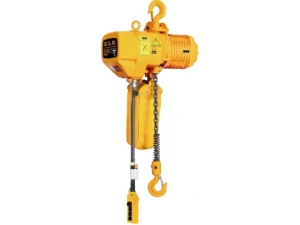
A manual chain hoist wins below roughly 20 lifts per day or wherever power is unreliable; an electric chain hoist pays off above 50 подъемников в день on a fixed station. Between those thresholds, frequency and operator fatigue decide.
| Factor | Ручная цепная лебедка | Электрическая цепная лебедка |
|---|---|---|
| Источник питания | только человеческая сила | 3-phase / single-phase motor |
| Скорость | Slow (0.5–3 m/min) | Fast (3–12 m/min) |
| Стоимость покупки | Low ($30–$800) | High ($150–$8,000+) |
| Install | Hang and go | Rail, trolley, wiring |
| Self-locking | Mechanical ratchet (power-independent) | Electromagnetic brake (power-dependent) |
| Срок службы | 10–20 years | 5–10 years |
| Best for | Temporary, low-frequency, off-grid | Fixed, high-frequency, automated lines |
The economics turn on duty cycle, not sticker price. An electric unit costs several times more upfront and adds rail and wiring, so for a warehouse doing a handful of lifts a day that capital rarely returns. For a production line cycling every few minutes, the manual hoist’s slow speed and operator fatigue cost more in labor than the electric unit’s price difference — so the powered option wins. For loads under 5 tons lifted occasionally, a manual chain hoist gives the best cost-to-performance ratio of any lifting device in this class. Both options are available factory-direct, so the decision can be made on duty cycle alone, not on what a single supplier happens to stock.
Certifications, Documents, and Supplier Evaluation
Which Certifications a Compliant Manual Chain Hoist Needs
A manual chain hoist sold into the EU must carry CE marking under the Machinery Directive (2006/42/EC); for North American sites it should conform to ASME B30.21, and load chains should meet ISO 4347. These are non-negotiable clearance and liability gates, not marketing badges.
The standards stack by market and component. Our range is built and tested to EN 13157 (European safety standard for manually operated chain hoists), ASME B30.21 (US), GB/T 13329 (China national standard), with GS safety certification and ЦЭ conformity; explosion-proof models add the ATEX Directive rating. Why it matters commercially: a unit without valid CE marking can be held at customs, and a hoist with no traceable test certificate can void your liability insurance the day it lifts a load. This is the highest-frequency paperwork failure in import procurement — the hoist is fine, the documents are missing.
Documents to Demand Before You Pay
Require physical documents, not verbal assurances. Ask any supplier — including us — to send these before deposit:
- Декларация соответствия ЕС (or the market-equivalent conformity statement)
- Load / overload test certificate for the rated capacity (proof of the 4:1 chain safety factor)
- ISO 9001 quality-system certificate for the manufacturing plant
- ATEX certificate for any explosion-proof model
- Mill / material certificate for the load chain grade (φ and grade-80/100)
Add the safety devices to the same checklist: confirm the overload limiter (slips at ~125% of rated capacity on select models), the self-locking ratchet brake, and the top and bottom hook latches. A supplier who can email these within a day is one who actually holds them; a supplier who “will send them later” is a risk you can see before paying.
Hidden Costs to Budget Before You Commit
The quoted unit price is rarely the landed cost — budget for lift-height surcharges, spare load chain, and freight on heavier units. These line items routinely add to a “cheap” hoist after the order is placed.
Three predictable extras: (1) Non-standard lift height — anything above 3 m is priced per extra metre of chain, so a 9 m lift on a 5-ton unit costs meaningfully more than the table figure. (2) Spare load chain and brake pads — low-cost hoists often ship without spares, and the φ10.6/φ11.2 grade chain is the first wear part; buying it later at single-unit prices erodes the saving. (3) Freight — a 10-ton hoist at 56 kg ships very differently from a 3.5 kg unit, and on small orders sea-freight minimums can rival the hoist price.
Заключение
For loads under 20 lifts a day or any off-grid site, a manual chain hoist for sale is the most cost-effective lifting choice you can make — provided you size capacity 25% above the load, confirm headroom, and get the certification documents in writing before you pay. Three actions before you order:
- Fix the model: heaviest load × 1.25 → capacity; measure installed headroom → standard vs low-headroom; match the build to your hazard (standard / explosion-proof / stainless).
- Demand the paperwork: EC Declaration of Conformity, load-test certificate, ISO 9001, plus ATEX for explosion-proof units.
- Get a factory-direct quote with lift height, spares, and freight itemised — so the price you compare is the price you land.
Часто задаваемые вопросы
Q1: How much does a manual chain hoist cost?
A manual chain hoist for sale typically costs $30–$800 as a market reference, depending mainly on capacity (0.25–20 t) and lift height. Light 0.25–0.5 t units run $30–$90; 5–10 t units reach $800. Non-standard lift heights and grade-100 chain add cost — request an itemised factory quote.
Q2: What capacity manual chain hoist should I buy?
Choose a rating at least 25% above your heaviest load — a 2,000 kg load needs a 3-ton hoist, not a 2-ton one. Never operate at or beyond the nameplate. The margin protects the 4:1 chain safety factor against shock and side-loading, and costs only one capacity step up.
Q3: What certifications should a manual chain hoist have?
For the EU, CE marking under the Machinery Directive (2006/42/EC); for the US, ASME B30.21; load chains to ISO 4347. Reputable units also meet EN 13157 or GB/T 13329 with GS and ISO 9001. Explosion-proof models need ATEX. Always request the EC Declaration of Conformity and load-test certificate before paying.
Q4: Manual or electric chain hoist — which is better?
A manual chain hoist is better below ~20 lifts per day, off-grid sites, or hazardous areas, and costs far less upfront. An electric chain hoist pays off above ~50 lifts per day on a fixed station, where speed and reduced operator fatigue outweigh its higher cost and installation needs.
Q5: What is the standard lift height, and can it be customised?
Standard lift height is 3 m (2.5 m on sub-1-ton models). Custom heights of 5 / 6 / 9 / 12 m or more are available on request, priced by the extra chain length and weight. Confirm both lift height and minimum hook distance before ordering, as both are fixed at the factory.