- ProductEquipmentPrecision Power, Customization Crane SolutionE-mail:WhatsApp / Wechat:+8613781917315Address:No.18 Shanhai Road, Changyuan City, Henan Province, China


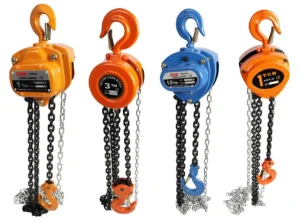
A manual chain hoist — also known as a hand chain hoist, chain block, or chain pulley block — is a mechanical lifting device that uses human force applied through a hand chain to raise, lower, or suspend heavy loads vertically. The internal gear reduction system multiplies the operator’s input force, allowing a single person to lift loads many times their own strength with minimal effort.
Manual chain hoists are compact, lightweight, and completely independent of electrical power. As a result, they are widely used in manufacturing plants, construction sites, mines, shipyards, warehouses, and emergency rescue operations worldwide.
Manual chain hoists are available in several configurations, each designed to meet specific working conditions and load requirements. Understanding the differences between types helps you select the most appropriate hand chain hoist for your application.
| Type | Description | Best For |
|---|---|---|
| Standard Manual Chain Hoist | Most common type; uses worm gear or planetary gear reduction | General lifting, installation work |
| Low Headroom Chain Hoist | Shortened hook-to-hook distance for tight spaces | Indoor work with limited vertical clearance |
| Explosion-Proof Chain Hoist | Brass/aluminum alloy components that prevent sparks | Petrochemical, mining, and flammable environments |
| Stainless Steel Chain Hoist | 304/316 stainless steel construction | Food processing, pharmaceutical, marine applications |
| Lightweight Portable Chain Hoist | Minimized weight for easy transport | Field work, remote sites, temporary rigging |
| Heavy-Duty Chain Hoist | Rated capacity of 20t and above | Shipyards, heavy equipment installation |
| Capacity Range | Typical Models | Common Applications |
|---|---|---|
| Light-duty | 0.25t / 0.5t | Auto repair, light industry |
| Medium-duty | 1t / 2t / 3t | Mechanical installation, warehousing |
| Heavy-duty | 5t / 10t / 16t | Construction, equipment maintenance |
| Extra heavy-duty | 20t / 30t / 50t | Shipyards, heavy industry |
Understanding the components of a manual chain hoist is essential for correct operation, routine inspection, and safe maintenance. Every part plays a specific role in the overall lifting mechanism.
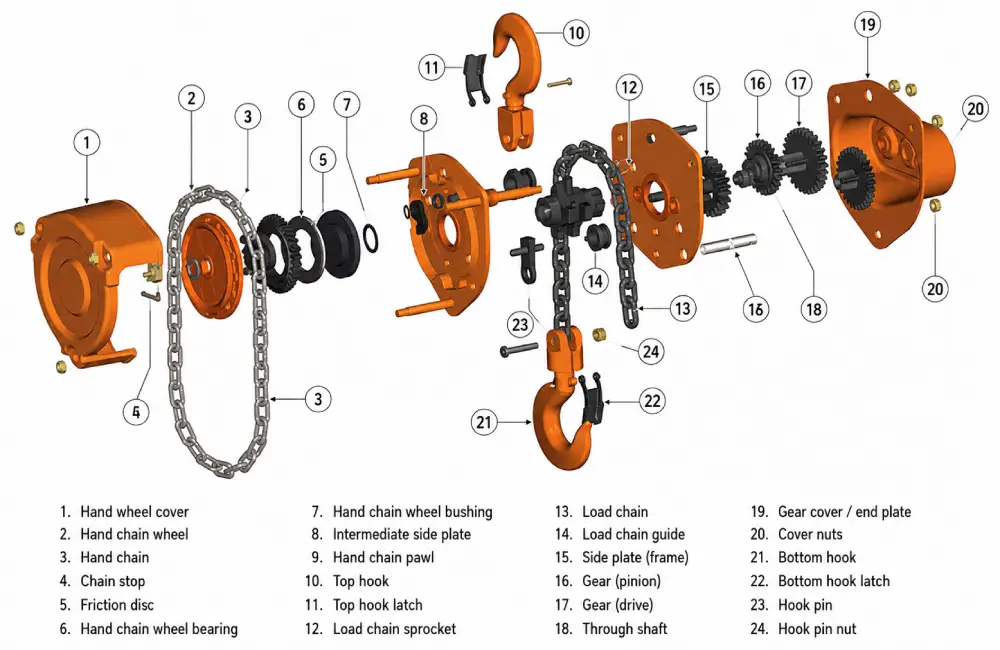
| No. | Component Name | Description |
|---|---|---|
| 1 | Hand Wheel Cover | Protects the internal hand chain wheel and prevents dust or debris entry. |
| 2 | Hand Chain Wheel | Drives the hoist mechanism when the hand chain is pulled. |
| 3 | Hand Chain | Operated manually to lift or lower the load. |
| 4 | Chain Stop | Prevents over-travel of the chain for safe operation. |
| 5 | Friction Disc | Core part of the braking system to hold the load securely. |
| 6 | Hand Chain Wheel Bearing | Supports smooth rotation of the hand chain wheel. |
| 7 | Hand Chain Wheel Bushing | Reduces friction and wear during operation. |
| 8 | Intermediate Side Plate | Provides structural support between internal components. |
| 9 | Hand Chain Pawl | Engages with the ratchet system to prevent reverse movement. |
| 10 | Top Hook | Connects the hoist to the overhead support structure. |
| 11 | Top Hook Latch | Safety latch to secure the top hook connection. |
| 12 | Load Chain Sprocket | Guides and drives the load chain during lifting. |
| 13 | Load Chain | Directly bears and lifts the load. |
| 14 | Load Chain Guide | Ensures proper alignment of the load chain. |
| 15 | Side Plate (Frame) | Main structural frame housing internal components. |
| 16 | Gear (Pinion) | Transfers motion within the gear system. |
| 17 | Gear (Drive) | Amplifies force to enable lifting of heavy loads. |
| 18 | Through Shaft | Connects and aligns rotating components across the hoist. |
| 19 | Gear Cover / End Plate | Encloses and protects the gear assembly. |
| 20 | Cover Nuts | Fasten and secure the housing components. |
| 21 | Bottom Hook | Attaches to the load being lifted. |
| 22 | Bottom Hook Latch | Prevents the load from slipping off the hook. |
| 23 | Hook Pin | Connects hook components securely. |
| 24 | Hook Pin Nut | Locks the hook pin in place for safety. |
The working principle of a manual chain hoist is based on mechanical advantage through gear reduction. This straightforward yet highly effective mechanism allows a single operator to safely lift loads that would otherwise require a team or powered equipment.
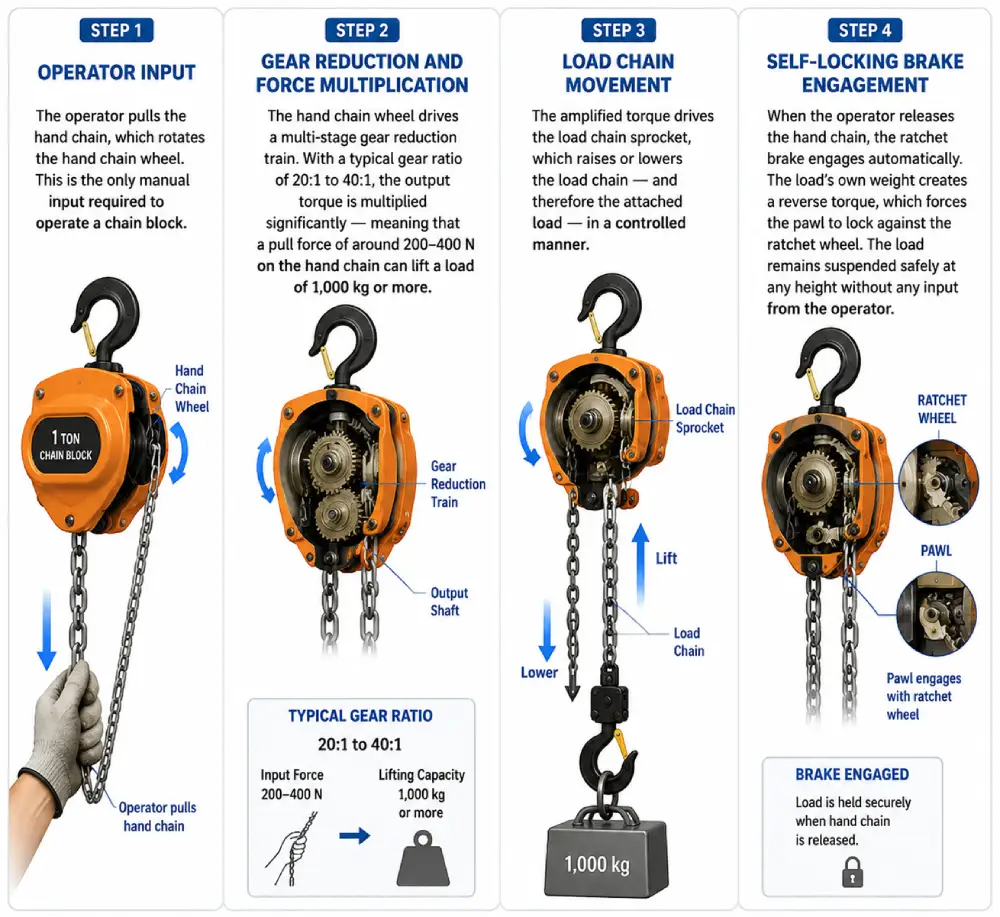
Step 1 — Operator Input: The operator pulls the hand chain, which rotates the hand chain wheel. This is the only manual input required to operate a chain block.
Step 2 — Gear Reduction and Force Multiplication: The hand chain wheel drives a multi-stage gear reduction train. With a typical gear ratio of 20:1 to 40:1, the output torque is multiplied significantly — meaning that a pull force of around 200–400 N on the hand chain can lift a load of 1,000 kg or more.
Step 3 — Load Chain Movement: The amplified torque drives the load chain sprocket, which raises or lowers the load chain — and therefore the attached load — in a controlled manner.
Step 4 — Self-Locking Brake Engagement: When the operator releases the hand chain, the ratchet brake engages automatically. The load’s own weight creates a reverse torque, which forces the pawl to lock against the ratchet wheel. The load remains suspended safely at any height without any input from the operator.
The ratchet brake is the core safety feature of every manual chain hoist:
Safety factor: The minimum breaking load of a manual chain hoist load chain must be at least 4 times the rated capacity (4:1 safety factor), in compliance with EN 13157 and ASME B30.21 international standards.
Choosing between a manual chain hoist and an electric chain hoist depends on your specific working conditions, frequency of use, and budget. The following comparison covers all the key decision factors:
| Comparison Factor | Manual Chain Hoist | Electric Chain Hoist |
|---|---|---|
| Power Source | Human power only | Electric motor (3-phase or single-phase) |
| Operating Speed | Slow (0.5 – 3 m/min) | Fast (3 – 12 m/min) |
| Operator Effort | Moderate; fatigue possible over long sessions | Minimal; push-button control |
| Power Dependency | None — works anywhere | Requires stable power supply |
| Self-Locking Safety | Mechanical ratchet; inherently self-locking | Relies on electromagnetic brake; power-dependent |
| Product Weight | Light (2.5 – 50 kg) | Heavy (20 – 200 kg) |
| Purchase Cost | Low ($30 – $800) | High ($150 – $8,000+) |
| Installation | Hang and go — no setup required | Requires rail, trolley, and electrical wiring |
| Maintenance Cost | Very low — minimal components | Higher — motor and control system servicing |
| Noise Level | Near-silent | Motor running noise |
| Operating Temperature | −20°C to +50°C | Narrower range (limited by motor) |
| Explosion-Proof Cost | Low — standard construction modification | High — requires full ATEX-rated unit |
| Service Life | 10 – 20 years | 5 – 10 years |
| Best Suited For | Temporary, low-frequency, or off-grid lifting | Fixed stations, high-frequency, automated lines |
| Model | Rated Capacity (t) | Standard Lift Height (m) | Min. Hook Distance (mm) | Hand Pull Force (N) | Load Chain Dia. (mm) | Chain Falls | Net Weight (kg) |
|---|---|---|---|---|---|---|---|
| HS-0.25 | 0.25 | 2.5 | 265 | ≤160 | φ5 | 1 | 2.5 |
| HS-0.5 | 0.5 | 2.5 | 290 | ≤190 | φ6 | 1 | 3.5 |
| HS-1 | 1 | 3.0 | 320 | ≤210 | φ7.1 | 1 | 7.2 |
| HS-1.5 | 1.5 | 3.0 | 340 | ≤230 | φ8 | 1 | 9.5 |
| HS-2 | 2 | 3.0 | 370 | ≤250 | φ9 | 1 | 13.0 |
| HS-3 | 3 | 3.0 | 400 | ≤320 | φ9 | 2 | 17.5 |
| HS-5 | 5 | 3.0 | 470 | ≤370 | φ10.6 | 2 | 28.0 |
| HS-10 | 10 | 3.0 | 590 | ≤400 | φ11.2 | 4 | 56.0 |
Custom lift heights available: 3 m / 5 m / 6 m / 9 m / 12 m / custom on request.
| Model | Rated Capacity (t) | Min. Hook Distance (mm) | Lift Height (m) | Net Weight (kg) |
|---|---|---|---|---|
| LSC-0.5 | 0.5 | 190 | 2.5 | 4.0 |
| LSC-1 | 1 | 215 | 3.0 | 8.5 |
| LSC-2 | 2 | 255 | 3.0 | 15.0 |
| LSC-3 | 3 | 300 | 3.0 | 21.0 |
| LSC-5 | 5 | 385 | 3.0 | 35.0 |
| Model | Rated Capacity (t) | ATEX Rating | Lift Height (m) | Net Weight (kg) |
|---|---|---|---|---|
| EXHS-0.5 | 0.5 | Ex II BT4 | 2.5 | 5.5 |
| EXHS-1 | 1 | Ex II BT4 | 3.0 | 11.0 |
| EXHS-2 | 2 | Ex II BT4 | 3.0 | 18.5 |
| EXHS-3 | 3 | Ex II BT4 | 3.0 | 25.0 |
| EXHS-5 | 5 | Ex II BT4 | 3.0 | 42.0 |
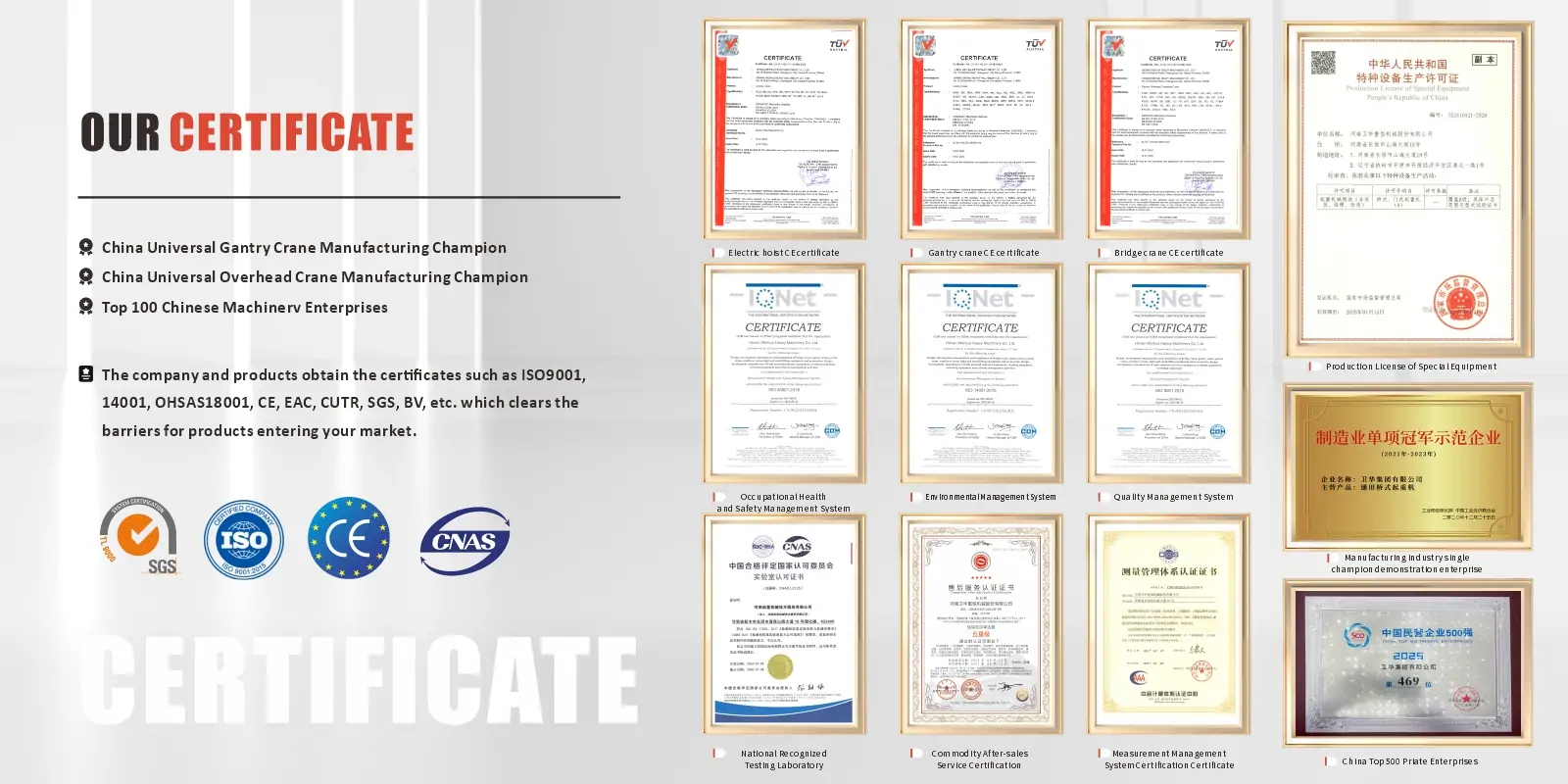
Our manual chain hoists are designed, manufactured, and tested to meet the most widely recognized international safety and quality standards. Compliance with these standards ensures reliable performance and protects both operators and assets.
| Standard / Certification | Scope |
|---|---|
| GB/T 13329 | China national standard for manual chain hoists |
| EN 13157 | European safety standard for manually operated chain hoists |
| ASME B30.21 | American standard for manually lever-operated hoists |
| CE Marking | European conformity certification |
| GS Mark | German safety certification (Geprüfte Sicherheit) |
| ISO 4347 | International standard for load chains used in chain hoists |
| ATEX Directive | European standard for explosion-proof equipment |
Selecting the correct manual chain hoist for your application requires careful consideration of several key factors. Follow these guidelines to make an informed purchasing decision:
Always select a manual chain hoist with a rated capacity at least 25% higher than your maximum load weight. For example, if your heaviest load is 2,000 kg, choose a 3t chain hoist. Never operate a hand chain hoist at or beyond its rated limit.
Standard lift height for most manual chain hoists is 3 meters. However, if your application requires lifting over greater distances — such as in high-bay warehouses or tall industrial structures — custom lift heights of 5 m, 6 m, 9 m, or 12 m are available on request.
A manual chain hoist is most cost-effective when the lifting frequency is low to moderate (up to 20–30 lifts per day). For higher frequencies, an electric chain hoist will improve productivity and reduce operator fatigue.
Always purchase manual chain hoists from manufacturers or suppliers who can provide documentation of compliance with EN 13157, ASME B30.21, or equivalent regional standards. Look for CE, GS, or other recognized certifications on the product label.
While the initial cost of a manual chain hoist is significantly lower than that of an electric model, it is equally important to factor in long-term maintenance costs, operator labor, and expected service life when making a final decision.
Weihua is a professional manual chain hoist manufacturer and supplier based in China, with over 37 years of experience in lifting equipment design and manufacturing. Drawing on extensive project experience across industrial plants, construction sites, shipyards, and mining operations, Weihua delivers reliable and customized manual chain hoist solutions for every application.
All products are manufactured under a strict quality control system, fully compliant with CE and ISO standards, ensuring outstanding safety performance and long-term durability. We provide a global after-sales service network and a one-year warranty on all chain hoist products.
We also offer a wide range of lifting equipment solutions, including electric chain hoists, lever hoists, and overhead crane systems. Contact our engineering team today for a customized manual chain hoist solution tailored to your requirements.
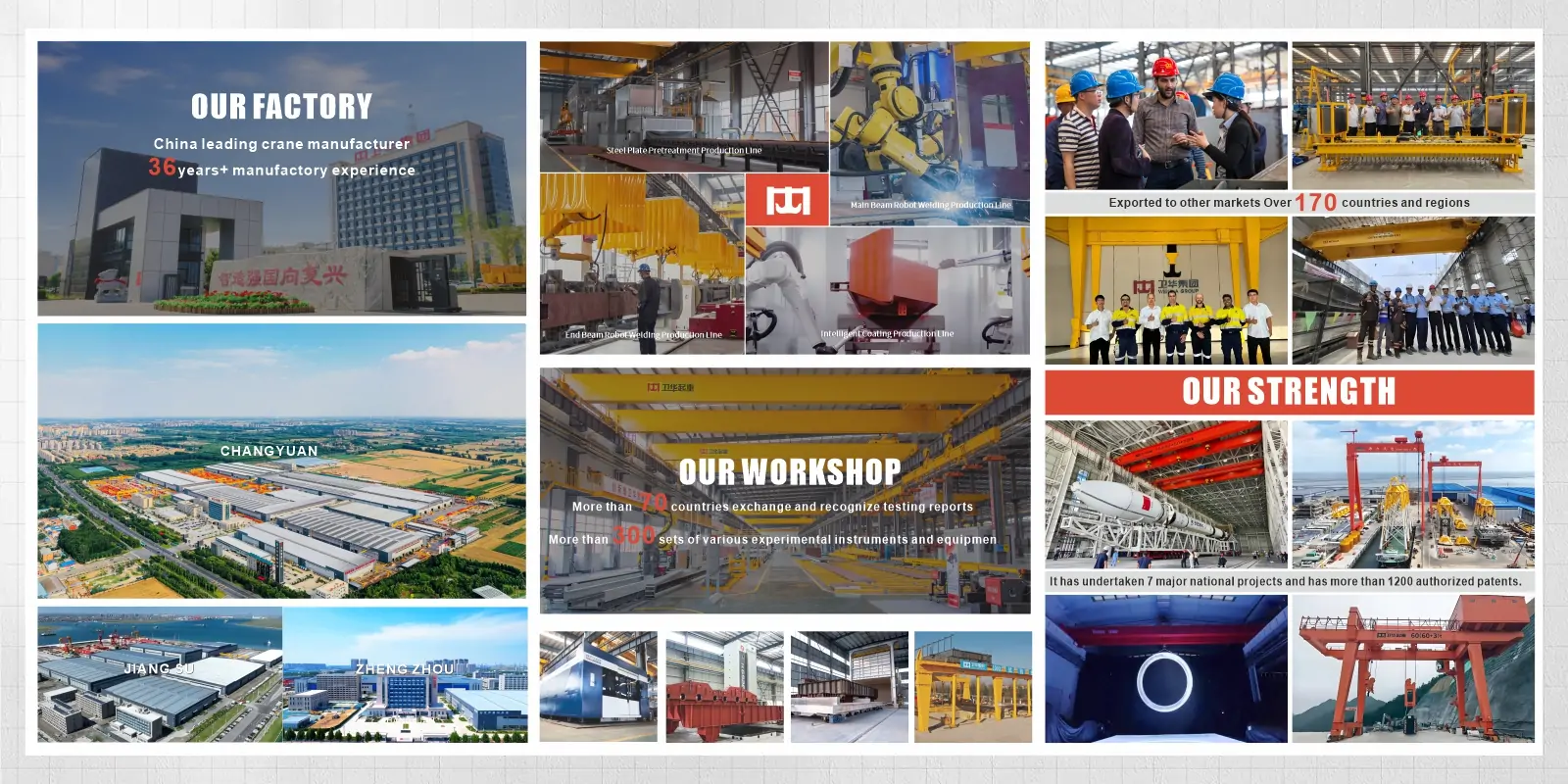
Weihua, founded in 1988, has evolved into a global leader in China's intelligent manufacturing field. We specialize in smart crane R&D and production while offering AGV solutions. Our professional engineering, delivery, and after-sales teams provide one-stop technical support, customized solutions, on-site installation guidance, and rapid-response global services to ensure every project operates safely and efficiently.
A: A manual chain hoist is operated by pulling a hanging hand chain in a continuous loop, which is ideal for vertical lifting. A lever hoist (ratchet hoist) uses a short lever handle with a ratcheting mechanism, making it better suited for horizontal pulling, tensioning, and tight spaces where a hanging chain would be inconvenient.
A: With regular inspection and proper lubrication, a quality manual chain hoist can provide 10 to 20 years of reliable service. The load chain is typically the first component to require replacement due to normal wear.
A: Yes. Standard manual chain hoists can be used outdoors in most weather conditions. For extended outdoor exposure, stainless steel models or models with corrosion-resistant coatings are recommended.
A: Most manufacturers offer manual chain hoists up to 50 tonnes. For loads exceeding this capacity, multi-fall rigging configurations or specialized heavy-lift equipment is typically required.
A: Key maintenance tasks include: inspecting the load chain for wear and elongation, lubricating the load chain and gears with appropriate grease, checking hooks for deformation, and testing the ratchet brake for proper engagement. A full maintenance log should be kept for each hoist unit.
Contact us now via email: [email protected], or fill in the form below.


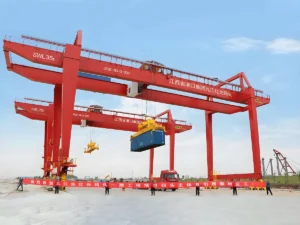
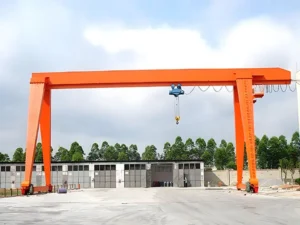
The gantry crane is a lifting equipment widely used across various industries, construction sites, ports, warehouses, and other fields. Its unique structure and powerful load-bearing capacity make it ideal for modern heavy-duty material handling. The “gantry” structure design allows the crane to move freely within a space, covering a large working area. So, what makes gantry cranes special? What are their types, parameters, control methods, applications, and working principles? How do they differ from bridge cranes? Let’s explore together. Types of Gantry Cranes Based on design, application, and operating environment, gantry cranes are typically categorized into the following types: Single-Girder Gantry Crane Single-girder gantry cranes are widely used across industrial sectors, warehouses, ports, and workshops. Featuring a single-girder support lifting mechanism, they traverse via side columns and bottom rails. With their simple structure, user-friendly operation, and moderate lifting capacity, they are ideal for handling light to medium loads. Capable of spanning large distances freely, single-girder gantry cranes are suitable for heavy material handling and lifting operations. Double Girder Gantry Crane Compared to single-girder gantry cranes, double-girder gantry cranes offer greater…
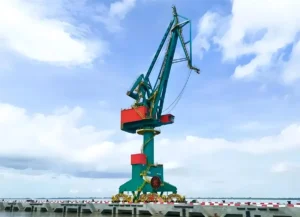
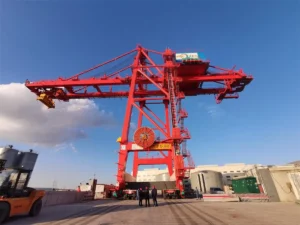
In ports, logistics parks, and industrial material handling, Portal Cranes and Gantry Cranes are two common and core loading/unloading equipment types. They differ in structural design, performance characteristics, operating methods, application scenarios, and investment costs. This article provides a comprehensive analysis of Portal Crane vs Gantry Crane and guides you in making the right selection. Structural Design Comparison The structural differences between Portal Cranes and Gantry Cranes primarily manifest in load-bearing methods, movement trajectories, and coverage ranges. The former centers on a fixed tower and rotating boom, emphasizing “point coverage” and flexible horizontal rotation. The latter features a portal frame structure and longitudinal rail travel, prioritizing “extensive horizontal movement” and efficient on-site logistics handling. Consequently, their distinct structural designs directly dictate their differing application scenarios. Portal Crane Structural Characteristics Portal slewing cranes employ single/double cantilever boom structures with the tower fixed to foundations or rails, enabling 360° or partial rotation. This configuration enables flexible operation in narrow, elongated spaces such as shorelines, dock fronts, and ship berths, making it particularly suitable for ship-to-shore material handling. Its core functionality combines vertical…
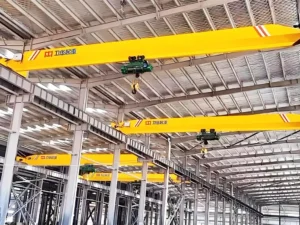
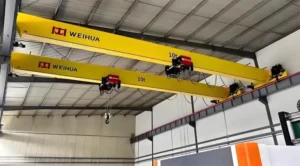
In modern industrial operations, efficient material handling is crucial for maximizing productivity and optimizing workflow. Bridge cranes, also known as overhead cranes or EOT cranes, are fixed material handling systems widely used in manufacturing, metal processing, warehousing, and loading/unloading operations. In this article, we will explore the working principle, main components, applications, and operational benefits of bridge cranes, providing a comprehensive guide for industrial planners and logistics professionals. Bridge Crane Working Principle A bridge crane operates on a bridge-like structure spanning the workspace, with a trolley and hoist system that moves horizontally along the bridge and vertically lifts or lowers loads. The crane’s movement across the runway, combined with precise hoist control, enables efficient and safe handling of heavy materials in factories, warehouses, and industrial facilities. For information on how overhead cranes work, please see this article: Overhead Crane Working Principle: Components, Motion & Operating Process Bridge Crane Terminology The following is an introduction to terminology related to bridge crane parts. Crane Capacity: Crane capacity refers to the maximum weight a bridge crane can safely lift. Typically measured in tons…
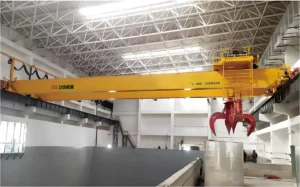
An EOT Crane (Electric Overhead Traveling Crane) is an efficient and reliable overhead lifting system used to handle heavy materials in factories, warehouses, workshops, and industrial plants. Running on overhead rails, EOT cranes enable safe and precise three-dimensional movement of loads through coordinated lifting, cross travel, and long travel motions. This article will guide you through EOT crane definitions, types, structure, working principles, applications, and cost factors to help you select the most suitable solution for your lifting needs. How EOT Crane Works? The working principle of an EOT crane involves a combination of vertical lifting, horizontal trolley movement, and longitudinal bridge travel, enabling efficient handling of heavy loads across industrial facilities. The crane operates on elevated runway rails installed along the building structure, with the bridge girder spanning the workspace. The hoist mechanism raises or lowers the load using steel wire ropes or chains, while the trolley moves the load horizontally along the bridge. The entire crane travels longitudinally along the runway rails, enabling three-dimensional positioning of materials. Modern EOT cranes are powered by electric motors with precise speed…
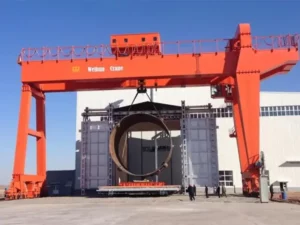
Gantry cranes are widely used in open-air stockyards, shipyards, factories, and construction sites, making them one of the most versatile and extensively applied material handling solutions. Gantry cranes come in various types, each customizable to suit different load capacities, site conditions, and operational requirements. However, selecting the wrong configuration can lead to unnecessary expenses, limited lifting capacity, or future expansion constraints. So, what are the main types of gantry cranes? How do you choose the right type for your application? In this guide, we will provide a detailed overview of different types of gantry cranes based on structure, mobility, and application scenarios, helping you make the right decision before investing in a lifting solution. The article is quite lengthy. Below is our table of contents. Please jump to the corresponding section as needed: What Is a Gantry Crane? Gantry cranes are lifting equipment designed for efficient handling of heavy cargo in large open-air sites. Their signature structure features one or more main beams supported by rigid (or flexible) legs on either side, forming a monumental “gate”-shaped frame. These cranes traverse…
 English English
  Русский
 العربية
 Français
 Português
 Español