- ProductEquipmentPrecision Power, Customization Crane SolutionE-mail:WhatsApp / Wechat:+8613781917315Address:No.18 Shanhai Road, Changyuan City, Henan Province, China


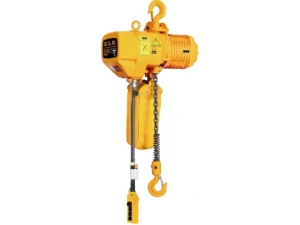
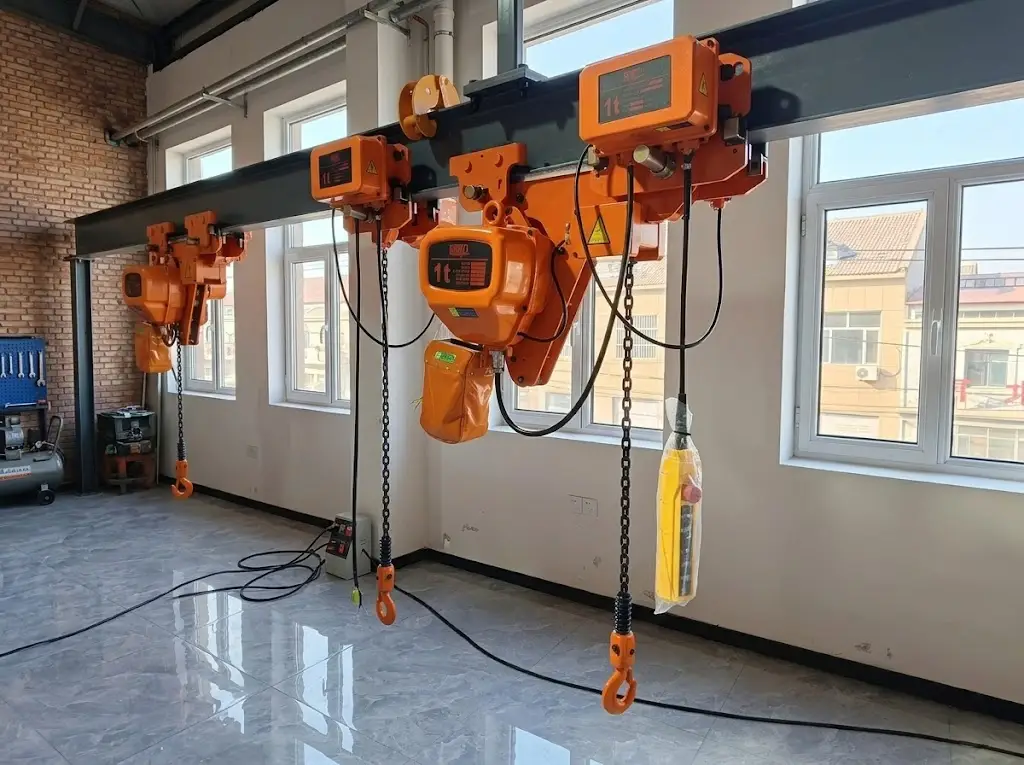
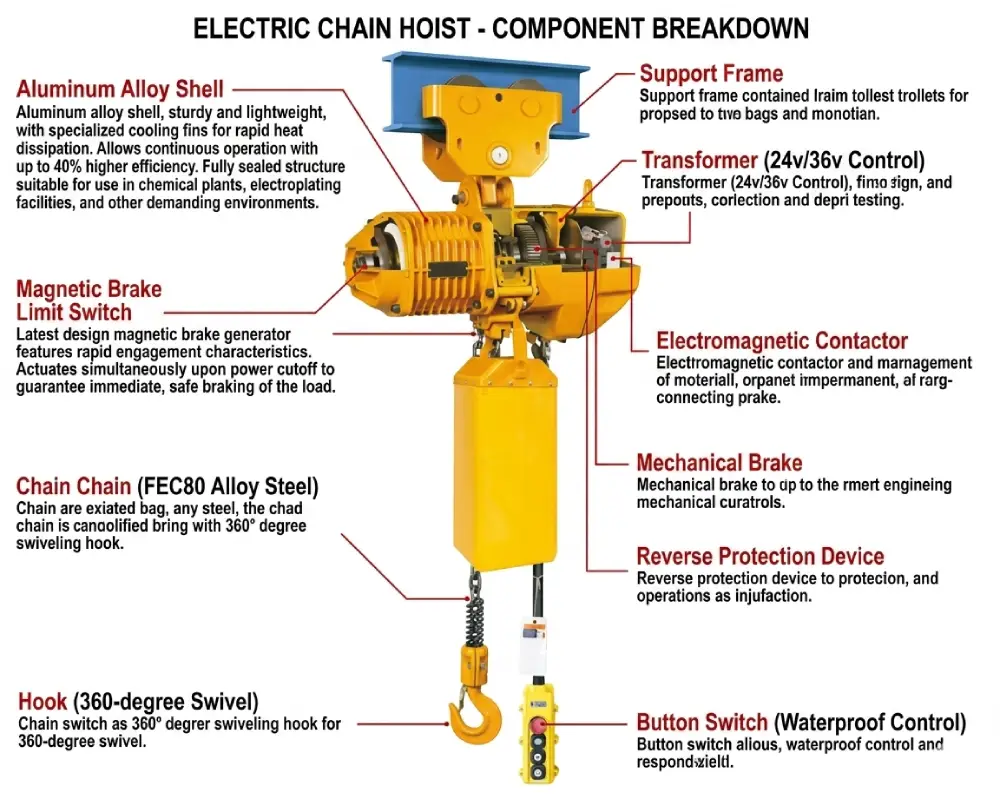
An electric chain hoist — also referred to as an electric hoist, motorized chain hoist, or electric chain block — is a mechanical lifting device powered by an electric motor. It uses a motor-driven sprocket to move a high-strength load chain, enabling the controlled vertical movement of heavy loads at the push of a button.
Unlike manual chain hoists that rely entirely on human effort, an electric chain hoist delivers consistent lifting speed, lower operator fatigue, and the ability to perform a high volume of lifts continuously throughout the working day. Electric chain hoists are commonly mounted on fixed beams, monorail systems, or overhead traveling cranes to form a complete material handling solution.
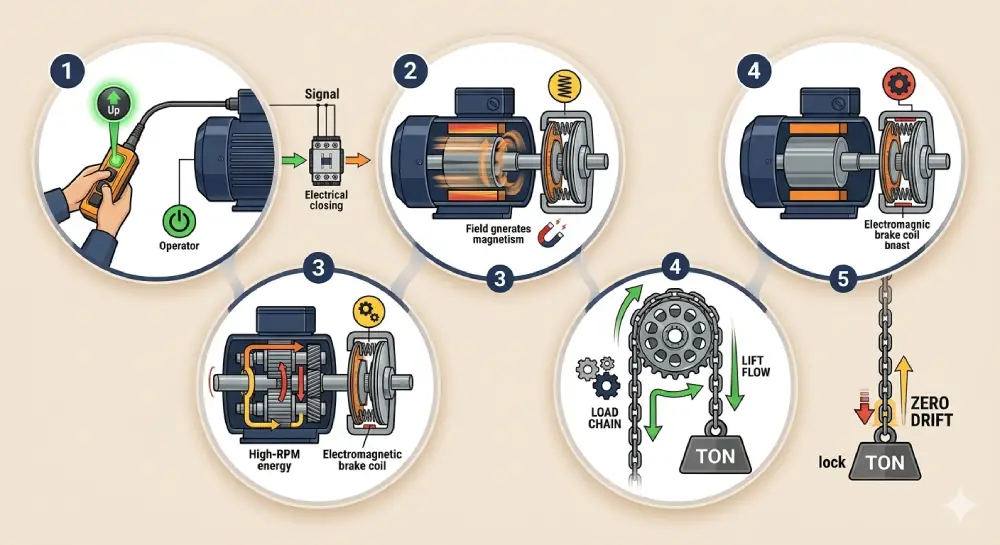
Step 1 — Operator Command: The operator presses the “up” or “down” button on the pendant control. This sends a signal to the motor contactor, which connects the electric motor to the power supply.
Step 2 — Motor Activation and Brake Release: The electric motor starts rotating. Simultaneously, the electromagnetic brake releases — the brake coil is energized, overcoming the spring force that holds the brake disc closed, allowing the drive shaft to rotate freely.
Step 3 — Gear Reduction and Torque Amplification: The motor drives the gearbox input shaft at full motor speed (typically 1,400–2,800 RPM). The multi-stage helical gear reduction reduces this to a slow, high-torque output (typically 10–60 RPM at the sprocket), producing enough force to lift the rated load.
Step 4 — Chain Movement: The gearbox output drives the load chain sprocket, which engages the load chain. Depending on the motor rotation direction, the chain is either wound up (raising the load) or paid out (lowering the load) in a controlled, consistent motion.
Step 5 — Load Holding and Brake Engagement: When the operator releases the button, the motor stops and the electromagnetic brake engages instantly — the spring force clamps the brake disc, holding the load at its current height with zero drift.
Selecting the right hoist type is one of the most important decisions in any material handling project. The following comparison covers all key decision factors between electric and manual chain hoists.
| Comparison Factor | Electric Chain Hoist | Manual Chain Hoist |
|---|---|---|
| Power source | Electric motor (3-phase or single-phase) | Human power only |
| Operating speed | Fast: 3 – 12 m/min | Slow: 0.5 – 3 m/min |
| Operator effort | Minimal — push-button control | Moderate — repeated hand chain pulling |
| Lifting frequency | High — 50+ lifts/day sustained | Low to moderate — up to 20 lifts/day |
| Power dependency | Requires stable electrical supply | No power needed — works anywhere |
| Self-locking safety | Electromagnetic brake; fail-safe on power loss | Mechanical ratchet; inherently self-locking |
| Overload protection | Built-in (standard on most models) | Available on select models only |
| Positioning precision | High — dual speed / VFD option | Low — depends on operator feel |
| Product weight | Heavy: 20 – 200 kg | Light: 2.5 – 50 kg |
| Purchase cost | Higher: $150 – $8,000+ | Lower: $30 – $800 |
| Installation | Requires beam, trolley, and electrical wiring | Hang and go — no setup required |
| Maintenance | Higher — motor, brake, controls require servicing | Very low — minimal components |
| Noise level | Motor running noise | Near-silent |
| Operating temperature | −10 °C to +40 °C (standard motor) | −20 °C to +50 °C |
| Explosion-proof cost | High — full ATEX motor and enclosure required | Low — brass/aluminum components only |
| Service life | 5 – 10 years (electrical components) | 10 – 20 years (mechanical only) |
| Best suited for | Fixed stations, high-frequency, automated lines | Temporary, off-grid, low-frequency, hazardous zones |
The tables below provide full technical specifications for Weihua standard, low-headroom, and explosion-proof electric chain hoist product lines.
| Model | Rated Capacity (t) | Lift Height (m) | Lifting Speed (m/min) | Motor Power (kW) | Voltage (V) | Load Chain Dia. (mm) | Chain Falls | Net Weight (kg) |
|---|---|---|---|---|---|---|---|---|
| ECH-0.5 | 0.5 | 3 / 6 | 8 / 0.8 | 0.4 | 380 | φ6.3 | 1 | 22 |
| ECH-1 | 1 | 3 / 6 | 8 / 0.8 | 0.8 | 380 | φ7.1 | 1 | 28 |
| ECH-2 | 2 | 3 / 6 | 8 / 0.8 | 1.5 | 380 | φ9 | 1 | 38 |
| ECH-3 | 3 | 3 / 6 | 6 / 0.6 | 2.2 | 380 | φ10 | 2 | 52 |
| ECH-5 | 5 | 3 / 6 | 4 / 0.4 | 3.0 | 380 | φ11.2 | 2 | 78 |
| ECH-10 | 10 | 3 / 6 | 3.5 / 0.35 | 5.5 | 380 | φ12.5 | 4 | 145 |
| ECH-16 | 16 | 3 / 6 | 3 / 0.3 | 7.5 | 380 | φ14 | 4 | 210 |
| ECH-20 | 20 | 3 / 6 | 2.5 / 0.25 | 11 | 380 | φ16 | 4×2 | 310 |
Dual lifting speed shown as full speed / creep speed. Single-speed models also available. Custom lift heights (6 m / 9 m / 12 m / 18 m / 24 m) on request.
| Model | Rated Capacity (t) | Min. Hook Distance (mm) | Lift Height (m) | Motor Power (kW) | Net Weight (kg) |
|---|---|---|---|---|---|
| LHECH-0.5 | 0.5 | 320 | 3 | 0.4 | 26 |
| LHECH-1 | 1 | 360 | 3 | 0.8 | 34 |
| LHECH-2 | 2 | 410 | 3 | 1.5 | 46 |
| LHECH-3 | 3 | 460 | 3 | 2.2 | 63 |
| LHECH-5 | 5 | 530 | 3 | 3.0 | 92 |
| Model | Rated Capacity (t) | ATEX Rating | Lift Height (m) | Motor Power (kW) | Net Weight (kg) |
|---|---|---|---|---|---|
| EXECH-0.5 | 0.5 | Ex II 2G IIB T4 | 3 | 0.4 | 30 |
| EXECH-1 | 1 | Ex II 2G IIB T4 | 3 | 0.8 | 40 |
| EXECH-2 | 2 | Ex II 2G IIB T4 | 3 | 1.5 | 55 |
| EXECH-3 | 3 | Ex II 2G IIB T4 | 3 | 2.2 | 72 |
| EXECH-5 | 5 | Ex II 2G IIB T4 | 3 | 3.0 | 105 |
| Beam Flange Width (mm) | Travel Speed (m/min) | Travel Motor Power (kW) |
|---|---|---|
| 74 – 150 | 20 | 0.2 |
| 100 – 200 | 20 | 0.4 |
| 150 – 300 | 20 | 0.4 |
| 200 – 400 | 20 | 0.75 |
All Weihua electric chain hoists are designed, manufactured, and tested to meet leading international safety and performance standards.
| Standard / Certification | Scope |
|---|---|
| FEM 1.001 | Federation Européenne de la Manutention — lifting equipment classification and duty cycle |
| EN 14492-2 | European standard for powered hoists — safety requirements |
| ASME HST-4 | American standard for electric chain hoists |
| GB/T 14406 | China national standard for general-purpose electric chain hoists |
| CE Marking | European conformity certification |
| ISO 4347 | International standard for load chains |
| ATEX Directive 2014/34/EU | Explosion-proof equipment for hazardous atmospheres |
| IP55 Motor Protection | Dust-tight and water jet resistant motor enclosure (standard) |
Choosing the correct electric chain hoist requires a structured approach. Consider the following factors before making a selection:
Select an electric chain hoist with a rated capacity at least 25% above your maximum working load. For example, for a maximum load of 4,000 kg, choose a 5 t model. Never operate an electric hoist at or above its rated limit.
Electric chain hoists are classified by duty class (FEM / ISO M class) based on the number of lifts per day and the average load ratio. Selecting the correct duty class is essential for equipment longevity:
| Duty Class | Lifts per Day | Load Spectrum | Typical Application |
|---|---|---|---|
| M3 (FEM 1Am) | Up to 20 | Light | Maintenance, infrequent use |
| M4 (FEM 2m) | 20 – 40 | Medium | General workshop use |
| M5 (FEM 3m) | 40 – 80 | Medium-heavy | Active production lines |
| M6 (FEM 4m) | 80 – 160 | Heavy | Heavy continuous operation |
Standard lift heights are 3 m and 6 m. For tall buildings, high-bay warehouses, or deep shafts, custom lift heights of 9 m, 12 m, 18 m, and 24 m are available. Always confirm the available headroom before specifying lift height.
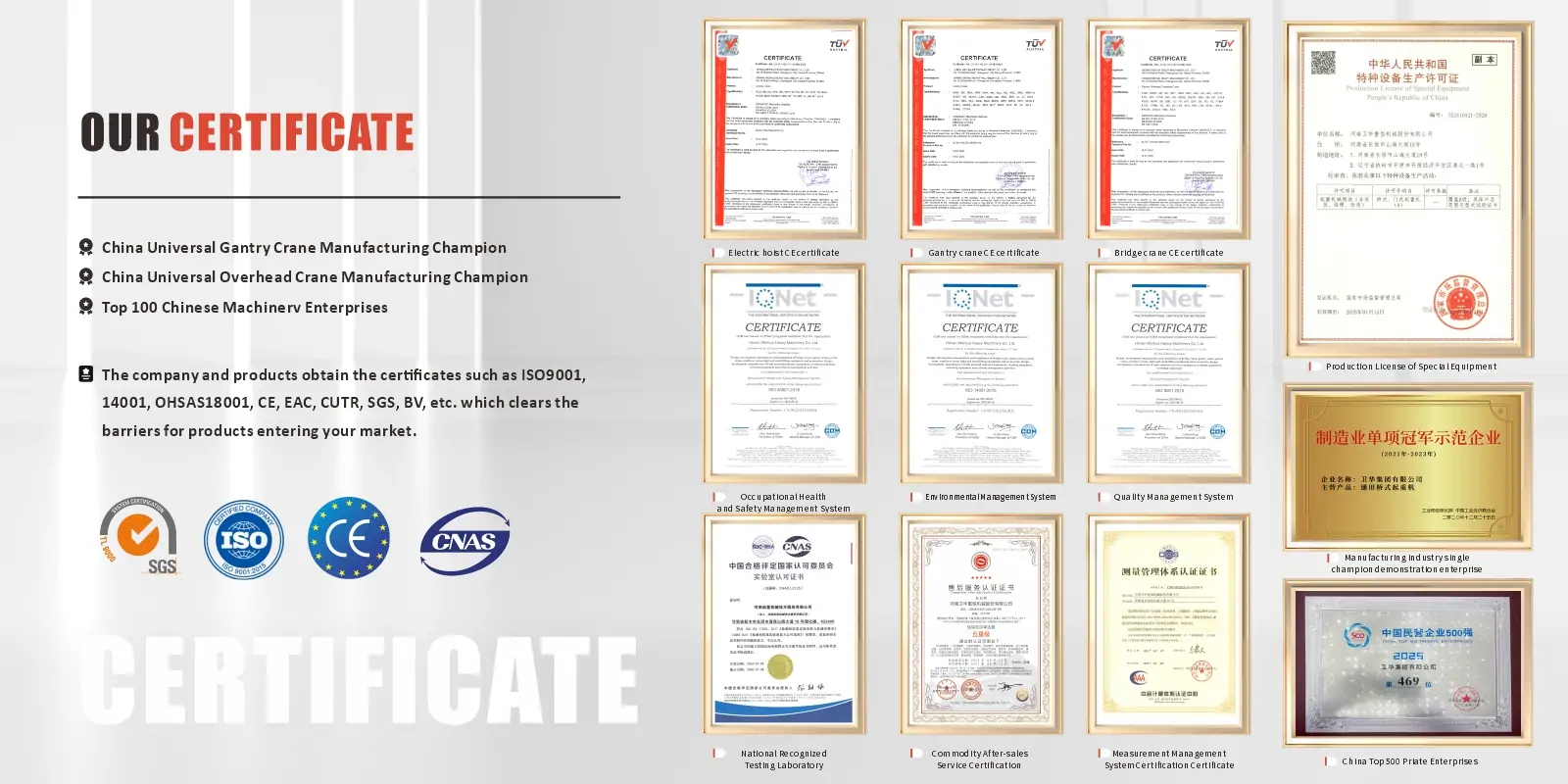
Always purchase electric chain hoists from a manufacturer with documented CE, ISO, and relevant regional certifications. Confirm that the supplier can provide after-sales service, spare parts availability, and technical support in your region.
Weihua is a professional electric chain hoist manufacturer and supplier based in China, with over 37 years of experience in lifting equipment design and manufacturing. All Weihua electric chain hoists are produced under a rigorous quality management system certified to ISO 9001, and all products are CE-marked in compliance with the European Machinery Directive.
Weihua provides a global after-sales service network, a one-year product warranty, and long-term spare parts availability for all hoist models. Our engineering team is available to support custom hoist specifications, crane system integration, and on-site installation guidance.
We also offer a comprehensive range of lifting equipment solutions, including manual chain hoists, overhead traveling cranes, gantry cranes, and jib cranes. Contact our engineering team today for a customized electric chain hoist solution tailored to your requirements.
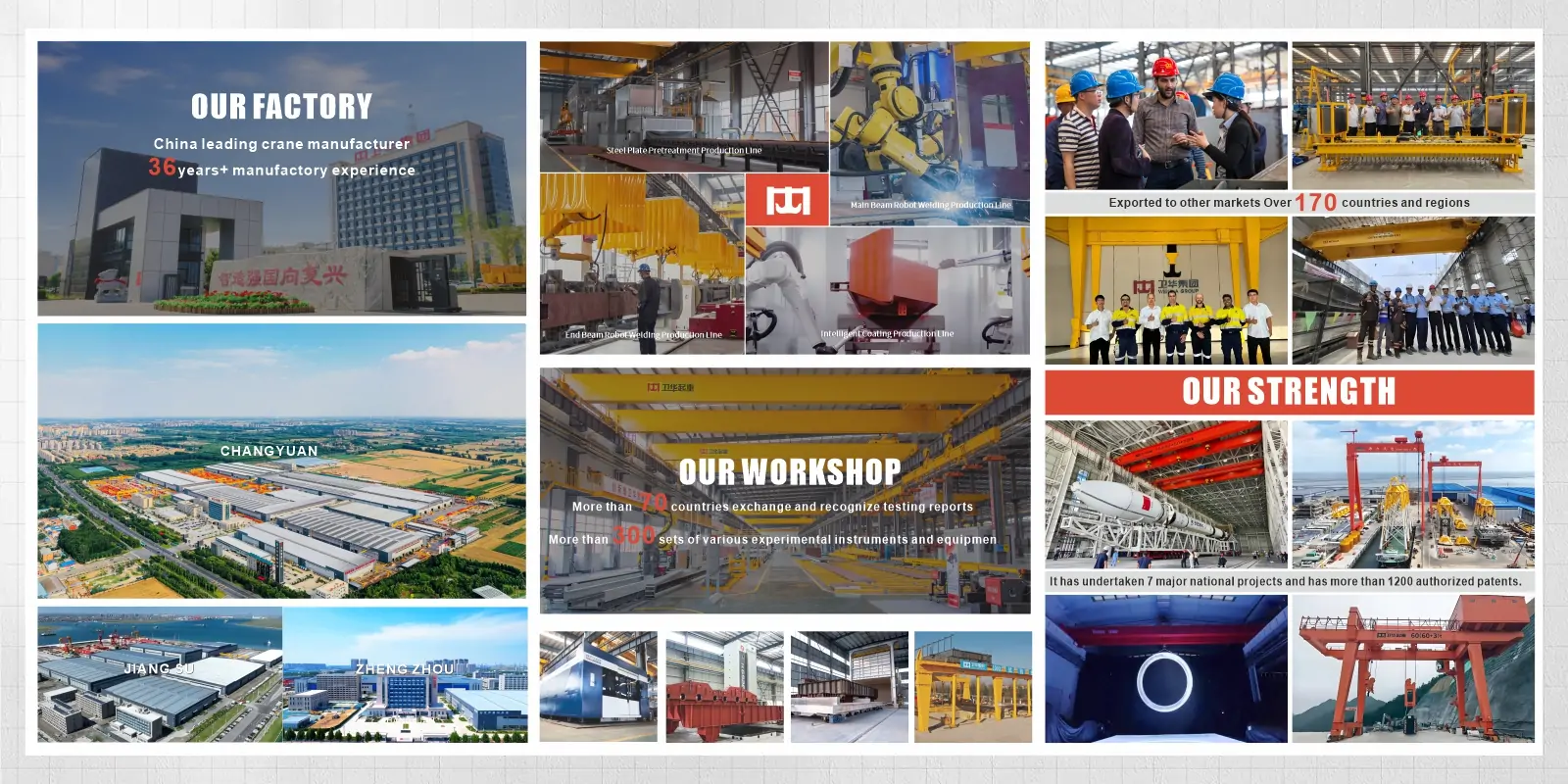
Weihua, founded in 1988, has evolved into a global leader in China's intelligent manufacturing field. We specialize in smart crane R&D and production while offering AGV solutions. Our professional engineering, delivery, and after-sales teams provide one-stop technical support, customized solutions, on-site installation guidance, and rapid-response global services to ensure every project operates safely and efficiently.
Contact us now via email: [email protected], or fill in the form below.


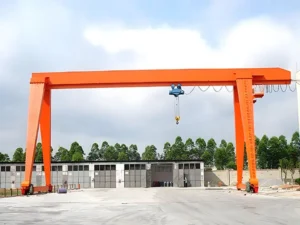
The gantry crane is a lifting equipment widely used across various industries, construction sites, ports, warehouses, and other fields. Its unique structure and powerful load-bearing capacity make it ideal for modern heavy-duty material handling. The “gantry” structure design allows the crane to move freely within a space, covering a large working area. So, what makes gantry cranes special? What are their types, parameters, control methods, applications, and working principles? How do they differ from bridge cranes? Let’s explore together. Types of Gantry Cranes Based on design, application, and operating environment, gantry cranes are typically categorized into the following types: Single-Girder Gantry Crane Single-girder gantry cranes are widely used across industrial sectors, warehouses, ports, and workshops. Featuring a single-girder support lifting mechanism, they traverse via side columns and bottom rails. With their simple structure, user-friendly operation, and moderate lifting capacity, they are ideal for handling light to medium loads. Capable of spanning large distances freely, single-girder gantry cranes are suitable for heavy material handling and lifting operations. Double Girder Gantry Crane Compared to single-girder gantry cranes, double-girder gantry cranes offer greater…
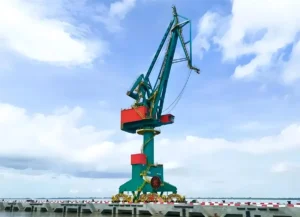
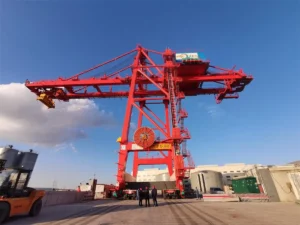
In ports, logistics parks, and industrial material handling, Portal Cranes and Gantry Cranes are two common and core loading/unloading equipment types. They differ in structural design, performance characteristics, operating methods, application scenarios, and investment costs. This article provides a comprehensive analysis of Portal Crane vs Gantry Crane and guides you in making the right selection. Structural Design Comparison The structural differences between Portal Cranes and Gantry Cranes primarily manifest in load-bearing methods, movement trajectories, and coverage ranges. The former centers on a fixed tower and rotating boom, emphasizing “point coverage” and flexible horizontal rotation. The latter features a portal frame structure and longitudinal rail travel, prioritizing “extensive horizontal movement” and efficient on-site logistics handling. Consequently, their distinct structural designs directly dictate their differing application scenarios. Portal Crane Structural Characteristics Portal slewing cranes employ single/double cantilever boom structures with the tower fixed to foundations or rails, enabling 360° or partial rotation. This configuration enables flexible operation in narrow, elongated spaces such as shorelines, dock fronts, and ship berths, making it particularly suitable for ship-to-shore material handling. Its core functionality combines vertical…
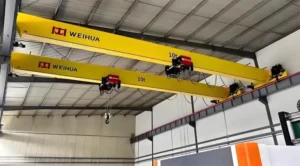
In modern industrial operations, efficient material handling is crucial for maximizing productivity and optimizing workflow. Bridge cranes, also known as overhead cranes or EOT cranes, are fixed material handling systems widely used in manufacturing, metal processing, warehousing, and loading/unloading operations. In this article, we will explore the working principle, main components, applications, and operational benefits of bridge cranes, providing a comprehensive guide for industrial planners and logistics professionals. Bridge Crane Working Principle A bridge crane operates on a bridge-like structure spanning the workspace, with a trolley and hoist system that moves horizontally along the bridge and vertically lifts or lowers loads. The crane’s movement across the runway, combined with precise hoist control, enables efficient and safe handling of heavy materials in factories, warehouses, and industrial facilities. For information on how overhead cranes work, please see this article: Overhead Crane Working Principle: Components, Motion & Operating Process Bridge Crane Terminology The following is an introduction to terminology related to bridge crane parts. Crane Capacity: Crane capacity refers to the maximum weight a bridge crane can safely lift. Typically measured in tons…
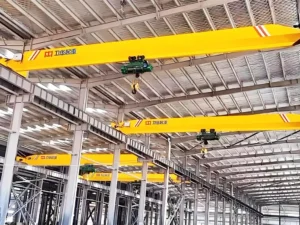
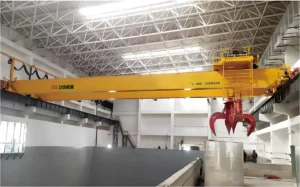
An EOT Crane (Electric Overhead Traveling Crane) is an efficient and reliable overhead lifting system used to handle heavy materials in factories, warehouses, workshops, and industrial plants. Running on overhead rails, EOT cranes enable safe and precise three-dimensional movement of loads through coordinated lifting, cross travel, and long travel motions. This article will guide you through EOT crane definitions, types, structure, working principles, applications, and cost factors to help you select the most suitable solution for your lifting needs. How EOT Crane Works? The working principle of an EOT crane involves a combination of vertical lifting, horizontal trolley movement, and longitudinal bridge travel, enabling efficient handling of heavy loads across industrial facilities. The crane operates on elevated runway rails installed along the building structure, with the bridge girder spanning the workspace. The hoist mechanism raises or lowers the load using steel wire ropes or chains, while the trolley moves the load horizontally along the bridge. The entire crane travels longitudinally along the runway rails, enabling three-dimensional positioning of materials. Modern EOT cranes are powered by electric motors with precise speed…
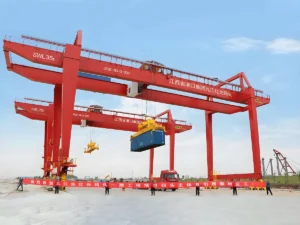
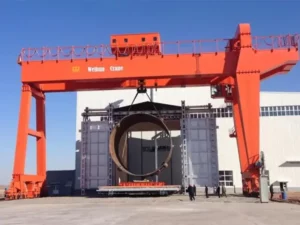
Gantry cranes are widely used in open-air stockyards, shipyards, factories, and construction sites, making them one of the most versatile and extensively applied material handling solutions. Gantry cranes come in various types, each customizable to suit different load capacities, site conditions, and operational requirements. However, selecting the wrong configuration can lead to unnecessary expenses, limited lifting capacity, or future expansion constraints. So, what are the main types of gantry cranes? How do you choose the right type for your application? In this guide, we will provide a detailed overview of different types of gantry cranes based on structure, mobility, and application scenarios, helping you make the right decision before investing in a lifting solution. The article is quite lengthy. Below is our table of contents. Please jump to the corresponding section as needed: What Is a Gantry Crane? Gantry cranes are lifting equipment designed for efficient handling of heavy cargo in large open-air sites. Their signature structure features one or more main beams supported by rigid (or flexible) legs on either side, forming a monumental “gate”-shaped frame. These cranes traverse…
 English English
  Русский
 العربية
 Français
 Português
 Español