- ProductoEquipoPrecisión de Potencia, Personalización Solución de GrúasCorreo electrónicoWhatsApp / Wechat:+8613781917315Dirección:N.º 18, carretera Shanhai, ciudad de Changyuan, provincia de Henan, China


When heavy loads need to move and fixed overhead cranes aren’t an option, a portable gantry crane delivers the lifting capacity, flexibility, and safety professionals depend on. Designed for automotive repair shops, warehouses, construction sites, and fabrication facilities, our adjustable gantry cranes combine industrial-grade strength with genuine portability.
Each crane features stepless height and span adjustment, heavy-duty locking caster wheels for smooth repositioning, and structural A36 steel construction rated to a 4:1 safety factor. Assembly requires no special tools and takes under 30 minutes — one person, one wrench, ready to work.
Our mobile gantry crane range covers capacities from 0.5 ton to 10 tons, with height adjustments reaching up to 16 feet, making them suitable for everything from a single-bay garage to a full industrial floor. Every model ships CE certified and ASME B30.2 compliant, with a factory load test certificate included.
Whether you’re pulling an engine, repositioning machinery, or handling freight without a forklift, a portable gantry crane gives you a safe, proven solution that moves with your work — not against it.
Not all portable gantry cranes are built the same. Structural design, adjustability, and portability vary significantly across types — and choosing the wrong configuration means a crane that doesn’t fit your space, your workflow, or your load. Browse by structure type below to find the model that works the way you do.
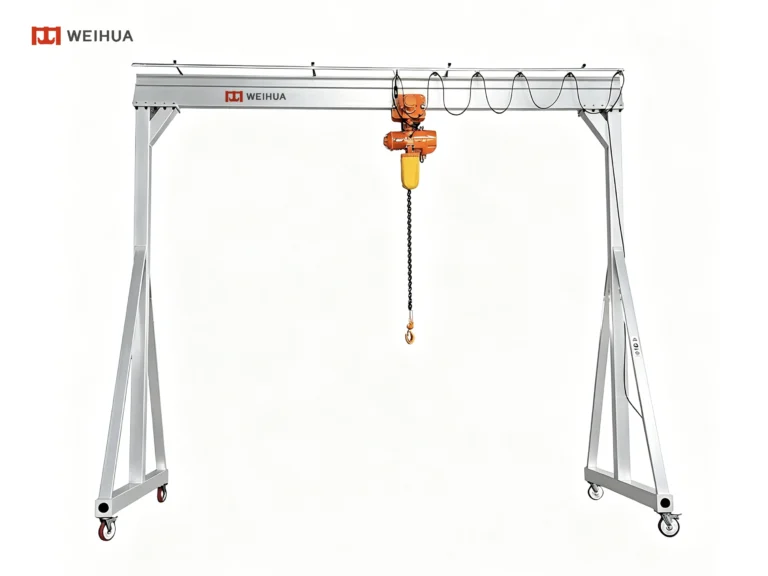
A fixed-height gantry crane offers maximum structural rigidity at a set working height. With no telescoping columns or adjustment hardware, the frame is lighter, simpler, and exceptionally stable under continuous or high-cycle lifting operations. Ideal for dedicated workstations where the lifting height never changes.
Best for: Production lines, dedicated assembly stations, permanent shop setups
Capacity range: 0.5T – 10T
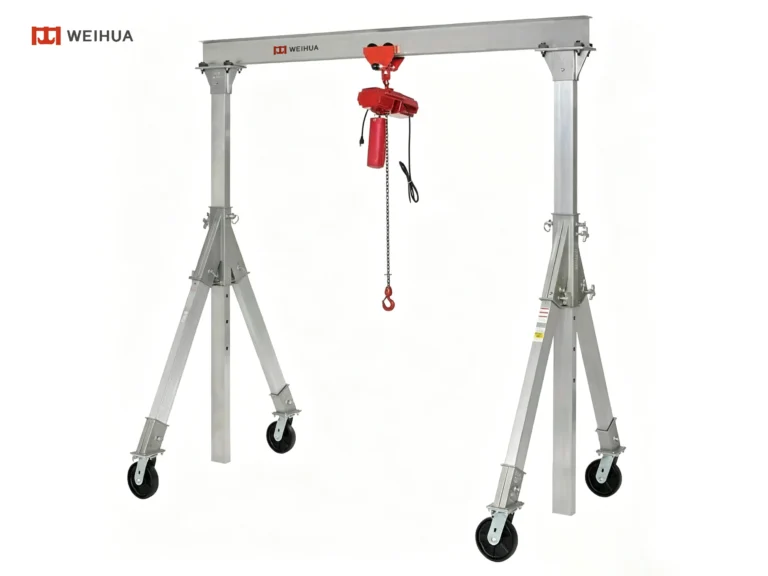
The most versatile option in the range. Telescoping leg columns allow continuous height adjustment, and slotted base rails let you widen or narrow the leg span to fit different workspaces or load sizes. One crane adapts to multiple jobs across a single facility — or moves between job sites entirely.
Best for: Multi-purpose shops, automotive repair, warehouses, rental fleets
Capacity range: 0.5T – 10T
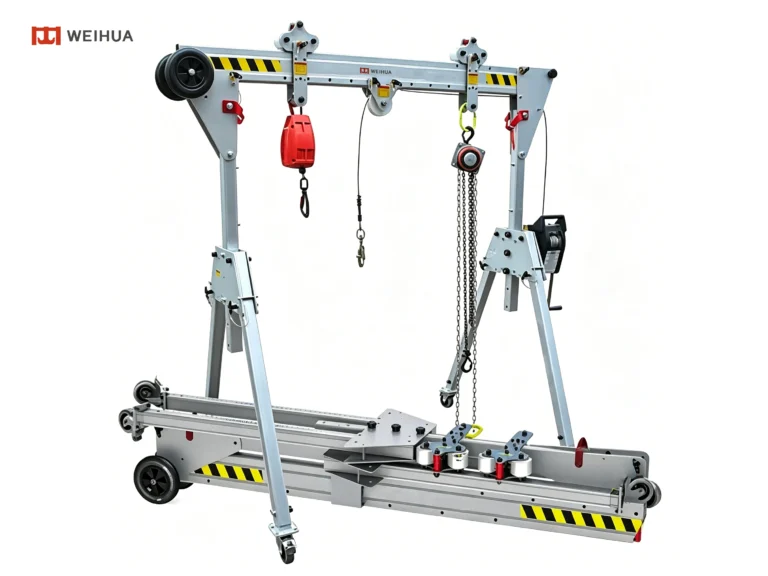
A folding gantry crane breaks down to a compact flat profile without disassembling individual components. Hinged leg joints and a collapsible beam allow the entire crane to fold in minutes and stand upright against a wall or slide into a vehicle. No loose bolts, no lost hardware between uses.
Best for: Mobile service technicians, contractors, space-constrained garages, shared-tool environments
Capacity range: 0.5T – 3T
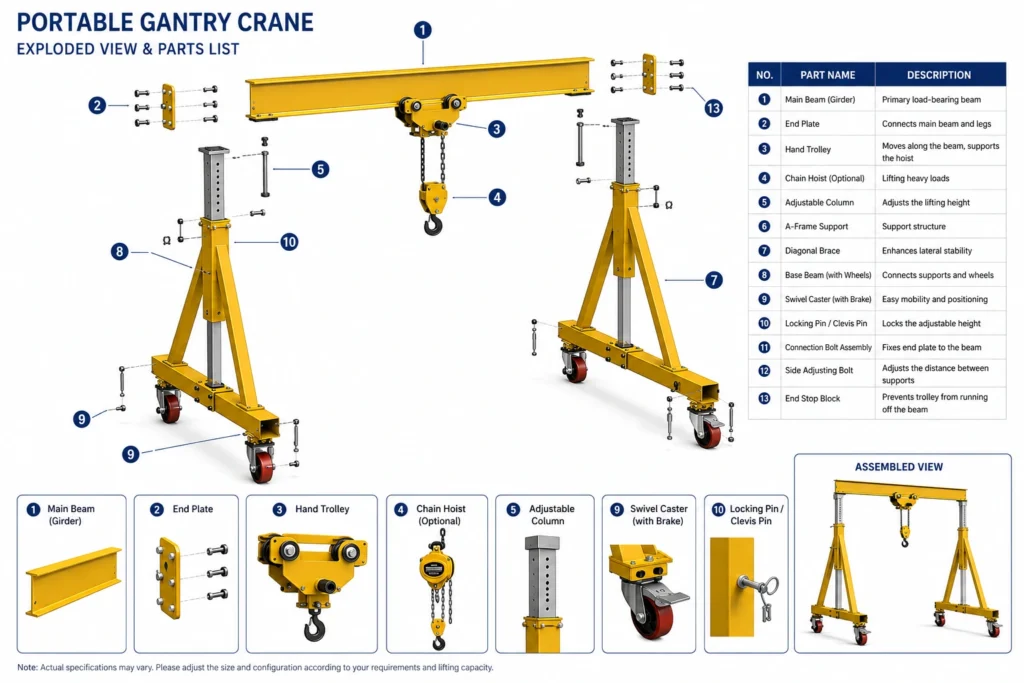
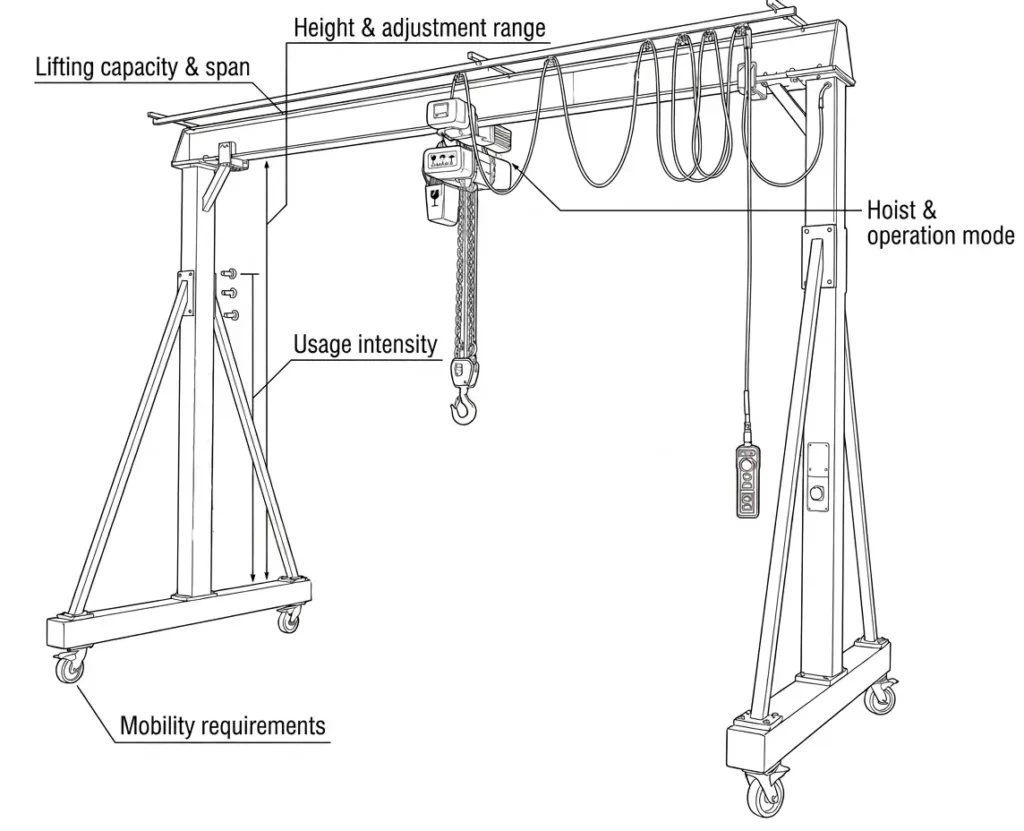
The main beam runs the full working width of the crane and carries 100% of the lifted load. Built from structural A36 steel — I-beam profile on 0.5T–3T models, wide-flange H-beam on 5T–10T models — it is engineered to minimize deflection at maximum rated capacity. The precision-machined bottom flange provides a flat, consistent running surface for any compatible trolley or hoist, ensuring smooth lateral load positioning across the full beam length.
Two A-frame leg assemblies support the main beam at each end. Each leg uses a telescoping inner-and-outer column design, allowing continuous height adjustment from 6 ft (PGC-0.5T) up to 18 ft (PGC-10T). Column wall thickness scales with capacity — 4 mm on light models, 6 mm on 5T and 10T — keeping the structure rigid under full load. The wide A-frame stance distributes weight evenly to the casters and resists lateral tipping during dynamic lifts.
A single integrated system controls both working height and leg-to-leg span. Height is set via hardened steel locking pins and Grade-8 bolts at clearly marked 6-inch increments on each leg column. Span is adjusted along slotted base rails before rigging. Together, these two adjustments let the crane fit a low-ceiling garage bay or a wide industrial bay without any cutting, welding, or permanent modification.
Four swivel casters provide full floor mobility between lifts. Wheel size and load rating scale with crane capacity: 6-inch polyurethane on 0.5T–2T models, 8-inch rubber on 3T–5T, and 10-inch industrial cast iron on the 10T. Every set includes two dual-action locking brakes that independently stop both wheel rotation and swivel movement — lock all four before any lift to convert the mobile frame into a fixed, stable platform.
Diagonal cross braces connect the inner and outer leg tubes on each A-frame, triangulating the structure and eliminating racking under off-center or dynamic loads. On 3T and above, a horizontal tie rod spans the upper leg pair for additional rigidity. The 10T model adds a second lower cross brace per leg pair, providing full-height triangulation rated for the highest shear forces in the range. All connections use clevis-pin hardware for tool-free assembly and disassembly.
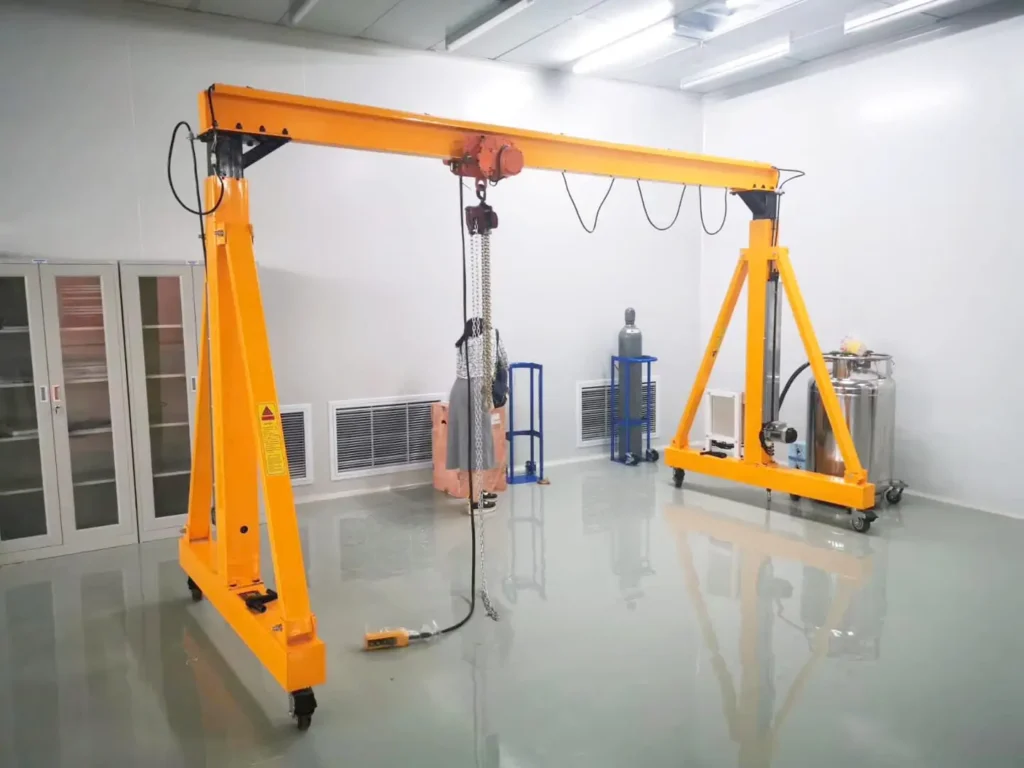
A portable gantry crane operates on a straightforward mechanical principle: two vertical leg assemblies support a horizontal beam overhead, and a hoist mounted to that beam generates the lifting force. When the hoist is activated — by hand chain or electric motor — it winds a load chain or wire rope around a drum, converting rotational force into vertical lift. The load travels straight up, suspended from a hook beneath the hoist.
What makes a portable gantry crane distinct is the mobility built into every part of the system. The beam sits at an adjustable height above the floor, the legs stand on locking caster wheels, and the hoist or trolley slides laterally along the beam. This gives you three axes of load control: raise and lower with the hoist, move side to side along the beam with the trolley, and reposition the entire crane across the floor by rolling it on its casters. Together, these three movements allow a single operator to pick up a load, position it precisely, and set it down exactly where it needs to go — without a second person, without a forklift, and without a fixed crane installation.
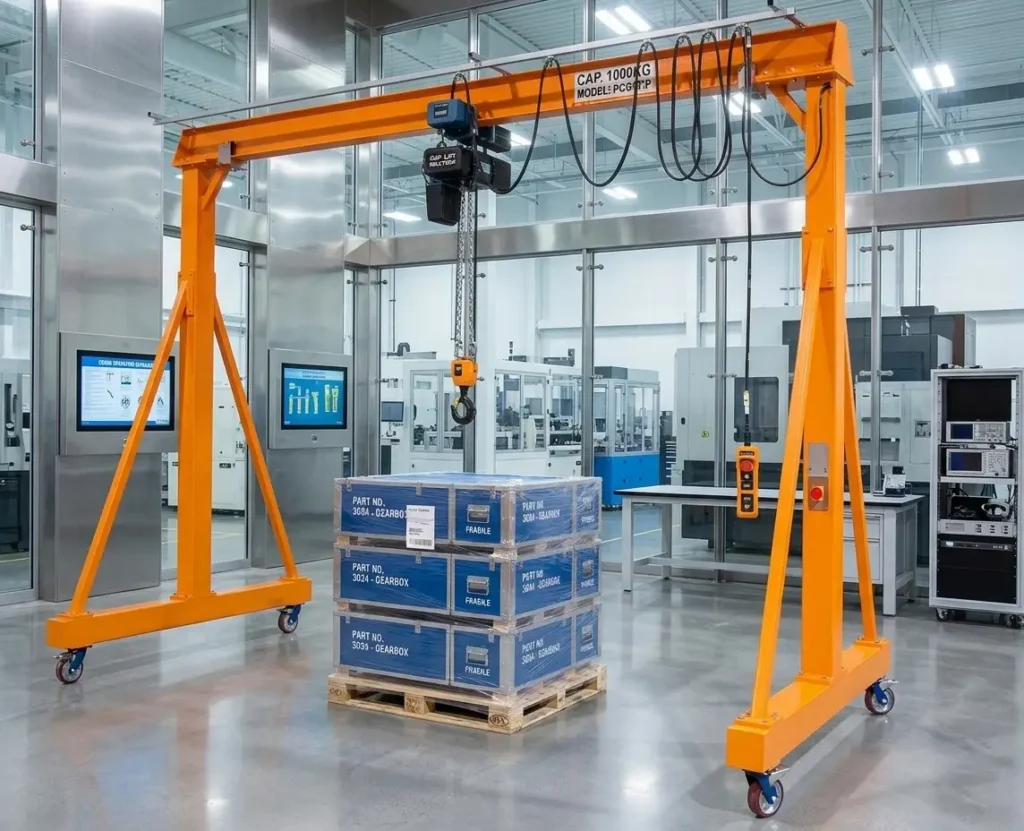
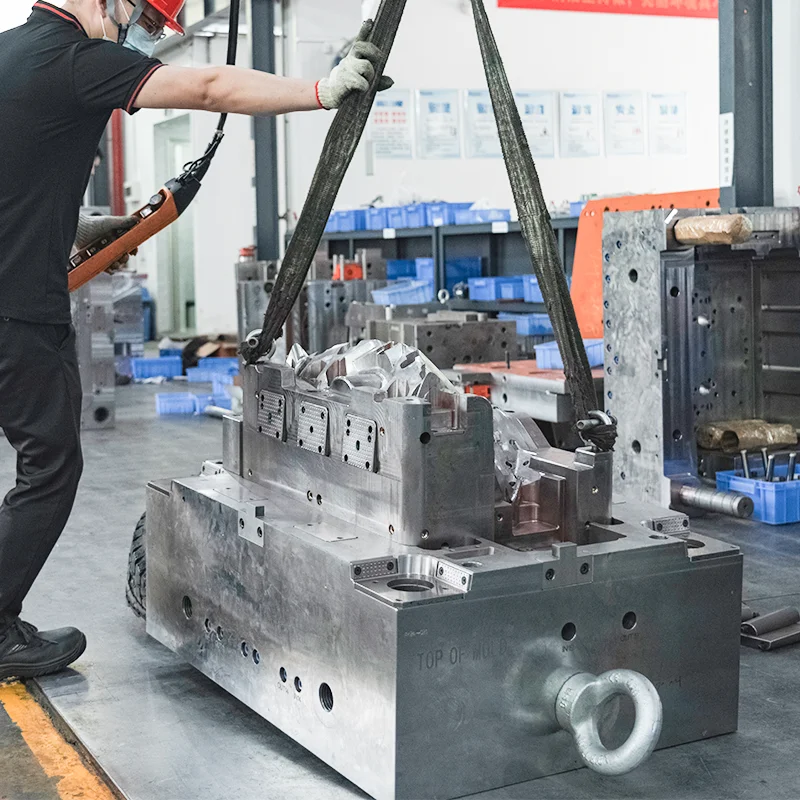
A medium-to-large mold manufacturing company specializing in injection molds and precision metal molds faced a common challenge: as individual mold weights grew to between 200 kg and 1 ton, their existing forklift and manual handling methods could no longer meet the precision, safety, or efficiency demands of modern assembly work.
The solution was a customized mobile portable gantry crane — 0.5T to 1T capacity, 3.5-meter span, with a 1–3 meter lifting height range. Fitted with PU caster wheels for rail-free floor mobility and driven by an electric chain hoist with variable frequency speed control, the crane moved freely between workstations, eliminated manual lifting risks, and delivered the positioning accuracy precision mold assembly requires.
The result: measurably improved production efficiency, a safer working environment, and a lifting system flexible enough to adapt to different mold sizes and changing workshop layouts — all without permanent installation or structural modification to the facility.
Model Naming: PGC stands for Portable Gantry Crane. Each model is designated by its rated lifting capacity — for example, PGC-2T denotes a Portable Gantry Crane with a 2-ton rated capacity.
| Parámetro | PGC-0.5T | PGC-1T | PGC-2T | PGC-3T | PGC-5T | PGC-10T |
|---|---|---|---|---|---|---|
| Capacidad de elevación | 0.5 t (1,100 lbs) | 1 t (2,200 lbs) | 2 t (4,400 lbs) | 3 t (6,600 lbs) | 5 t (11,000 lbs) | 10 t (22,000 lbs) |
| Min. Height | 6 ft (1.8 m) | 7 ft (2.1 m) | 8 ft (2.4 m) | 8 ft (2.4 m) | 10 ft (3.0 m) | 12 ft (3.6 m) |
| Max. Height | 10 ft (3.0 m) | 12 ft (3.7 m) | 14 ft (4.3 m) | 15 ft (4.6 m) | 16 ft (4.9 m) | 18 ft (5.5 m) |
| Min. Span | 6 ft (1.8 m) | 8 ft (2.4 m) | 9 ft (2.7 m) | 10 ft (3.0 m) | 12 ft (3.7 m) | 14 ft (4.3 m) |
| Max. Span | 10 ft (3.0 m) | 12 ft (3.7 m) | 13 ft (4.0 m) | 14 ft (4.3 m) | 16 ft (4.9 m) | 18 ft (5.5 m) |
| Beam Length | 10 ft (3.0 m) | 12 ft (3.7 m) | 13 ft (4.0 m) | 14 ft (4.3 m) | 16 ft (4.9 m) | 18 ft (5.5 m) |
| Net Weight | 132 lbs (60 kg) | 198 lbs (90 kg) | 286 lbs (130 kg) | 374 lbs (170 kg) | 528 lbs (240 kg) | 880 lbs (400 kg) |
| Caster Size | 6 in | 6 in | 6 in | 8 in | 8 in | 10 in |
| Safety Factor | 4:1 | 4:1 | 4:1 | 4:1 | 4:1 | 4:1 |
| Certification | CE / ASME B30.2 | CE / ASME B30.2 | CE / ASME B30.2 | CE / ASME B30.2 | CE / ASME B30.2 | CE / ASME B30.2 |
All height and span values indicate the adjustment range. Dimensions shown are for standard configurations; custom sizes are available on request.
Las grúas pórtico deben inspeccionarse periódicamente durante su funcionamiento para garantizar un uso seguro. Para obtener una lista de verificación de inspección detallada, consulte el artículo: “Lista de verificación para la inspección de grúas pórtico: Guía de inspección diaria, mensual y anual.”
Getting the right portable gantry crane starts with the right questions. Share your application details and our engineering team will recommend the ideal configuration or prepare a custom quote within 24 hours.
WEIHUA is a leading global portable gantry crane manufacturer and supplier, with excellent engineering technology driving efficient lifting operations across diverse industries worldwide. We can tailor an exclusive custom portable gantry crane solution for you, covering selection consultation, installation, commissioning, and lifelong maintenance. If you are looking for the most reliable portable gantry crane for sale, please contacta a nuestro equipo de expertos inmediatamente para obtener una cotización personalizada y un plan técnico.
Weihua, fundada en 1988, se ha convertido en un líder mundial en el campo de la fabricación inteligente de China. Nos especializamos en la I+D y producción de grúas inteligentes, ofreciendo al mismo tiempo soluciones AGV. Nuestros equipos profesionales de ingeniería, entrega y posventa brindan soporte técnico integral, soluciones personalizadas, orientación de instalación in situ y servicios globales de respuesta rápida para garantizar que cada proyecto funcione de manera segura y eficiente.
Yes. We offer custom fabrication from a minimum order of 1 unit. Customizable parameters include lifting capacity, height and span dimensions, leg configuration, caster type, hoist integration, surface treatment, and certification requirements. Submit your specifications and our engineering team will respond within 24 hours.
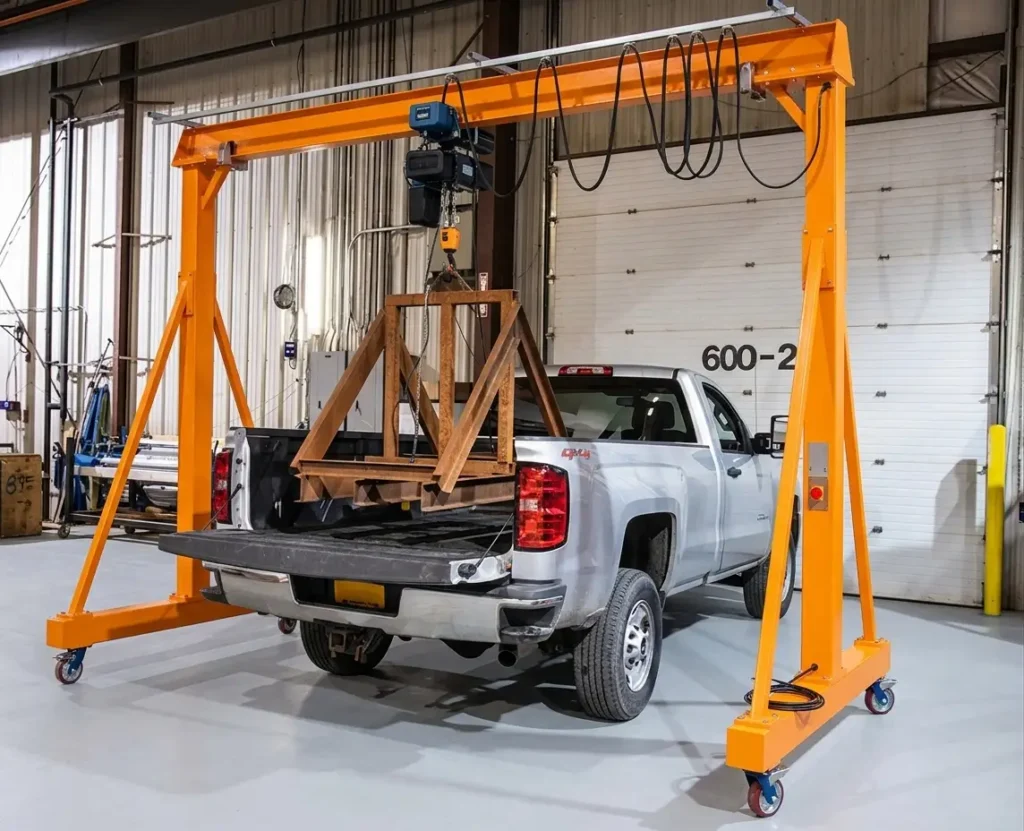
A portable gantry crane is used to lift, move, and position heavy loads in environments where a fixed overhead crane is not practical. Common applications include automotive engine removal, warehouse material handling, mold assembly, machinery installation, and construction site lifting.
A fixed-height gantry crane is set to one working height and offers maximum rigidity for dedicated workstations. An adjustable gantry crane features telescoping legs that allow continuous height adjustment and a variable span, making it suitable for multiple applications across different spaces.
Yes. All models are rated for outdoor use on firm, level surfaces. Outdoor operation requires regular inspection of fasteners and casters for corrosion. Hot-dip galvanized surface treatment is recommended for permanent or frequent outdoor use.
Our cranes are compatible with manual chain hoists, electric chain hoists, lever hoists, and push or geared trolleys rated to the crane’s capacity. Hoists can be purchased separately or as part of a bundled package.
Contáctenos ahora por correo electrónico: [email protected], o rellene el formulario a continuación.
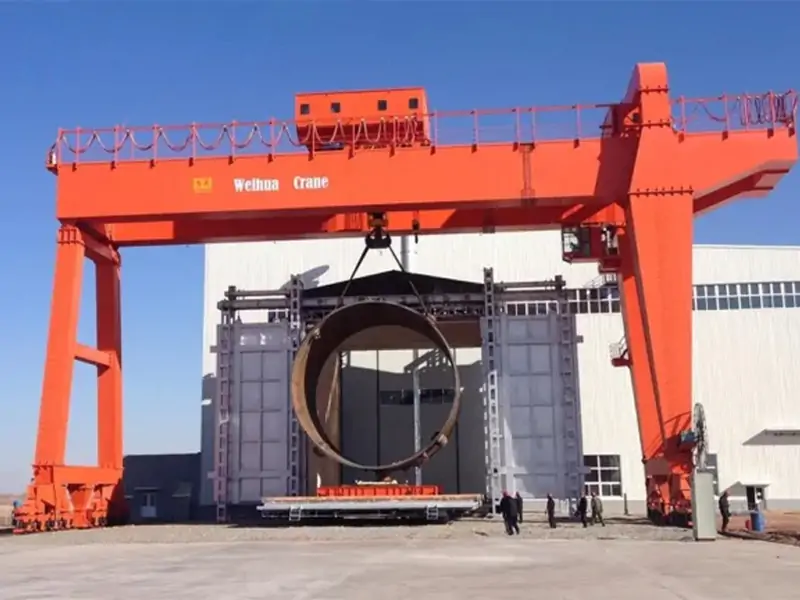


La grúa pórtico es un equipo de elevación ampliamente utilizado en diversas industrias, sitios de construcción, puertos, almacenes y otros campos. Su estructura única y su potente capacidad de carga la hacen ideal para el manejo de materiales modernos de alta resistencia. El diseño de la estructura de “pórtico” permite que la grúa se mueva libremente dentro de un espacio, cubriendo una gran área de trabajo. Entonces, ¿qué hace especiales a las grúas pórtico? ¿Cuáles son sus tipos, parámetros, métodos de control, aplicaciones y principios de funcionamiento? ¿En qué se diferencian de las grúas puente? Vamos a explorarlo juntos. Tipos de grúas pórtico Según el diseño, la aplicación y el entorno operativo, las grúas pórtico se clasifican típicamente en los siguientes tipos: Grúa pórtico de viga única Las grúas pórtico de viga única se utilizan ampliamente en sectores industriales, almacenes, puertos y talleres. Con un mecanismo de elevación de soporte de viga única, se desplazan a través de columnas laterales y rieles inferiores. Con su estructura simple, operación amigable y capacidad de elevación moderada, son ideales para el manejo de cargas ligeras a medianas. Capaces de abarcar grandes distancias libremente, las grúas pórtico de viga única son adecuadas para operaciones de elevación y manejo de materiales pesados. Grúa pórtico de doble viga En comparación con las grúas pórtico de viga única, las grúas pórtico de doble viga ofrecen mayor...
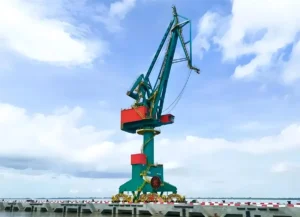
En puertos, parques logísticos y manipulación de materiales industriales, las grúas pórtico y las grúas de portal son dos tipos de equipos de carga/descarga comunes y fundamentales. Difieren en diseño estructural, características de rendimiento, métodos de operación, escenarios de aplicación y costos de inversión. Este artículo proporciona un análisis integral de las grúas pórtico frente a las grúas de portal y lo guía en la selección correcta. Comparación del diseño estructural Las diferencias estructurales entre las grúas pórtico y las grúas de portal se manifiestan principalmente en los métodos de soporte de carga, las trayectorias de movimiento y los rangos de cobertura. La primera se centra en una torre fija y una pluma giratoria, enfatizando la “cobertura puntual” y la rotación horizontal flexible. La segunda presenta una estructura de marco de portal y desplazamiento longitudinal sobre rieles, priorizando el “amplio movimiento horizontal” y la manipulación eficiente de la logística en el sitio. En consecuencia, sus distintos diseños estructurales dictan directamente sus diferentes escenarios de aplicación. Características estructurales de la grúa pórtico Las grúas de portal giratorias emplean estructuras de pluma en voladizo simple/doble con la torre fijada a cimientos o rieles, lo que permite una rotación de 360° o parcial. Esta configuración permite una operación flexible en espacios estrechos y alargados, como líneas de costa, frentes de muelle y atraques de barcos, lo que la hace particularmente adecuada para la manipulación de materiales de barco a tierra. Su funcionalidad principal combina verticalmente...
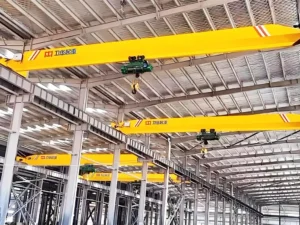
En las operaciones industriales modernas, el manejo eficiente de materiales es crucial para maximizar la productividad y optimizar el flujo de trabajo. Las grúas puente, también conocidas como grúas viajeras o grúas EOT, son sistemas fijos de manejo de materiales ampliamente utilizados en manufactura, procesamiento de metales, almacenamiento y operaciones de carga/descarga. En este artículo, exploraremos el principio de funcionamiento, los componentes principales, las aplicaciones y los beneficios operativos de las grúas puente, proporcionando una guía completa para planificadores industriales y profesionales de la logística. Principio de Funcionamiento de las Grúas Puente Una grúa puente opera sobre una estructura similar a un puente que abarca el área de trabajo, con un carro y un polipasto que se mueven horizontalmente a lo largo del puente y elevan o descienden cargas verticalmente. El movimiento de la grúa a lo largo de la vía, combinado con un control preciso del polipasto, permite el manejo eficiente y seguro de materiales pesados en fábricas, almacenes e instalaciones industriales. Para obtener información sobre cómo funcionan las grúas viajeras, consulte este artículo: Principio de Funcionamiento de las Grúas Viajeras: Componentes, Movimiento y Proceso de Operación Terminología de las Grúas Puente A continuación, se presenta una introducción a la terminología relacionada con las partes de las grúas puente. Capacidad de la Grúa: La capacidad de la grúa se refiere al peso máximo que una grúa puente puede levantar de forma segura. Típicamente medido en toneladas…
Una grúa EOT (Grúa Eléctrica de Puente) es un sistema de elevación aéreo eficiente y fiable que se utiliza para manipular materiales pesados en fábricas, almacenes, talleres y plantas industriales. Funcionando sobre rieles elevados, las grúas EOT permiten el movimiento tridimensional seguro y preciso de cargas mediante movimientos coordinados de elevación, traslación transversal y traslación longitudinal. Este artículo le guiará a través de las definiciones de las grúas EOT, sus tipos, estructura, principios de funcionamiento, aplicaciones y factores de costo para ayudarle a seleccionar la solución más adecuada para sus necesidades de elevación. ¿Cómo funciona una grúa EOT? El principio de funcionamiento de una grúa EOT implica una combinación de elevación vertical, movimiento horizontal del carro y desplazamiento longitudinal del puente, lo que permite la manipulación eficiente de cargas pesadas en las instalaciones industriales. La grúa opera sobre rieles de pista elevados instalados a lo largo de la estructura del edificio, con la viga del puente abarcando el área de trabajo. El mecanismo de elevación sube o baja la carga utilizando cables de acero o cadenas, mientras que el carro mueve la carga horizontalmente a lo largo del puente. Toda la grúa se desplaza longitudinalmente a lo largo de los rieles de la pista, permitiendo la posición tridimensional de los materiales. Las grúas EOT modernas están impulsadas por motores eléctricos con velocidad precisa...
Las grúas pórtico se utilizan ampliamente en patios de almacenamiento al aire libre, astilleros, fábricas y sitios de construcción, lo que las convierte en una de las soluciones de manipulación de materiales más versátiles y aplicadas. Las grúas pórtico vienen en varios tipos, cada una personalizable para adaptarse a diferentes capacidades de carga, condiciones del sitio y requisitos operativos. Sin embargo, la elección de la configuración incorrecta puede generar gastos innecesarios, capacidad de elevación limitada o restricciones de expansión futuras. Entonces, ¿cuáles son los principales tipos de grúas pórtico? ¿Cómo elige el tipo correcto para su aplicación? En esta guía, proporcionaremos una descripción general detallada de los diferentes tipos de grúas pórtico según la estructura, la movilidad y los escenarios de aplicación, lo que le ayudará a tomar la decisión correcta antes de invertir en una solución de elevación. El artículo es bastante extenso. A continuación se presenta nuestra tabla de contenidos. Por favor, salte a la sección correspondiente según sea necesario: ¿Qué es una grúa pórtico? Las grúas pórtico son equipos de elevación diseñados para la manipulación eficiente de carga pesada en grandes sitios al aire libre. Su estructura distintiva presenta una o más vigas principales soportadas por patas rígidas (o flexibles) a cada lado, formando un marco monumental en forma de “puerta”. Estas grúas se desplazan...
 English English
  Русский
 العربية
 Français
 Português
 Español