








Tabla de contenidos
Introducción
In modern container terminals, an RTG crane spreader plays a key role in connecting the crane and container during lifting operations. As the main load-handling attachment below the RTG crane trolley, the spreader directly affects container lifting safety, handling efficiency, and long-term maintenance costs. Selecting a suitable spreader is not only about lifting capacity but also about matching container sizes, working conditions, and terminal operation needs.
In this guide, I will explain the main factors to consider when choosing an RTG crane spreader, including spreader types, container compatibility, load capacity, drive systems, control methods, and customization options. With practical experience in crane applications, we aim to help operators and buyers understand how to select a reliable RTG crane spreader that fits their specific container handling requirements.
What Is an RTG Crane Spreader?
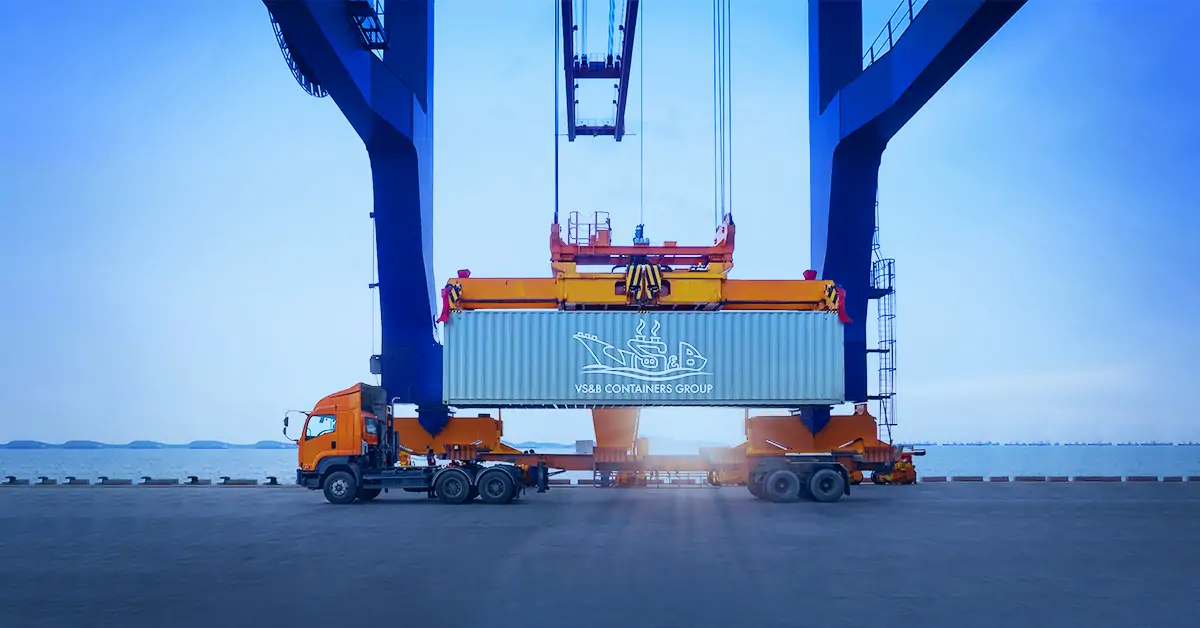
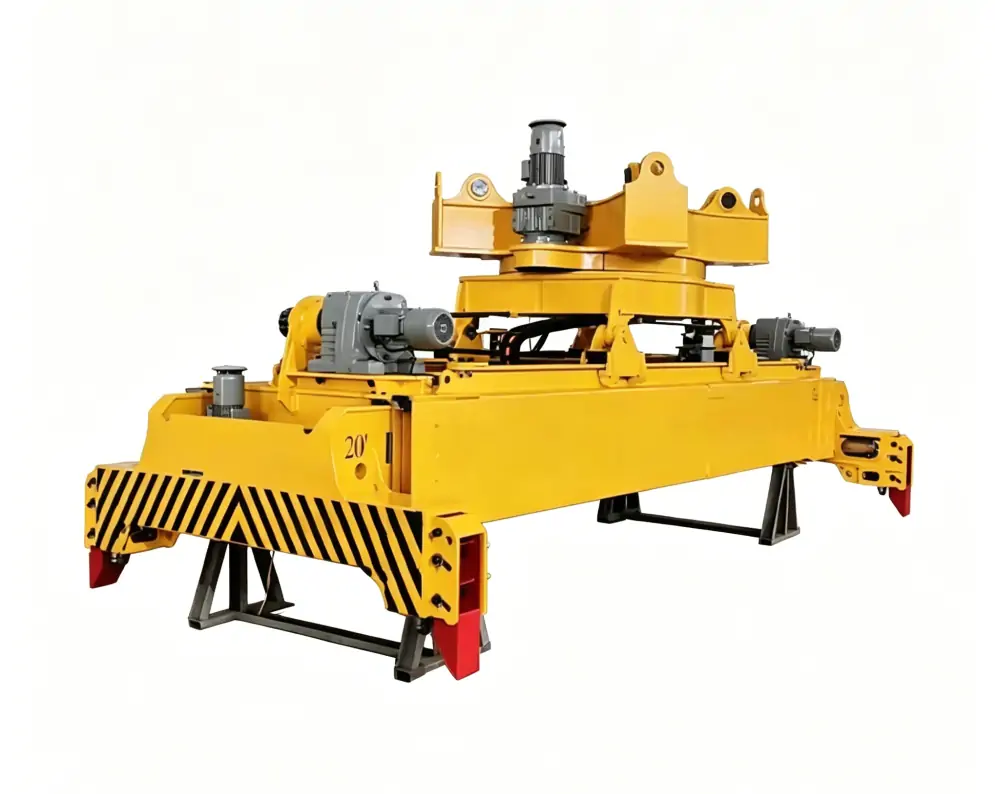
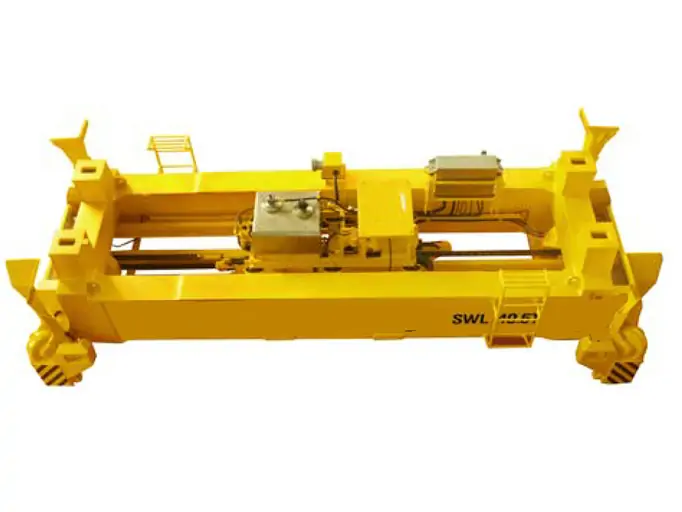
Un RTG crane spreader, also called a container spreader or twistlock spreader, is a lifting attachment mounted below an RTG crane trolley. It connects the crane and container through twistlock mechanisms that engage with the container corner castings for container lifting and positioning.
An RTG crane spreader uses a telescopic frame for 20ft, 40ft, and 45ft container handling. The frame length changes through hydraulic or electric drive systems. The twistlocks rotate 90 degrees and lock into the container corner castings to hold the container during lifting and movement.
RTG crane spreaders are used in container yards for frequent loading, unloading, and stacking operations. The main components include the telescopic frame, twistlock assemblies, drive system, sensors, and control unit. Regular checks of twistlocks, hydraulic parts, and electrical connections are required for stable operation.
What Types of RTG Crane Spreaders?
RTG crane spreaders are designed in different structures according to container handling requirements, operation methods, and terminal conditions. The main types include fixed spreaders, telescopic spreaders, automatic spreaders, and rotating spreaders.
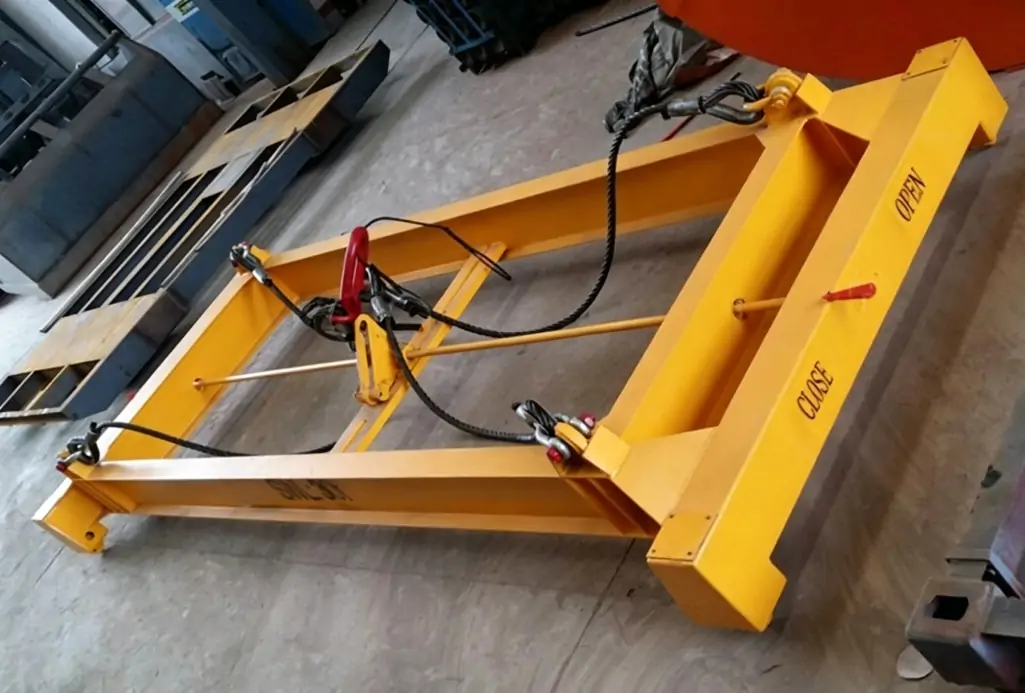
Fixed RTG Crane Spreader
A fixed spreader is designed for handling containers of one specific size, such as 20ft or 40ft containers. It has a simple structure with fewer moving parts, which makes maintenance easier and operation more stable.
Application Range:
- Terminals handling single-size containers
- Dedicated container yards
- Low-frequency container handling operations
- Applications requiring simple and reliable lifting equipment
Telescopic RTG Crane Spreader
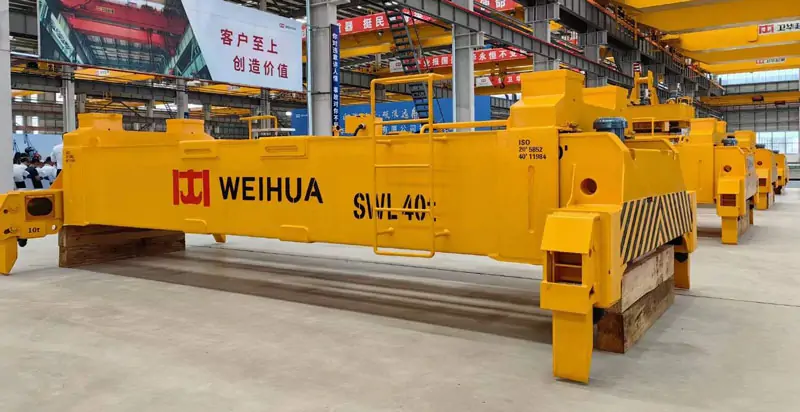
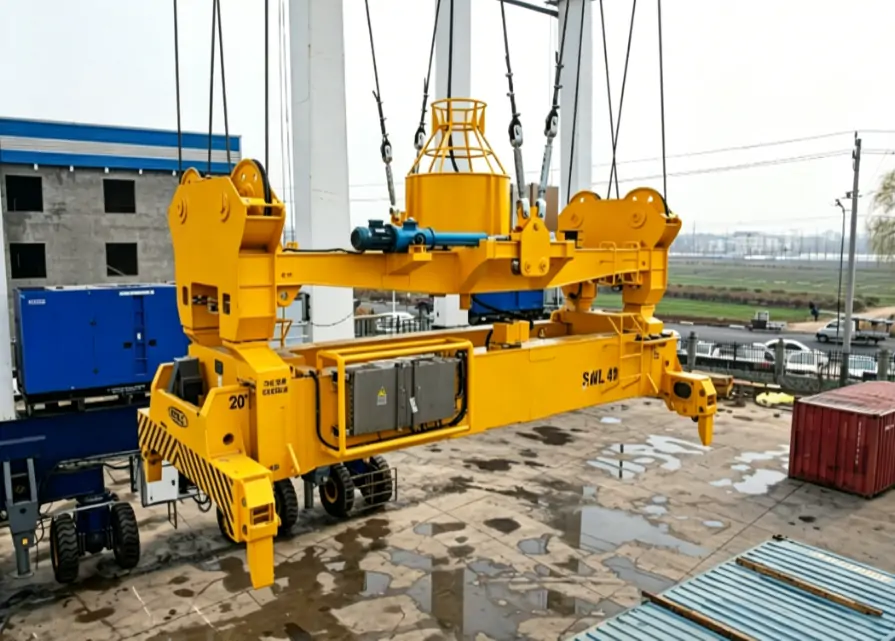
A telescopic spreader uses an adjustable frame to handle different container lengths, including 20ft, 40ft, and 45ft containers. The frame extends or retracts through hydraulic or electric drive systems to match different container sizes.
Application Range:
- Container terminals handling multiple container sizes
- Port yards with high container turnover
- Intermodal transportation yards
- General RTG crane container handling operations
Automatic RTG Crane Spreader
An automatic spreader is equipped with sensors, control systems, and automatic twistlock functions. It reduces manual operation during container lifting and works with automated or remote-controlled RTG crane systems.
Application Range:
- Terminales de contenedores automatizadas
- Remote-controlled RTG crane operations
- Large container yards requiring higher handling efficiency
- Terminals with strict positioning and operation requirements
Rotating RTG Crane Spreader
A rotating spreader allows the container to rotate during lifting. It is used when container angle adjustment is required during loading, unloading, or stacking operations.
Application Range:
- Container yards with limited operating space
- Special container handling processes
- Operations requiring container orientation adjustment
- Terminals handling complex stacking conditions

Choosing the right RTG crane spreader depends on container sizes, handling frequency, automation requirements, and terminal operating conditions. Fixed spreaders suit dedicated operations, telescopic spreaders fit multi-size container handling, automatic spreaders support smart terminals, and rotating spreaders serve applications requiring container angle adjustment.
Factors When Choosing an RTG Crane Spreader
Choosing an RTG crane spreader requires consideration of lifting conditions, crane compatibility, operation requirements, and maintenance costs. The following factors are important during the selection process.
Rated Load Capacity and Safety Factor
The spreader SWL (Safe Working Load) must match the lifting capacity of the RTG crane. Common RTG spreaders are designed for 30.5t to 40.5t container handling, covering standard 20ft, 40ft, and 45ft containers.
The load capacity should include a safety margin for dynamic loads caused by uneven loading, wind, and container movement. For twin-container operations, check whether the spreader supports dual 20ft container locking.
Telescopic Mechanism and Container Compatibility
The telescopic system determines the container size range and operation efficiency. Hydraulic telescopic systems provide strong locking force and fast adjustment, which fit frequent container size changes. Electric telescopic systems have a simpler structure and lower maintenance requirements.
The spreader should cover the required container sizes, including 20ft, 40ft, and 45ft containers. A manual emergency release function is recommended for situations such as hydraulic system failure.
Automation Interface and Positioning Accuracy
For RTG cranes with automation upgrades, the spreader should support sensors, positioning devices, and communication interfaces for integration with the control system.
Laser sensors, encoders, or other positioning components help improve container alignment accuracy. Remote control communication protocols such as CANopen or Profinet may be required for connection with terminal management systems.
For semi-automatic operation, anti-sway functions can reduce container movement during lifting and positioning.
Power System and Energy Consumption
The spreader’s power system must match the RTG crane’s power supply, such as 380V/50Hz or 690V/60Hz configurations.
Energy consumption should be considered during long-term operation. Hydraulic spreaders use a hydraulic power unit for telescopic movement, while electric spreaders can reduce energy consumption through direct drive systems.
For battery-powered or hybrid RTG cranes, check the spreader’s peak power demand to avoid excessive impact on the crane energy system.
Environmental Adaptability and Protection Level
Container terminals often operate in high humidity, salt spray, and outdoor environments. Electrical components should meet suitable protection levels, such as IP65 or above, for reliable operation.
The spreader structure should use corrosion-resistant coatings, such as hot-dip galvanizing or epoxy zinc-rich coating. Extreme temperature areas may require special hydraulic oil, seals, and temperature control systems.
Anti-collision devices should also be considered to reduce damage caused by contact with containers or yard equipment.
Maintenance Convenience and Spare Parts Supply
A modular spreader design makes replacement of key components such as twistlocks, cylinders, and sensors easier.
Before purchase, check the supplier’s spare parts availability and technical support capability. Quick access to maintenance services helps reduce RTG downtime.
The total maintenance cost should be included in the equipment evaluation, not only the initial purchase price.
Compliance and Safety Standards
The spreader should meet relevant safety standards, such as ISO 15442 and FEM 9.511 requirements, with certifications such as CE or BV when required.
The twistlock system should include mechanical safety protection to prevent lifting before complete locking or after incomplete unlocking.
For international projects, confirm compliance with local regulations, including standards such as OSHA or AS/NZS requirements.
Selecting an RTG crane spreader requires a balance between current operating requirements and future expansion plans. Load capacity, container compatibility, automation capability, environmental protection, maintenance support, and safety standards should all be considered during evaluation. A complete assessment based on purchase cost, energy consumption, and maintenance requirements provides a more reliable choice than comparing initial prices alone.
RTG Crane Spreader Specification Checklist
| Categoría | Parámetro | Especificación |
|---|---|---|
| Capacidad de Carga | Carga de trabajo segura (SWL) | 30.5t / 35t / 40.5t / 41t |
| Corner Casting Load | 19.5t × 4 or 10t × 4 | |
| Allowable Load Eccentricity | ±10% | |
| Estructura | Spreader Weight | Approx. 13t–14.5t |
| Compatibilidad con contenedores | ISO 20ft / 40ft / 45ft containers, some models support 53ft | |
| Clase trabajadora | A6–A7 | |
| Telescopic System | Drive Type | Hydraulic motor + gearbox + chain drive, or electric drive |
| Telescopic Time (20ft–45ft) | Approx. 30 seconds | |
| Twistlock Rotation Time | Approx. 1 second for 90° rotation | |
| Flipper Operation Time | 5–7 seconds for 180° movement | |
| Power & Electrical | Fuente de alimentación | AC 380V, 3-phase, 50Hz; control voltage AC 220V |
| Total Power | ≤8kW | |
| Hydraulic Pressure | 100–120 bar | |
| Protection Level | IP55 or above | |
| Temperatura de funcionamiento | -20°C to +45°C / +55°C | |
| Safety & Automation | Sistema antivibración | Electronic anti-sway or mechanical damping, swing angle ≤0.5° |
| Twistlock Interlock | Hoisting disabled before complete locking or unlocking | |
| Positioning Interface | Laser radar/encoder support, container positioning accuracy ±5mm | |
| Communication Protocol | CANopen or Profinet | |
| Safety Monitoring | Load monitoring, fault diagnosis, anti-collision system | |
| Environmental Adaptability | Protección contra la corrosión | Hot-dip galvanizing or epoxy zinc-rich coating for salt spray environments |
| Wind Speed Requirement | ≤20m/s during operation, ≤44m/s during idle condition | |
| Humidity Requirement | Relative humidity up to 95% with condensation | |
| Standards & Certification | Design Standard | ISO 15442 or FEM 9.511 |
| Certification | CE, GS, ISO 9001, CCS, BV or other required certifications | |
| Operation Conditions | Container Stacking Height | 3–5 containers high |
| Velocidad de elevación | 20–50 m/min | |
| RTG Travel Speed | 60–120 m/min |
Notas
- The RTG crane spreader capacity must match the lifting capacity of the RTG crane. Common rated capacities include 35t, 40t, and 45t. A 40t-class spreader typically consumes around 0.8–1.2 kWh per telescopic cycle. Electric drive models can reduce energy consumption compared with hydraulic systems.
- For RTG automation upgrades, the spreader should support positioning interfaces and remote control protocols. Container positioning accuracy should reach around ±5mm. Current RTG spreader systems support manual, semi-automatic, automatic, and remote control operation modes.
- Maintenance requirements should be considered during selection. Modular spreader designs allow faster replacement of twistlocks, hydraulic cylinders, sensors, and other key components. Annual maintenance costs are generally around 3%–5% of the spreader purchase price.
This checklist provides a reference for RTG crane spreader selection. The final configuration should be selected according to container yard workload, automation requirements, working environment, and lifecycle cost.
Common Mistakes When Choosing an RTG Crane Spreader
Selecting an RTG crane spreader requires matching the equipment with the crane, container types, and terminal operation conditions. Some common selection mistakes may increase maintenance costs, reduce handling efficiency, and affect crane operation.
Choosing a Spreader Without Matching RTG Crane Capacity
The spreader load capacity must match the RTG crane lifting system. Selecting a spreader based only on container weight without considering crane capacity, dynamic loads, and safety requirements may cause overload risks and shorten equipment service life.
Ignoring Container Size Requirements
Some terminals handle multiple container sizes, including 20ft, 40ft, and 45ft containers. Choosing a fixed spreader for operations that require different container lengths can limit flexibility and increase equipment replacement costs.
Focusing Only on Initial Purchase Price
A lower purchase price does not always mean lower operating costs. Spreader quality, energy consumption, spare parts availability, and maintenance requirements directly affect the total cost during long-term operation.
Overlooking Automation Compatibility
For terminals planning RTG automation upgrades, the spreader should support required sensors, positioning systems, and communication interfaces. A spreader without automation compatibility may require additional modification in the future.
Neglecting Working Environment Conditions
RTG spreaders operate outdoors in environments with salt spray, humidity, dust, and temperature changes. Selecting equipment without considering corrosion protection, electrical protection level, and climate conditions may lead to frequent failures.
Choosing a Spreader Without Considering Maintenance
Twistlocks, hydraulic cylinders, sensors, and electrical components require regular inspection and replacement. A design without easy access to key parts can increase downtime and maintenance difficulty.
Ignoring Supplier Technical Support
The supplier’s manufacturing experience, customization capability, spare parts supply, and after-sales service are important factors for long-term operation. Lack of technical support may affect troubleshooting and equipment availability.
A suitable RTG crane spreader should match current handling requirements while allowing future upgrades. Load capacity, container compatibility, automation needs, and lifecycle cost should be reviewed before making the final decision.
Customized RTG Crane Spreader Options
RTG crane spreaders can be customized according to container types, crane capacity, automation requirements, and operating conditions.
- Telescopic System: Hydraulic or electric telescopic systems are available. Hydraulic drive provides higher locking force for frequent size changes, while electric drive offers lower energy consumption and simpler maintenance. Telescopic range can cover 20ft–53ft containers.
- Twistlock System: Single twistlock or dual twistlock configurations are available for standard and twin 20ft container handling. High-strength alloy steel twistlocks and corrosion-resistant coatings can be selected for harsh environments.
- Anti-Sway System: Electronic anti-sway or mechanical damping systems can be configured according to RTG speed and stacking height. Electronic systems can control container swing angle within about ±0.5°.
- Automation Interface: The spreader can integrate laser radar, encoder, or vision positioning systems. Communication interfaces such as CANopen, Profinet, and Modbus TCP support automated RTG operation with positioning accuracy up to ±5mm.
- Power System: The power unit can be matched with RTG power supply requirements, including 380V/50Hz, 690V/60Hz, or DC systems. Energy-saving modes can be added to reduce standby consumption.
- Safety Monitoring: Load monitoring, twistlock status detection, fault diagnosis, and remote data transmission functions are available for equipment condition monitoring.
- Corrosion Protection: Coating options include hot-dip galvanizing, epoxy zinc-rich coating, and polyurethane paint for marine environments. Special seals and components can be selected for temperatures from -20°C to +55°C.
- Auxiliary Functions: Optional equipment includes 180° flippers, weighing sensors, anti-collision devices, and LED work lights for special handling requirements.
- Lightweight Design: For older RTGs or cranes with limited lifting capacity, structural optimization can reduce spreader weight while maintaining rated load performance.
- Maintenance Design: Modular structures allow quick replacement of twistlocks, hydraulic cylinders, and sensors. Central lubrication and condition monitoring interfaces can reduce maintenance time.
A customized RTG crane spreader should be designed based on container handling volume, crane specifications, automation plans, and site conditions. A suitable configuration helps maintain reliable operation throughout the equipment service life.
Conclusión
The selection of an RTG crane spreader involves more than choosing the rated load capacity. Container size, RTG crane specifications, working environment, automation requirements, and maintenance conditions all affect the final configuration. The right spreader design helps keep container handling operations stable and reduces unnecessary downtime.
WEIHUA supplies RTG crane spreaders for different container terminal applications, with options for telescopic systems, automation functions, safety devices, and customized structures. Our team can provide a suitable spreader solution based on your RTG model and operation requirements. Contáctanos for technical consultation and project support.
Preguntas frecuentes
What is an RTG crane spreader?
An RTG crane spreader is a container lifting attachment installed under an RTG crane trolley. It connects with container corner castings through twistlocks for lifting and stacking operations.
What types of RTG crane spreaders are available?
Common types include fixed spreaders, telescopic spreaders, rotating spreaders, and automatic spreaders.
Which RTG crane spreader is best for 20ft and 40ft containers?
A telescopic RTG crane spreader is usually the preferred option because it can adjust between different container sizes.
How do I select RTG spreader capacity?
The spreader capacity should match the maximum container weight and the RTG crane’s rated lifting capacity.
What is the difference between fixed and telescopic spreaders?
A fixed spreader handles one container size, while a telescopic spreader can adjust for multiple container lengths.
Can an RTG crane spreader be customized?
Yes. RTG spreaders can be customized according to container sizes, lifting capacity, automation requirements, and working conditions.
How long does an RTG crane spreader last?
Service life depends on operating cycles, maintenance, working environment, and component quality.
How do I maintain an RTG crane spreader?
Regular inspection of twistlocks, electrical systems, sensors, lubrication points, and structural components helps maintain reliable operation.