








A purchasing manager at a mid-sized terminal once came to us with a quote he’d found online — a tidy figure for a “40-ton straddle carrier.” When we looked at the specs together, the unit he’d priced was designed for a single 20-foot box in a warehouse setting, with no provision for yard stacking or port-grade duty cycles. The gap between that number and what his container terminal actually needed turned out to be substantial.
That gap isn’t unusual. Straddle carrier price varies widely because the equipment itself is defined by your project — the container types you handle, the stacking height your yard requires, the power infrastructure available on site, and the duty intensity of your operations. There is no catalog price that applies across projects, and a figure that isn’t tied to a confirmed specification isn’t a budget — it’s a placeholder.
This article explains the factors that drive straddle carrier cost, compares the two main rubber-tyred options Weihua supplies for container terminals (Straddle Carrier and RTG), and provides a structured checklist of the project information you’ll need to get an accurate quote from our engineering team.
Table of Contents

Quick Reference: Straddle Carrier Configuration Tiers
| Configuration Dimension | Entry-Level | Standard Port | Heavy-Duty / Electric |
|---|---|---|---|
| Lifting Capacity | 30 t | 40–50 t | 60 t |
| Container Specification | 20 ft | 20 ft / 40 ft | 20 ft / 40 ft / 45 ft |
| Stacking Height | 1 over 2 | 1 over 3 | 1 over 3–4 |
| Row Span | 2 rows | 2–3 rows | 4 rows |
| Drive Type | Diesel | Diesel / Hybrid | Full Electric |
| Control System | Manual PLC | Semi-automatic | Automated |
Why Straddle Carrier Price Has No Standard List
Every Unit Is Built to a Project Spec Sheet
Straddle carriers are engineered around your terminal’s specific container type, yard layout, and operating intensity — which is why quoting always starts with a spec sheet, not a catalog page.
The frame span has to clear the container stack with working clearance. Lifting height is set by how many layers you need to stack. The wheel count and drive configuration depend on your ground conditions and yard width. These aren’t options you pick from a dropdown — they’re parameters derived from your site. Change any one of them and the structural engineering changes with it.
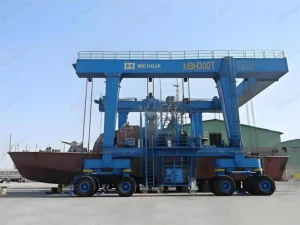
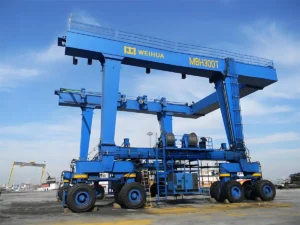
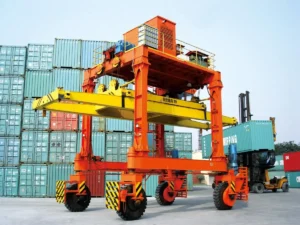
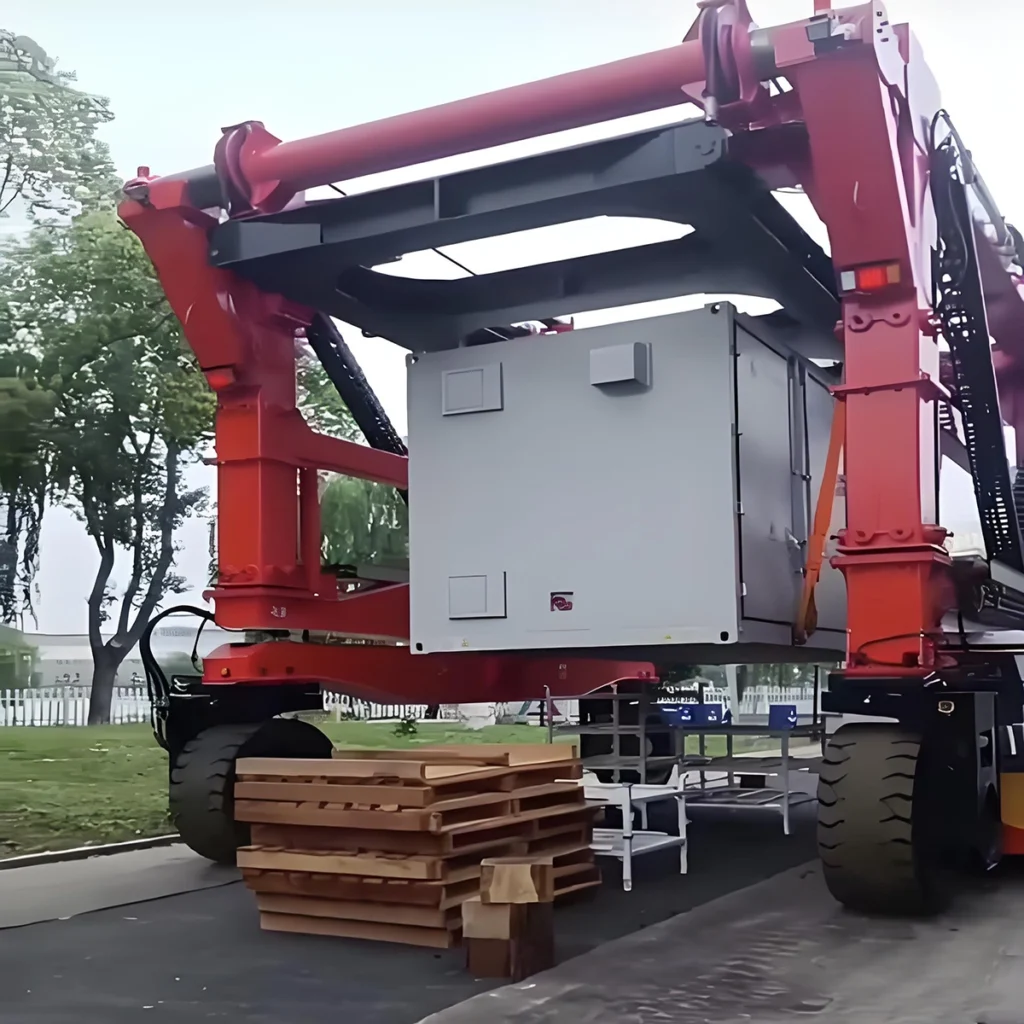
Weihua’s Industrial Straddle Carrier covers lifting capacities from 30 to 60 tons and is configurable for 20 ft, 40 ft, and 45 ft ISO containers, with stacking height up to 3–4 containers high and row spans of 2–4 rows. That range sounds compact, but the engineering difference between a 30-ton, 2-row, 1-over-2 diesel unit and a 60-ton, 4-row, 1-over-4 electric unit is considerable. The same rated tonnage on a spec sheet doesn’t tell you which you’re looking at.
Drive System: The Largest Single Cost Variable
Among all configuration choices, the drive system — diesel, hybrid, or full electric — typically has the largest single impact on straddle carrier price.
The reason is engineering depth. A diesel unit runs on proven, mature components: a high-power diesel engine, a large-capacity fuel tank, and a rubber-tyred multi-wheel drive system. It has the highest initial cost-to-performance ratio for high-intensity, continuous outdoor operations, and maintenance infrastructure is universally available. The tradeoff is operating cost: fuel spend and emissions over a 10–15 year asset life add up significantly.
A hybrid configuration introduces a battery storage system alongside the diesel engine, adding complexity to both the drivetrain and the control architecture. Fuel consumption typically drops substantially compared to a diesel-only unit, and noise levels fall as well — a meaningful factor for terminals near populated areas or operating under emissions regulations. The upfront premium over a diesel unit is offset over time by lower fuel bills, but the crossover point depends heavily on duty cycle intensity and local fuel prices. For a terminal cycling containers continuously across multiple shifts, the math tends to work in favor of hybrid. For a facility doing a few dozen moves a day, it often doesn’t.
A fully electric straddle carrier — powered by cable reel or lithium battery — eliminates local emissions entirely and has the lowest long-term energy cost. However, the total cost of going electric includes more than the machine itself: charging infrastructure, power supply capacity at the terminal, and cable management systems are real line items in the project budget that don’t appear on the equipment quotation. We recommend that buyers request a full site electrification cost estimate alongside the equipment quote to avoid underestimating the investment.
Automation and Control Level
Moving from manual PLC operation to semi-automated or fully automated control adds cost — but the right question is whether your throughput targets justify the investment, not whether the technology is appealing.
Weihua’s straddle carrier control systems range from standard manual PLC to semi-automatic and fully automated remote control, with integration options for terminal operating systems (TOS). Automated configurations require positioning sensors (laser, GPS), collision avoidance arrays, and system integration work that can be as expensive as the mechanical hardware itself. At a high-throughput terminal running three shifts with tight container cycle times, that investment tends to pay back through reduced labor cost and higher equipment utilization. At a smaller operation, a skilled operator in the cab and a well-laid-out yard will usually deliver better value.
Specifications That Determine Your Quote Tier
Container Configuration: More Important Than Rated Tonnage
The container specification — 20 ft only, 20 ft/40 ft, or the full 20 ft/40 ft/45 ft range with multi-row span — is a more critical pricing factor than the rated lifting capacity alone.
Here’s why: a 45 ft container is 2.5 metres longer than a 40 ft box. Designing the frame to accommodate it means wider span, longer hydraulic telescoping stroke on the spreader, and more demanding structural stiffness requirements across the full lifting height. Add twin-lift capability and you are compounding that engineering demand. Two units with the same 50-ton lifting rating can have very different structural bills of materials depending on which containers they’re designed to handle.
Before requesting a quote, confirm: which container sizes your terminal handles, and the maximum gross weight of the heaviest single box you will lift. Those two inputs alone narrow the specification tier significantly.
Stacking Height Requirements
Each additional stacking tier is a meaningful engineering step, not a minor parameter adjustment — the gap between 1-over-2 and 1-over-3 stacking affects the lifting stroke, the spreader guidance system, the frame height and therefore its bending moment, and the whole-machine center-of-gravity management.
Weihua’s Industrial Straddle Carrier supports stacking heights up to 3–4 containers high. For terminals that need to stack higher, RTG cranes — which Weihua supplies with stacking heights of 1-over-4 to 1-over-6 — are typically the more appropriate choice, though the tradeoff in horizontal travel speed and flexibility is significant. That comparison is covered in the next section.
Site Conditions and Ground-Bearing Capacity
Ground-bearing capacity is the specification most frequently missing from an initial inquiry, and it directly affects tire configuration, machine weight distribution, and the total cost of site preparation — none of which appears on the equipment quotation.
Straddle carriers operate on rubber tyres across a wide area of the yard, including turning zones and transfer lanes. If the ground surface isn’t rated for the wheel loads, the site prep cost to bring it to spec can be substantial — and because that work is contracted separately, it often surfaces only after the equipment budget has already been approved. In our experience, this is one of the most common sources of budget overruns in straddle carrier deployment projects: the equipment comes in on budget; the civils don’t.
For your inquiry, provide: ground surface type, bearing capacity in kN/m², maximum yard slope, and the available clearance in turning and transfer zones. Without these, wheel configuration cannot be confirmed and the quotation will carry a caveat that may require revision once site data arrives.

Straddle Carrier vs. RTG: When Does Each Make More Sense?

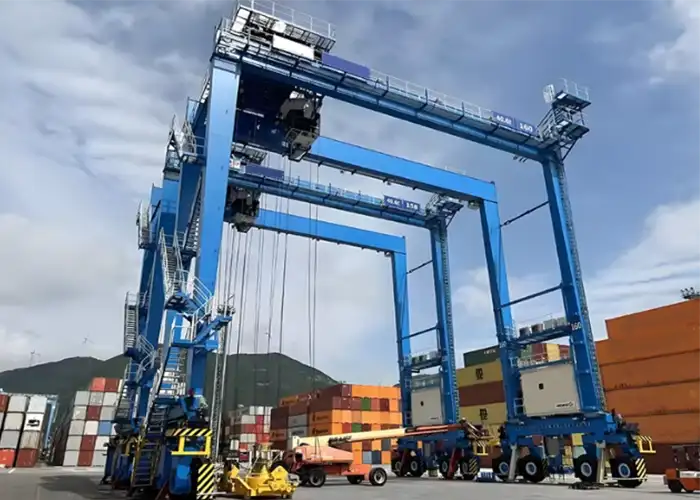
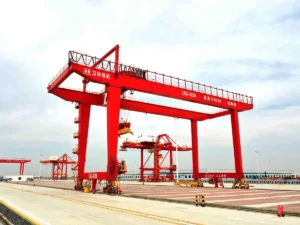
Both the Industrial Straddle Carrier and the Rubber Tyred Gantry (RTG) Crane are rubber-tyred, track-free container handling solutions. Weihua supplies both, and the choice between them is one we work through with most terminal buyers. The right answer depends on your yard layout, throughput profile, and how you expect operations to evolve.
Flexibility vs. Stacking Capacity
Straddle carriers offer the highest operational flexibility and horizontal transport speed; RTG cranes stack higher and suit terminals with stable, dense yard blocks.
Here are the key numbers from Weihua’s own product specifications:
| Specification | Straddle Carrier | RTG Crane |
|---|---|---|
| Lifting Capacity | 30–60 t | 35–70 t |
| Stacking Height | Up to 3–4 layers | 1 over 4–6 (up to 1 over 6) |
| Row Span | 2–4 rows | 6+1 to 8+1 rows |
| Max Travel Speed (unladen) | Up to 25–30 km/h | 25–50 m/min (gantry travel) |
| Drive Options | Diesel / Electric / Hybrid | Diesel / Hybrid / Full Electric (E-RTG) |
| Rail Requirement | None | None |
| Control System | Manual to Automated | Manual to Automated (ARTG) |
| Duty Classification | A5 | A5 |
For terminals prioritizing fast horizontal container movement and flexible yard layouts — especially where container flows are irregular, blocks are frequently reconfigured, or the terminal is still scaling — straddle carriers typically offer a better operational fit. For high-density stacking in fixed block operations where container dwell time is longer and throughput per square metre is the main optimization target, RTG cranes offer a better capacity-to-cost ratio over the medium term.
Infrastructure and Lifetime Operating Cost
Neither solution requires fixed rails, which is why both are popular for terminals that need operational flexibility or want to avoid heavy civil infrastructure investment upfront.
The key cost difference over time comes from tire wear, ground preparation requirements, and energy system choices. Straddle carriers travel more kilometres per shift than RTGs and cover a wider ground area, so tire condition and ground surface quality have a larger impact on operating cost and machine reliability. RTG cranes in fixed block operations have predictable travel patterns and generally lower tire wear rates per TEU handled.
On energy: both platforms support electric and hybrid options. Weihua’s E-RTG uses grid power via cable reel or conductor rail — a supply infrastructure that suits fixed-block operations well. Fully electric straddle carriers running on lithium batteries are increasingly viable for high-cycle terminals with stable shift structures, but battery management and charging logistics need to be planned at the site level.
If your terminal handles high container turnover with frequent cross-block transfers, or if your yard layout is still being finalized, start the conversation with the straddle carrier. If your container volumes are stable, your block configuration is fixed, and your priority is lowest long-run cost per TEU moved, an RTG or Rail Mounted Gantry (RMG) deserves serious comparison. Our engineering team can run both options against your throughput data.
Get Custom Quotation NowCertifications and Compliance
Standards Applicable to Port-Grade Straddle Carriers
Port-grade straddle carriers are typically required to comply with CE marking requirements, FEM crane design rules, and ISO crane classification standards as a minimum baseline for international procurement — and verifying these before shortlisting suppliers is a decision checkpoint, not an afterthought.
Weihua’s Industrial Straddle Carrier is CE and ISO certified. The applicable standards framework for port-grade container handling equipment of this type generally includes: CE marking under the EU Machinery Directive 2006/42/EC; FEM 1.001 crane design rules; ISO 4301 crane duty classification; and ISO 9001 quality management system certification at the manufacturing level. For projects destined for Eurasian Customs Union markets, EAC certification is an additional requirement. Local authority approvals for lifting equipment at the destination port may impose additional compliance steps — confirm these with your project team early.
How to Verify Compliance Before Signing
Ask for documentation before you sign — verbal certification assurances are not a substitute for paper when the equipment is operating in a regulated port environment.
The core documents to request from any supplier:
- EC Declaration of Conformity (required for CE-marked equipment)
- Overload test certificate (issued after factory load testing)
- ISO 9001 manufacturer certification (confirms quality management system)
- Key component traceability — especially hydraulic systems and electrical control units
- After-sales and spare parts commitment in writing
Weihua can provide these documents upon request. For projects in markets with specific certification requirements, contact our engineering team early in the process so the compliance package can be confirmed before order placement.
How to Request a Straddle Carrier Quote from Weihua
The Project Information You Need to Prepare
A complete inquiry gets you an accurate project quote within days. An incomplete one leads to multiple rounds of back-and-forth that delay your budget confirmation — and in our experience, the most common missing items are ground-bearing capacity and container gross weight, not the headline lifting tonnage.
Before contacting us, work through this checklist:
- Container types handled — 20 ft / 40 ft / 45 ft, or a mix; maximum single-box gross weight (tons)
- Required stacking height — 1 over how many layers
- Row span — how many container rows the machine must straddle
- Drive system preference — diesel / hybrid / full electric; local power supply voltage and frequency if electric
- Control level — manual / semi-automatic / fully automated; TOS integration requirements
- Operating environment — outdoor port / covered yard / factory interior; climate conditions (coastal salt air, high temperature, low temperature)
- Ground conditions — surface type, bearing capacity (kN/m²), maximum slope, turning zone clearance
- Destination market / port — determines certification requirements
- Expected daily operating cycles — informs duty class specification and equipment design life
- Target delivery date — determines production scheduling requirements
You don’t need every number before reaching out — but the more of these you can confirm, the more precise the first quotation will be.
Get Custom Quotation NowLead Time and Delivery Planning
Straddle carriers are built to order. Manufacturing lead time varies by configuration complexity; more heavily customized units — particularly fully electric or automated configurations — require longer production schedules. Factor your delivery requirement into the project timeline before issuing a formal RFQ, and confirm lead time with our team at the same time you request the quotation.
Delivery of a port-grade straddle carrier is an oversized freight operation. The destination port’s unloading capability, the availability of suitable heavy-transport vehicles on the ground side, and the site access route all need to be confirmed in advance. These logistics costs are not included in the equipment quotation. Weihua’s project delivery team can advise on typical shipping and site logistics requirements based on your destination.
On-site installation, commissioning, and operator training are supported by Weihua’s global after-sales team. We maintain a comprehensive spare parts inventory for critical components and offer ongoing maintenance programs to extend equipment service life.
Conclusion
Straddle carrier price is project-specific by design. The right budget starts with confirmed specifications — container type, stacking height, drive system, and site conditions — not a figure borrowed from a third-party listing or an online marketplace.
Three things worth doing before you reach out:
- Run through the project information checklist above and confirm as many items as you can
- Decide whether the straddle carrier or RTG comparison applies to your terminal — the spec table in this article gives you the numbers to start that conversation
- When you do request a quote, ask for the certification document list and a lifecycle cost comparison alongside the unit price — the full picture looks different from the headline number
FAQ
Q1: What is the lifting capacity range for Weihua’s industrial straddle carrier crane?
Weihua’s Industrial Straddle Carrier covers a capacity range of 30 to 60 tons and can be customized to match your container weight requirements and operating intensity. The rated capacity needs to be confirmed against the heaviest single-box gross weight your terminal handles — contact our team to confirm the right specification for your project.
Q2: Can Weihua’s straddle carrier handle 45 ft containers?
Yes. The Industrial Straddle Carrier is configurable for 20 ft, 40 ft, and 45 ft ISO standard containers. Frame span and spreader stroke are adjusted during the customization process to match the container dimensions you specify.
Q3: What certifications does Weihua’s straddle carrier carry?
The Industrial Straddle Carrier is CE and ISO certified. For specific documentation — including the EC Declaration of Conformity, overload test certificate, and ISO 9001 manufacturer certificate — contact our sales team to request the relevant files for your target market.
Q4: How does a straddle carrier compare to an RTG crane for a mid-sized container terminal?
Both are rubber-tyred, track-free solutions with no fixed rail requirement. Straddle carriers offer faster horizontal travel (up to 25–30 km/h unladen) and suit flexible, high-turnover operations; RTG cranes stack higher (up to 1-over-6) and are more efficient in fixed, high-density block operations. The right choice depends on your yard layout and throughput profile — our engineering team can compare both options against your specific site data.
Q5: Does drive system choice significantly affect straddle carrier price?
Yes — the drive system is typically the largest single contributor to price variation between otherwise similar configurations. We supply diesel, hybrid, and fully electric options. We recommend requesting a lifecycle cost comparison alongside the upfront quote: fuel savings, maintenance differentials, and potential infrastructure costs for electrification can shift the total investment picture substantially.