



A chain hoist for sale can mean a $45 manual block or a $2,000 explosion-proof electric unit — and choosing the wrong one costs far more than the price difference. If you’re a factory procurement manager, equipment supervisor, or sourcing team lead, this guide gives you a direct comparison of all four chain hoist types, realistic price ranges, key specifications to verify, and a framework for evaluating chain hoist suppliers — whether you’re buying domestically or sourcing from chain hoist manufacturers in China.
Most buyers run into the same three problems: they underspecify duty cycle (and get a unit that fails early), they compare prices across incompatible product grades, or they overlook trolley and suspension compatibility until delivery. This guide solves all three before you commit to a purchase order.
By the end, you’ll have a clear framework to match the right chain hoist for sale to your application — and enough supplier knowledge to avoid the most common procurement errors.
TL;DR: Chain Hoists
- • Pricing: Chain hoists range from $30 (0.5T manual) to $2,000+ (20T electric); most industrial buyers typically invest between $150–$2,500.
- • Types: Choose from manual, electric, lever models, each specifically engineered for different operating profiles and usage frequencies.
- • Specifications: Match capacity to 110% of your maximum load, verify FEM M3–M8 duty cycles, and confirm CE/ASME/GS certifications before ordering.
Quick Reference: Chain Hoist Price by Type and Capacity
Prices are market reference — FOB factory (China-origin) and US market retail indicative. Actual pricing varies by specification, certification, and order volume.
| Type | Capacity Range | FOB Factory (indicative, $) | US Market Retail (indicative, $) | Best For |
|---|---|---|---|---|
| Manual chain hoist | 0.5T – 20T | $30 – $600 | $80 – $1,200 | Low-frequency lifts, remote sites |
| Electric chain hoist | 0.5T – 10T+ | $150 – $2,000 | $500 – $6,000+ | Warehouses, production lines |
| Lever hoist | 0.25T – 9T | $25 – $450 | $60 – $900 | Rigging, tensioning, horizontal pulls |
Reference: CE Machinery Directive 2006/42/EC; FEM 9.511 Duty Classification Standard. Source: Compiled from manufacturer FOB quotes and US distributor pricing, 2024–2026.
Get Custom Quotation NowFour Types of Chain Hoists for Sale — Which One Fits Your Operation?


Not every chain hoist for sale is built for the same task. The type you select determines performance ceiling, maintenance cost, operator fatigue, and total cost of ownership over a 5–10 year service life. The four main categories cover most industrial scenarios.
Manual Chain Hoist (Hand Chain Block)
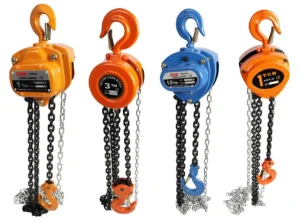
A manual chain hoist lifts loads via a hand-pulled chain loop running through a gear reduction mechanism, requiring no electricity or compressed air. Capacity ranges from 0.5T to 20T; lift heights are customizable from 3m to 30m (per EN 13157 guidance for manually-operated hoists).
Manual hoists are the most portable and most affordable entry point among all chain hoists for sale. They’re the standard choice for construction sites, maintenance teams, small fabrication shops, and any application where power access is unreliable or where lifts happen infrequently — fewer than 10–15 cycles per shift.
One underappreciated advantage: no power supply means no electrical safety compliance burden. In outdoor, remote, or temporary-install scenarios, this matters as much as purchase price.
Best for: Infrequent lifts, outdoor environments, budget procurement, portable multi-site operations.
Watch out for: Mechanical advantage ratio (expressed as pull force required per ton of load). A poor-ratio unit means 35–40 kg of operator pull force per ton lifted — a significant ergonomic cost on repeat lifts.
Electric Chain Hoist
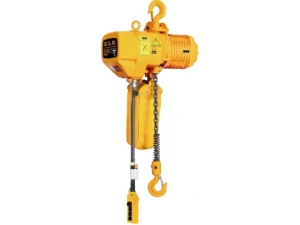
An electric chain hoist drives the load chain via a motor and gear system, controlled through a pendant station or wireless remote, eliminating manual chain pulling entirely. Capacities span 0.5T to 10T+ in standard configurations; duty cycle ratings run from M3 (light industrial) to M8 (heavy-duty continuous) under FEM 9.511 classification.
Electric models are the most commonly purchased type of chain hoist for sale in industrial settings. The duty cycle specification is the single most important — and most commonly misread — parameter. An M3-rated unit running 40 lifts per hour will fail in months. An M5 or M6 unit under the same load handles it comfortably.
Power configuration matters too: single-phase 115V/230V serves smaller operations and retail workshops; three-phase 230V/460V is the standard for industrial production environments in North America.
Best for: Warehouses, manufacturing lines, distribution centers, any application exceeding 15+ lift cycles per shift.
Lever Hoist (Come-Along)
A lever hoist uses a short ratchet lever handle — typically 200–400mm long — to lift, pull, or tension a load in any orientation, including horizontal. Capacity range is 0.25T to 9T; most working configurations involve 3T or less.
Lever hoists are frequently overlooked when buyers search for chain hoists for sale, yet they solve problems that neither manual nor electric hoists address: horizontal tensioning, rigging load adjustment, pulling equipment into position, and lifting in confined spaces where a hand chain loop cannot be swung. They’re standard equipment in rigging crews, shipyards, and entertainment rigging applications.
Weight is a key advantage: a quality 1.5T lever hoist typically weighs 4–6 kg versus 12–18 kg for an equivalent manual chain hoist.
Best for: Rigging crews, horizontal pulling, tensioning applications, confined-space lifts.
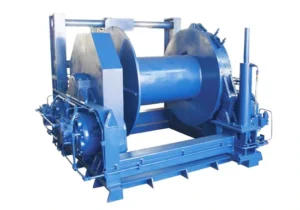
Summary: For loads under 5T in a standard warehouse or factory with consistent power, an electric chain hoist offers the best performance-to-cost ratio. For portability or low-frequency use, a manual chain hoist is the practical default. Beyond chain hoists, Weihua also manufactures complementary lifting equipment including hydraulic winches for marine, port, and specialized industrial applications. Our hydraulic winches integrate seamlessly with gantry cranes, boat lifting systems, and offshore operations.
Chain Hoist Specifications — What to Confirm Before You Buy
Procurement errors on chain hoists are expensive to correct. A wrong-spec unit shipped internationally means double freight, weeks of downtime, and a customs return process. Run through this specification checklist before finalizing any chain hoist price quotation.
Load Capacity and Safety Factor
Always specify capacity at 110% of your maximum anticipated load, not the maximum load itself. This provides a working buffer and aligns with the standard safety factor approach under ASME B30.16 (Overhead Hoists) and EN 14492-2 (Power-driven hoists). Most manufacturers rate capacity at 4:1 safety factor (proof load = 2× working load limit; test load = 1.5× WLL).
Common capacity error: buyers specify their average load, not their maximum occasional load. If you routinely lift 800 kg but occasionally move a 1,200 kg die set, you need a 2T hoist, not a 1T unit.
Duty Cycle and FEM Classification
FEM 9.511 defines duty classes M1 (very light, occasional use) through M8 (heavy continuous industrial service). The class determines the hoist’s designed service life in lift cycles — and directly affects price.
| FEM Duty Class | Typical Use Case | Design Life (lift cycles) |
|---|---|---|
| M3 | Maintenance, infrequent production | ~12,500 |
| M4 | General production, moderate frequency | ~25,000 |
| M5 | Regular production shifts | ~50,000 |
| M6 | High-frequency warehouse/factory | ~100,000 |
| M7–M8 | Continuous heavy duty | 200,000+ |
Source: FEM 9.511 Section 2.3, Group Classifications for Hoisting Mechanisms
Most catalog electric hoists sold online are rated M3–M4. If your operation runs two shifts, you need M5 minimum. Ask for the FEM classification in writing before accepting any chain hoist supplier quote.
Lift Height and Head Room
Standard lift heights are 3m, 6m, 10m, and 20m; custom heights to 100m+ are available from most chain hoist manufacturers. Head room — the distance between the mounting point and the hook at maximum raised position — is often the deciding factor in low-ceiling applications.
Low-headroom models (designated “LH” in most catalog systems) reduce this dimension by 25–40% compared to standard hook-mounted units, at a 10–20% price premium. Confirm the minimum headroom dimension from the supplier’s technical drawing, not the catalog copy.
Trolley Type and Suspension Method
Most chain hoists ship as hook-mounted units only — meaning they hang from a fixed point. For horizontal travel, you need a trolley, and trolley selection is a separate decision that many buyers miss when pricing a chain hoist purchase.
Three trolley types are available for standard I-beam and H-beam mounting:
- Plain (push) trolley: Manual sideways movement; lowest cost; best for low-frequency travel
- Geared trolley: Hand-chain operated; better control; suited to longer runs or heavier loads
- Motorized trolley: Electric drive, paired with electric hoist for full remote operation
Confirm beam flange width compatibility — standard ranges are 50–300mm — and beam weight rating before ordering. A mismatched trolley is not a field-correctable problem.
Chain Hoist Certifications — What the Marks Actually Mean
Certifications are not equivalent, and the correct mark depends entirely on your destination market and operating environment.
CE Marking and EU Machinery Directive
CE marking under the EU Machinery Directive 2006/42/EC is mandatory for chain hoists sold or used within the European Economic Area. It confirms the product meets essential health and safety requirements — design, materials, load testing, and documentation. CE is the baseline certification for European industrial buyers and for export to most markets that reference EU standards.
CE is not a quality grade — it’s a legal minimum. Two CE-marked hoists can differ significantly in actual build quality and component grade. Ask for the Declaration of Conformity and the technical file reference to verify substance behind the mark.
ASME B30.16 and North American Standards
ASME B30.16 (Overhead Hoists — Underhung) is the governing standard for hoist design and application in North America. Unlike CE, it is not a mandatory certification mark — it’s a design and performance standard that reputable hoists are built to comply with. ASME-compliant hoists from established US brands (CM, Coffing, Harrington, Yale) are the default specification for US facility procurement.
For chain hoist manufacturers in China supplying North American buyers, ASME compliance is the key differentiator to verify. Ask for test reports referencing ASME B30.16 and confirm load testing documentation.
GS Mark and ATEX
The GS mark (Geprüfte Sicherheit, Germany) is a voluntary third-party certification exceeding CE minimum requirements — it involves factory audits and product type testing. GS-certified hoists command a 15–25% price premium but provide a higher verified quality assurance level. Prevalent in German-speaking markets and specified by German automotive OEMs and aerospace suppliers.
ATEX certification (Directive 2014/34/EU) is mandatory for hoists used in potentially explosive atmospheres — chemical plants, paint facilities, grain storage, and offshore environments. ATEX-rated pneumatic and spark-resistant hoists carry an “Ex” classification code (e.g., II 2G Ex h IIC T4 Gb). This is a hard requirement — a non-ATEX unit in an ATEX zone is a regulatory violation regardless of other certifications held.

Sourcing from Chain Hoist Manufacturers in China — Opportunities and Red Flags
China-origin chain hoists for sale represent the dominant share of global supply at every capacity tier. Understanding the sourcing landscape separates buyers who achieve 25–40% cost reductions from those who receive non-compliant units, failed load tests, and delayed certification documentation.
The Supplier Tier Structure
China’s chain hoist manufacturing base operates across three distinct tiers.
Tier 1 — Export-grade manufacturers (e.g., Yantai, Suzhou, Henan province clusters): Full CE documentation, established export track records, English-language technical support, factory audit access. Pricing reflects genuine compliance costs. These are the chain hoist suppliers appropriate for European and North American industrial procurement.
Tier 2 — Domestic/regional suppliers: Products may carry CE marks but documentation depth is inconsistent. Load test reports may reference internal standards rather than EN 14492-2. Price is 20–35% lower than Tier 1. Appropriate for markets with lower regulatory scrutiny or where buyers have internal inspection capacity.
Tier 3 — Trading companies reselling OEM product: No manufacturing capability, no technical documentation generation, limited ability to customize. Price looks attractive; total cost of procurement — failed inspections, returned shipments, documentation deficiencies — is often higher.
Supplier Evaluation Checklist
Before placing any chain hoist order with a new supplier — domestic or international:
- Request the CE Declaration of Conformity (DoC) for your specific model number. A generic CE certificate covering a product family without model-specific DoC is a red flag.
- Ask for the load test report — proof test at 2× WLL and dynamic test results. Dates should be within the last 24 months.
- Verify FEM duty classification in the product datasheet, not just in verbal claims.
- Request a factory audit or third-party inspection for first orders above 10 units.
- Check lead chain material certification: Grade 80 (EN 818-7) or Grade 100 chain is the standard for industrial hoists; lower-grade chain is a common cost-cutting substitution in non-compliant products.
- Confirm minimum headroom drawing (not catalog dimensions alone).
- Ask for references from buyers in your destination market.
Red Flags That Signal a Non-Compliant Product
- CE certificate issued by the manufacturer itself with no Notified Body involvement
- Load capacity specified in “kg” only, with no WLL statement
- No FEM or ISO duty cycle classification visible in any documentation
- Price significantly below the FOB floor for the capacity tier (e.g., a 5T electric hoist at $90 FOB)
- Unwillingness to provide English-language technical documentation
- Lead chain not identified by grade in the bill of materials
Practical Buying Scenarios — Matching Application to Product
Small Workshop or Maintenance Team (1–3T, Low Frequency)
For a fabrication shop or maintenance department doing 5–15 lifts per day at capacities under 3T, a manual chain hoist or lever hoist is the practical and cost-effective choice. A quality CE-marked 2T manual hoist in this segment retails at $120–$350 from US distributors, or $50–$150 FOB from Tier 1 Chinese chain hoist manufacturers. Budget $20–$60 extra for a compatible plain trolley if beam travel is needed.
Warehouse or Distribution Center (1–10T, High Frequency)
High-cycle warehouse operations demand an electric chain hoist rated M5 or M6 under FEM 9.511. For capacities up to 5T, expect $800–$3,500 at US market retail (CM Lodestar, Coffing JLC, Harrington NER are common benchmarks); $400–$1,800 FOB factory from CE-certified Chinese manufacturers. Add a motorized trolley for full-bay coverage — trolley cost adds 20–35% to the hoist price.
Bulk Factory Procurement (10+ Units)
Multi-unit procurement from chain hoist manufacturers opens factory-direct pricing: 10+ units typically unlocks 15–25% below standard FOB list; 50+ units can reach 30–40% reductions for established buyers. Specify duty cycle in the purchase order, require batch-level load test certificates (not just product-level), and build a 2% quality inspection allowance into project budgets for SGS or equivalent third-party inspection.
Conclusion
Sourcing the right chain hoist for sale comes down to three decisions made correctly upfront: type (manual, electric, lever, or pneumatic), duty cycle (FEM M3 through M8), and certification standard (CE, ASME B30.16, or ATEX). Every other specification — capacity, lift height, trolley type, voltage — follows from those three.
Three actionable steps before your next purchase order:
- Define your lift frequency first. Cycles per shift determines duty class, which determines product tier. Getting this wrong is the most expensive single procurement error in hoist buying.
- Request documentation before price negotiation. CE Declaration of Conformity, load test report, FEM classification in writing — these should arrive before you discuss unit pricing.
- Compare FOB factory price against US market retail using the table above to calibrate whether a supplier quote represents genuine value or a compliance shortcut.
Whether you’re buying a single portable chain hoist for a maintenance team or placing a 50-unit factory order from chain hoist manufacturers in China, the framework above applies. Contact our engineering team for a specification review and factory-direct quote with worldwide delivery.
FAQ
Q1: What is the price range for a chain hoist for sale?
Chain hoists for sale range from around $30 for a basic 0.5T manual unit to $2,000+ for a high-duty-cycle electric model above 10T. Most industrial buyers purchasing 1–5T electric hoists for warehouse or factory use fall in the $500–$3,500 range at US market retail, or $200–$1,500 FOB from CE-certified manufacturers. Price is primarily driven by capacity, duty cycle rating (FEM class), and certification level.
Q2: What is the difference between a manual chain hoist and a lever hoist?
A manual chain hoist lifts vertically using a hand-chain loop and is best for suspended, overhead lifts. A lever hoist uses a short ratchet handle and works in any orientation — vertical, horizontal, or angled — making it standard for rigging, tensioning, and pulling applications. Both are unpowered, but they serve different use cases and should not be treated as substitutes for each other.
Q3: What certifications should I require when purchasing chain hoists?
For European Union use, CE marking under the Machinery Directive 2006/42/EC is legally mandatory. For North American operations, ASME B30.16 compliance is the industry standard. For hazardous or explosive environments, ATEX certification (Directive 2014/34/EU) is a hard requirement — no other certification substitutes for it. Always request the Declaration of Conformity and load test documentation, not just the mark itself.
Q4: Is it safe to source chain hoists from manufacturers in China?
Yes, with appropriate due diligence. Tier 1 Chinese chain hoist manufacturers produce CE-compliant, load-tested products that supply major global industrial buyers. The key checks are: CE Declaration of Conformity for your specific model, load test report from a recognized test body, FEM duty classification in writing, and Grade 80 or Grade 100 chain certification. First-time orders above 10 units should include SGS or equivalent third-party inspection.
Q5: How often should chain hoists be inspected and serviced?
Under ASME B30.16, frequent inspections (visual checks) are required before each use. Periodic inspections — detailed examination of all load-bearing components — are required at intervals not exceeding 12 months for regular-use hoists, or more frequently based on usage severity. Under EN 13157 / EN 14492-2 (EU standards), the inspection regime follows manufacturer recommendations, typically every 6–12 months for industrial applications. Keep a written inspection log: it’s both a safety requirement and a due diligence record in the event of an incident.



 English
  Русский
  العربية
  Français
  Português
  Español