
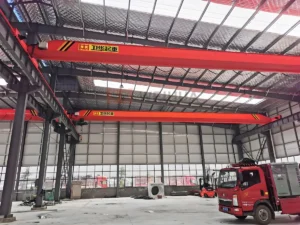
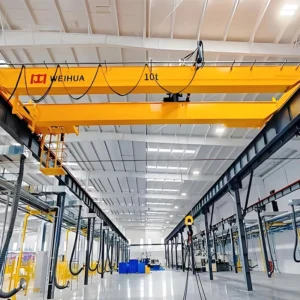
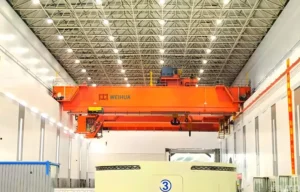
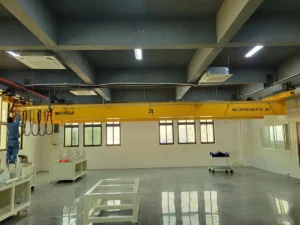
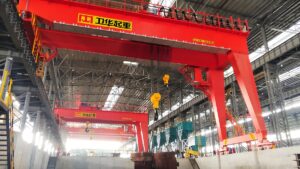
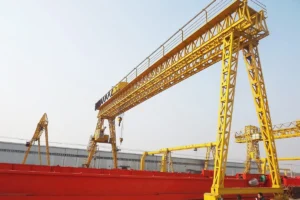

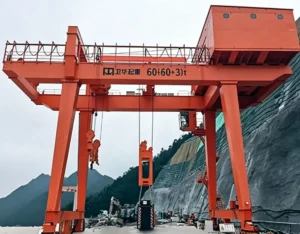
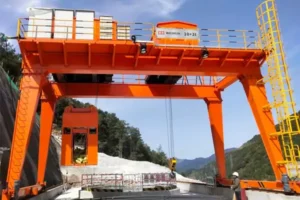

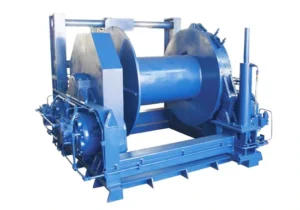






If your facility handles flammable gases, chemical vapors, or combustible dust, a standard overhead crane is not a safe option — it is a regulatory liability. An explosion proof overhead crane eliminates the electrical ignition sources that could trigger a catastrophic event in Zone 1/Zone 2 (ATEX/IECEx) or Class I/II Division 1/2 (NEC) environments. The market reference price ranges from roughly $18,000 for a 5-ton single girder unit to $280,000+ for a heavy-duty 100-ton double girder system with full ATEX/IECEx certification, depending on gas group, duty class, and span.
The most common mistake buyers make is treating explosion-proof certification as a single checkbox. In practice, matching the crane’s explosion protection level to your site’s specific gas group (IIA, IIB, or IIC) and temperature class (T1–T6) is what determines whether the equipment is legally compliant and operationally safe — and the gap between getting this right versus wrong can mean the difference between a cleared permit and a complete rework at delivery.
This guide covers the four main crane types, how to read explosion-proof ratings, what specifications to confirm, how to verify supplier credentials, and what certifications and documents to request before signing a purchase order.
Table of Contents
Quick Reference: Explosion Proof Overhead Crane Types & Price Ranges
| Type | Lifting Capacity | Span | Duty Class | Typical Price Range | Best For |
|---|---|---|---|---|---|
| Single Girder | 1–20 t | 7.5–25 m | A5–A6 | $18,000–$65,000 | Light/medium loads, standard workshops |
| Double Girder | 5–100 t | 10–35 m | A6–A7 | $45,000–$280,000+ | Heavy-duty, high-frequency operations |
| Underslung | 1–10 t | 7.5–20 m | A4–A5 | $15,000–$40,000 | Low headroom, confined spaces |
| Hoist Type | 1–16 t | 7.5–28 m | A5–A6 | $16,000–$58,000 | Light/medium loads, easy maintenance |
Get Custom Quotation NowAll prices are market reference ranges based on Chinese supplier pricing for ATEX/IECEx-certified units. Exact pricing depends on gas group rating, customization, and span.
For more information on standards for explosion-proof cranes, read the article: “Explosion Proof Crane Standards Explained: Atex, lecex & Nec”
What Makes a Crane “Explosion Proof” — and Why It Matters
The core principle: eliminating ignition sources, not just containing sparks
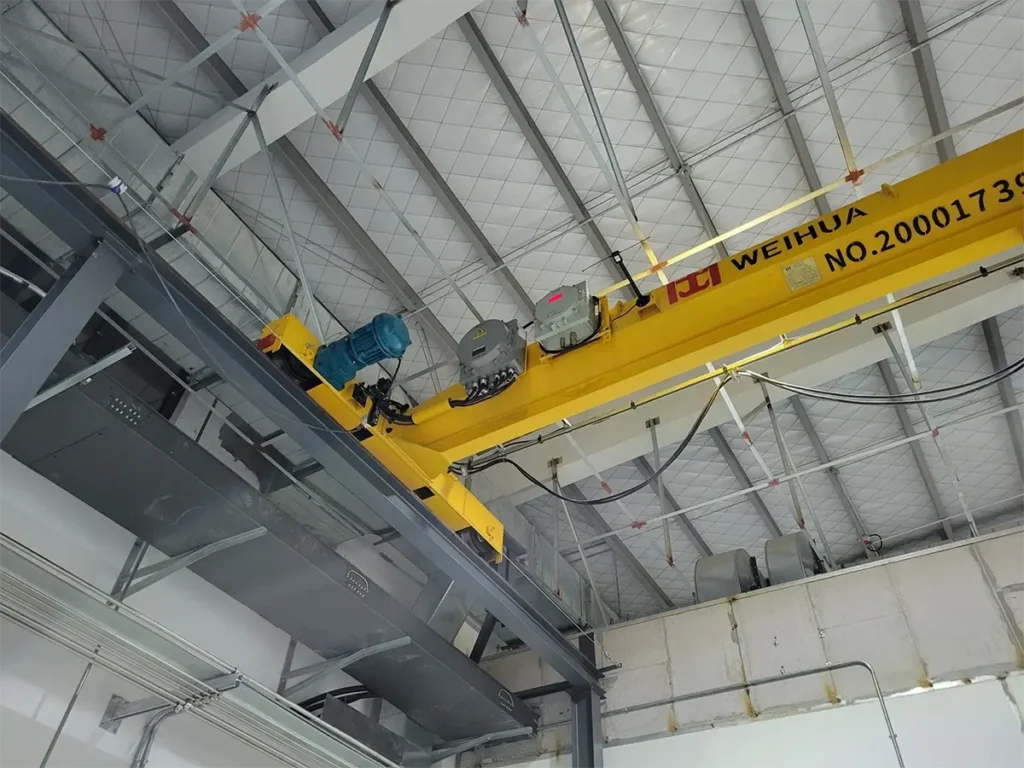
An explosion proof overhead crane is rated to operate safely in atmospheres where flammable gases, vapors, or combustible dust may be present, as classified under ATEX Directive 2014/34/EU, IECEx, and the U.S. National Electrical Code (NEC). The fundamental engineering goal is not to make the crane fireproof — it is to ensure that no component can generate sufficient electrical or thermal energy to ignite the surrounding atmosphere under normal or fault conditions.
This is achieved through three interlocking design principles. First, all motors, brakes, limit switches, control panels, and electrical enclosures are rated to flameproof (Ex d) or increased-safety (Ex e) protection levels, meaning any internal arc or spark is contained within the enclosure and cannot propagate outward. Second, surface temperatures of all components are limited to a maximum that stays below the auto-ignition temperature of the target gas — this is what the T-class (T1 through T6) designates. Third, non-sparking materials (such as copper-beryllium alloys or aluminum bronze) are used for mechanical contact surfaces like hooks, wheels, and end stops, reducing the risk of friction-generated ignition.
A standard overhead crane has none of these features. Its open motor windings, standard switchgear, and unpotected brake mechanisms are direct ignition risks in any classified hazardous zone.
Zone classification drives equipment selection, not the other way around
Before specifying any crane, your site’s area classification must be determined by a certified safety engineer — and that classification directly dictates what explosion-proof rating the crane must carry.
The two major classification systems work as follows:
- ATEX/IECEx zones (EU, international): Zone 1 means the explosive atmosphere is likely during normal operations; Zone 2 means it occurs only under abnormal conditions. Zone 0 (continuous presence) rarely permits any powered equipment.
- NEC Classes and Divisions (North America): Class I covers flammable gases/vapors; Class II covers combustible dust. Division 1 corresponds roughly to Zone 1, Division 2 to Zone 2.
A crane rated for Zone 2 is not legally compliant in a Zone 1 area — this is an error that surfaces at inspection, not at purchase, and remediation typically requires a full equipment replacement.
The Four Types of Explosion Proof Overhead Crane — and How to Choose
Single girder explosion proof crane: the practical choice for most chemical and pharmaceutical workshops
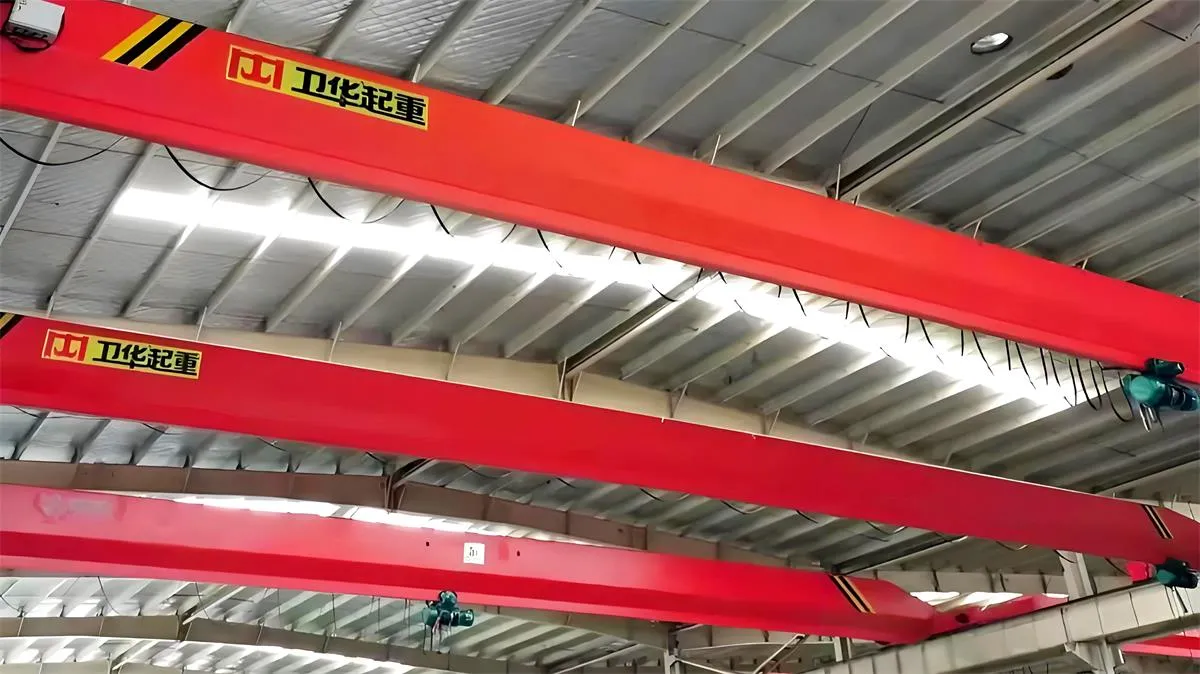
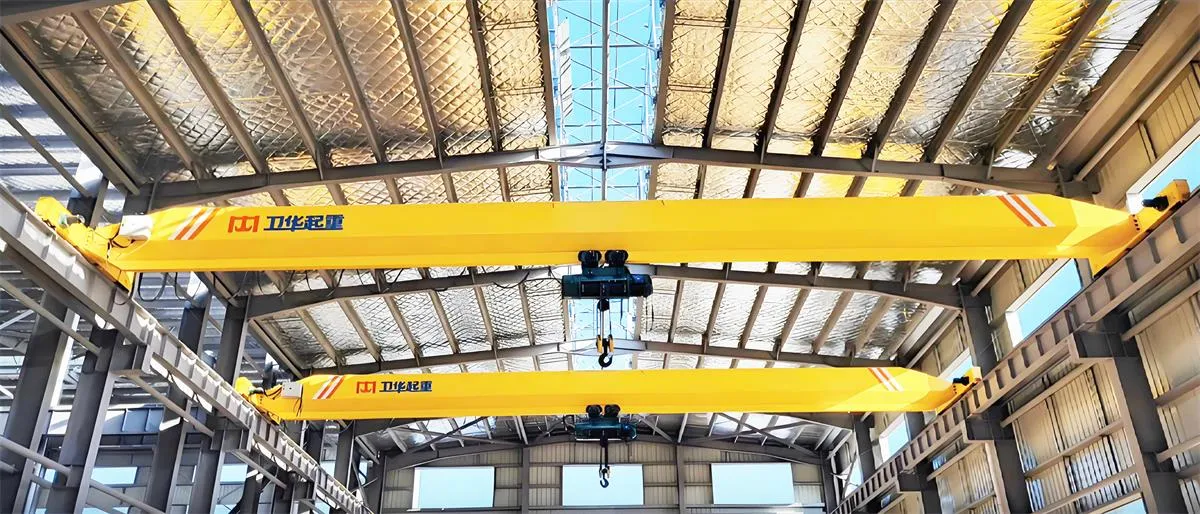
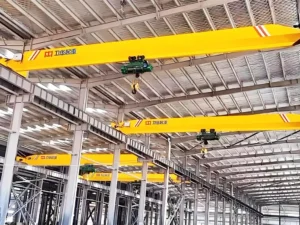
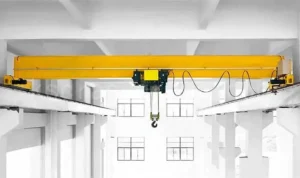
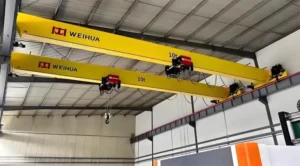
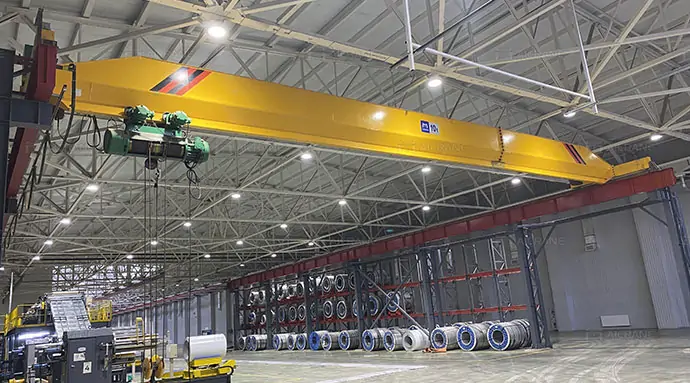
A single girder explosion proof crane handles 1–20 tons across spans of 7.5–25 meters and is the most commonly specified model for chemical processing facilities, pharmaceutical production areas, and battery manufacturing lines where loads are moderate and lifting cycles don’t exceed duty class A6.
The reason it dominates this segment comes down to economics and buildability. Single girder construction is lighter, puts less structural demand on the building frame (important in retrofit installations where runway beams may not be sized for a heavier double girder), and the lower self-weight means smaller runway rail requirements — typically QU50 to QU70. For a pharmaceutical plant moving 5-ton reactor vessels or a battery factory handling electrolyte storage modules, this configuration covers the operational envelope without the cost premium of a heavier system.
The limitation is clear: once your duty cycle climbs to A7 or your loads regularly exceed 15–20 tons, a single girder unit will not provide the structural rigidity or motor thermal tolerance for sustained high-frequency operation in a hazardous zone. Overloading a single girder ex-crane in a Zone 1 area isn’t just a mechanical issue — repeated motor overheating can eventually compromise the explosion-proof enclosure integrity.
Double girder explosion proof crane: for heavy loads, high frequency, and large spans
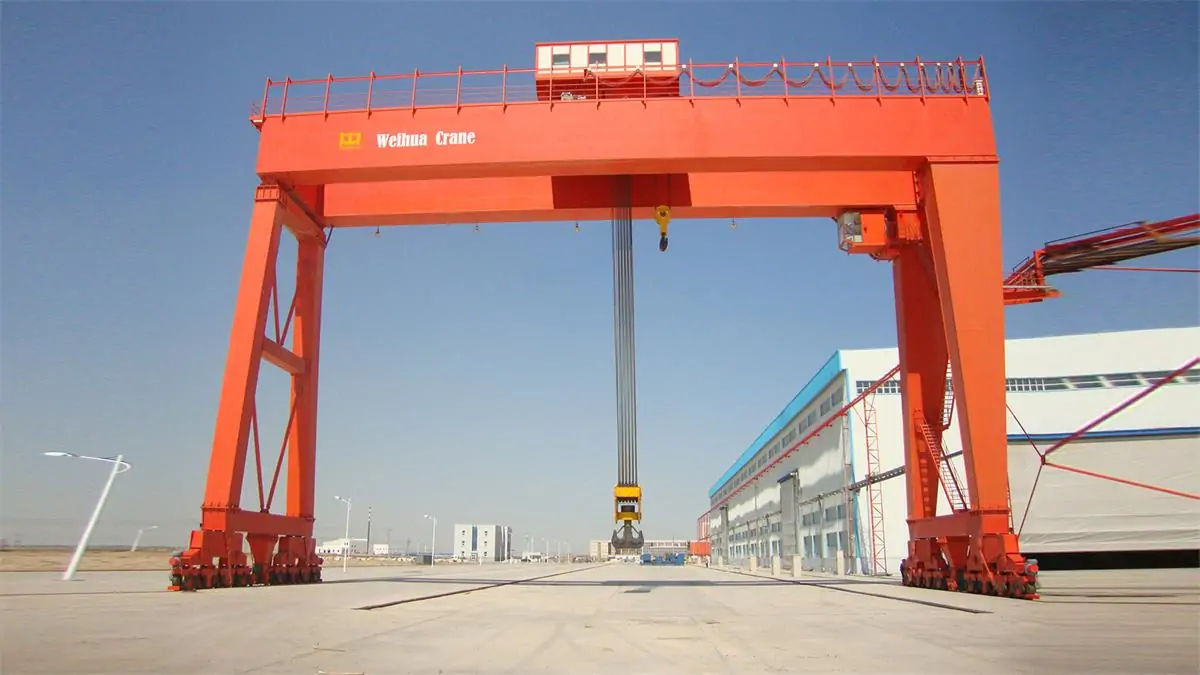
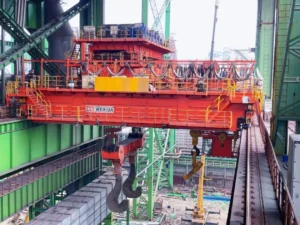
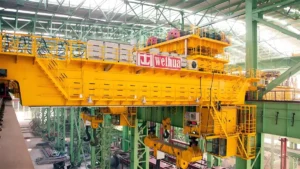
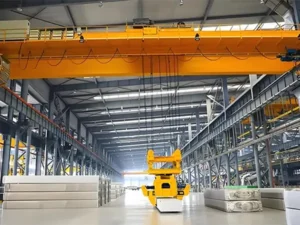
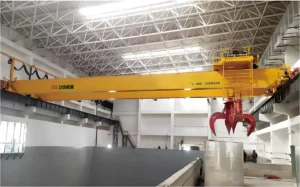
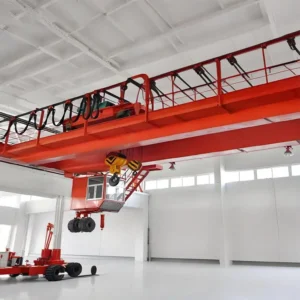
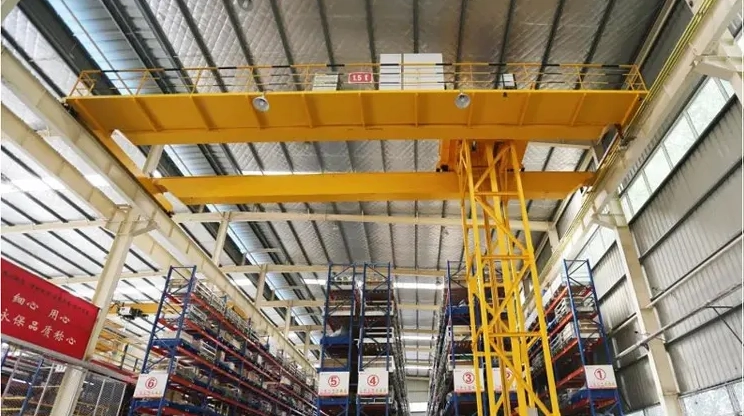
The double girder explosion proof crane covers 5–100 tons, spans up to 35 meters, and is rated for duty classes A6–A7, making it the right choice for petrochemical reactors, refinery maintenance bays, LNG compressor halls, and other environments where loads are heavy and the crane operates multiple shifts daily.
The structural difference from a single girder is significant: two main girders provide far greater resistance to vertical deflection under load, and the hook travel sits between the girders rather than below a single beam, enabling greater lifting height for a given building clearance. More importantly for the explosion-proof context, double girder cranes typically run an open winch trolley (as opposed to a suspended hoist), which allows larger, more robust explosion-proof motors with better thermal management — a critical factor in high duty class environments where motor temperature is both an operational concern and a safety parameter.
At the 50–100 ton end, these units often include operator cabins with explosion-proof air conditioning and pressurized enclosures (Ex p protection method), gas concentration monitoring integration, and anti-sway systems to reduce load pendulum motion at height — all standard features in well-specified refinery or chemical plant cranes.
Underslung explosion proof crane: the answer to low headroom in hazardous areas
The underslung (suspended) explosion proof crane carries 1–10 tons and is distinguished by being mounted beneath the existing building structure rather than on top of dedicated runway beams. This gives it a clear advantage in facilities where ceiling height is limited or where installing elevated runway beams would require structural reinforcement the building cannot accommodate.
In practical terms: if your available hook height under the structural flange is less than 4–5 meters and you need to move loads in a classified area, the underslung configuration often provides the only viable path that doesn’t require major civil works. The trade-off is that span and capacity are constrained by the building’s structural beam spacing and load rating — this is not a crane type for loads above 10 tons or spans beyond 20 meters.
Hoist type explosion proof crane: lower upfront cost, simpler maintenance footprint
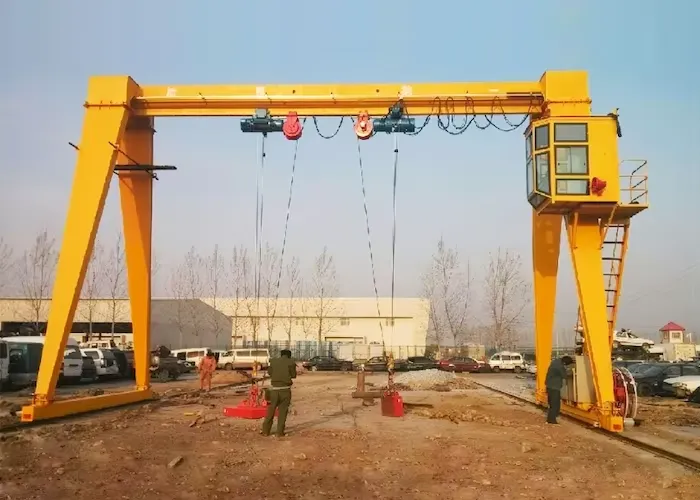
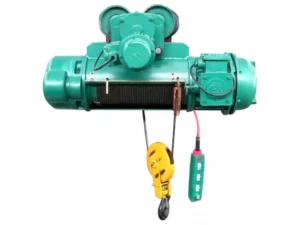
The hoist type explosion proof crane pairs a standard single or double girder bridge structure with a dedicated explosion proof wire rope hoist as the lifting mechanism. Capacity range is 1–16 tons across spans up to 28 meters, at duty class A5–A6.
The practical differentiation from the single girder “open winch” configuration above is maintenance: the hoist unit is a self-contained, replaceable module, which means routine maintenance (rope replacement, brake inspection, motor service) can be carried out by dismounting the hoist without decommissioning the entire crane. For facilities with limited crane maintenance expertise, this reduces downtime. The cost entry point is also lower — the hoist mechanism itself is a standard production item rather than a custom-built trolley winch, so supply chain and spares availability are better.
Not sure which configuration fits your site? Send your zone classification and load data — our engineers respond within 24 hours.
Get Custom Quotation NowReading Explosion-Proof Ratings: What the Codes Actually Mean
Gas group and temperature class determine your real compliance boundary
The single most technically misunderstood aspect of explosion-proof crane procurement is the relationship between gas group rating and temperature class — and it is the area where under-specified equipment most often fails at site inspection.
Explosion-proof equipment for gas atmospheres is rated by gas group (IIA, IIB, or IIC) and temperature class (T1–T6). The gas group rating reflects the ignition energy threshold of the target substance: IIA covers gases like propane and methane (relatively high ignition energy); IIB covers hydrogen sulfide, ethylene, and town gas; IIC covers hydrogen and acetylene, which have extremely low ignition energy and require the highest containment standard. A crane rated IIB is not compliant in an IIC hydrogen atmosphere — the containment gaps in the enclosure that are acceptable for IIB are too wide for IIC.
Temperature class works the other way around: T4 means the surface temperature of any component will not exceed 135°C; T6 means it stays below 85°C. If your process involves substances with an auto-ignition temperature of 100°C (common in some solvent atmospheres), a T4 crane creates a latent ignition risk from motor and brake surface temperatures. The correct T-class must be matched to the lowest auto-ignition temperature among all substances present in the classified area — not just the primary process gas.
Practical selection rule: specify your gas group and T-class in the RFQ document, require the supplier to confirm the crane’s certification covers that combination, and ask for the actual test certificate — not just a declaration that the unit is “ATEX certified.”
The IIA/IIB/IIC and T-class quick reference
| Gas Group | Typical Substances | Implication for Crane |
|---|---|---|
| IIA | Propane, methane, ammonia | Standard Ex d enclosures sufficient |
| IIB | Ethylene, H₂S, town gas | Tighter enclosure gaps required |
| IIC | Hydrogen, acetylene | Highest containment standard; not all suppliers can certify |
| T4 | Auto-ignition ≥ 135°C | Common for most petrochemical solvents |
| T5 | Auto-ignition ≥ 100°C | Required for some specialty chemicals |
| T6 | Auto-ignition ≥ 85°C | Rare; most applicable to carbon disulfide atmospheres |
Technical Specifications: What to Confirm Before Ordering
Duty class is the hidden variable that most buyers under-specify
The most common procurement error in explosion-proof crane purchasing is specifying capacity and span correctly while under-specifying duty class — and in a hazardous area, the consequences go beyond mechanical wear.
Duty class (A5, A6, A7 per ISO 4301 / FEM 1.001 classification) describes the combined effect of load spectrum and number of lifting cycles over the crane’s design life. A crane specified at A5 but operated at A7 intensity will experience motor temperatures that exceed the design envelope — and in an ATEX Zone 1 environment, a motor that runs hotter than its T-class surface temperature limit is not just wearing faster, it is a certified ignition risk.
Before ordering, calculate your actual daily cycles: how many lifts per shift, at what fraction of rated load, across how many shifts per day. If your production line moves loads every 10–15 minutes across two shifts, you are almost certainly in A6–A7 territory regardless of what your procurement team has historically specified. Weihua’s double girder explosion proof cranes cover A6–A7 duty class; the single girder and hoist-type units are rated A5–A6 — match your operational reality to the right model before sending the RFQ.
Complete specifications at a glance
| Parameter | Range (Weihua Explosion Proof Overhead Crane) |
|---|---|
| Lifting Capacity | 1–100 t |
| Span | 7.5–35 m |
| Lifting Height | 6–30 m |
| Duty Class | A4–A7 (by model) |
| Explosion Proof Grade | ATEX Zone 1/2, IECEx, NEC Class I & II Div. 1/2 |
| Hoisting Speed | 0.8–8 m/min |
| Traveling Speed | 20–60 m/min |
| Control Method | Pendant / Wireless Remote / Cabin |
| Power Supply | 380–415 V, 50 Hz (customizable) |
| Working Temperature | -25°C to +40°C |
Certifications and Compliance: What to Require From Your Supplier
Certification gaps are the leading cause of delayed commissioning — here is how to close them
A supplier who quotes “ATEX certified” without providing the actual certificate scope is giving you a marketing claim, not a compliance guarantee. The gap between a Declaration of Conformity that covers the full crane assembly (including all electrical components) and one that covers only the hoist unit is substantial — and it only becomes apparent when your local authority having jurisdiction reviews the documentation at installation.
For any explosion proof overhead crane purchase, require the following documents in writing before issuing the purchase order:
Required certifications and documents:
- EC Declaration of Conformity (for ATEX/EU) or IECEx Certificate of Conformity — covering the complete crane assembly, not individual components in isolation
- ATEX product certificate confirming gas group (IIA/IIB/IIC), T-class, and zone rating (Zone 1 or Zone 2)
- Overload and load test certificate — typically a 125% static load test conducted before shipment
- ISO 9001 quality management system certificate from the manufacturer
- CE marking documentation under the EU Machinery Directive (2006/42/EC) if equipment ships to the EU or to countries that recognize CE
- Technical file / technical drawings with explosion-proof component identification
- Operation and maintenance manual with explosion-proof inspection requirements
For North American projects, require NEC Class/Division documentation and confirm whether the equipment is listed by a Nationally Recognized Testing Laboratory (NRTL) such as UL or FM.
Why partial certification creates real operational risk
Some suppliers certify only the hoist or the motor and ship a standard structural assembly, claiming the crane is “explosion-proof” because its lifting mechanism is certified. This approach fails in Zone 1 environments: the traveling mechanisms (drive motors, contactors, control cabinets) are also potential ignition sources and must all carry appropriate Ex ratings. Partial certification may also void insurance coverage in the event of an incident — a point worth raising with your facility’s risk management team before finalizing any supplier.
Weihua’s explosion proof overhead cranes are designed with all critical components — hoisting mechanism, traveling mechanism, control system, brakes, and limit switches — meeting ATEX/IECEx explosion-proof standards. The company holds CE and ISO certifications and can provide full technical documentation at the quotation stage.
Get Custom Quotation NowApplications: Which Industries Require Explosion Proof Overhead Cranes


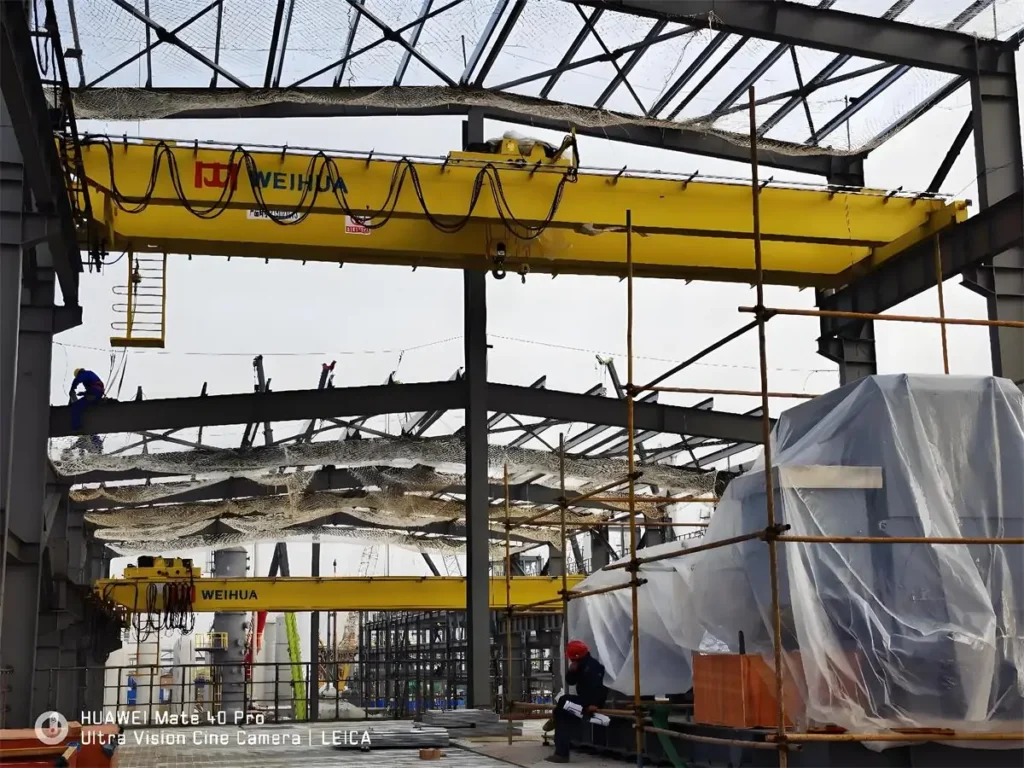
Most hazardous-area applications fall into six primary industry groups
Explosion proof overhead cranes are required wherever a facility’s area classification (as determined by a process safety engineer) designates Zone 1, Zone 2, Class I Division 1/2, or Class II Division 1/2. The industries where this applies most frequently are:
Petrochemical and oil refining: Maintenance lifts of reactor vessels, heat exchangers, and compressor assemblies in areas where hydrocarbon vapors are present. Double girder units at A6–A7 duty class are standard here, typically with IIB or IIC gas group rating depending on the specific process media.
Chemical manufacturing: Handling raw materials, intermediates, and finished product containers in solvent-rich environments. Gas group and T-class selection here is highly substance-specific — a plant handling ethylene oxide (IIC, low auto-ignition temperature) requires a fundamentally different specification from one handling propylene (IIA).
Pharmaceutical production: Solvent-based extraction and synthesis areas where alcohol vapors, acetone, or ether atmospheres may exist. Single girder units at A5–A6 are common; the underslung configuration is frequently chosen where mezzanine-level installations have limited hook height.
Battery and new energy manufacturing: Electrolyte filling lines and formation areas in lithium battery plants present Zone 1/2 conditions. This is a fast-growing application segment where demand for 5–20 ton explosion-proof cranes has increased substantially as battery factory capacity scales up globally.
Paint shops and coating facilities: Automotive and shipbuilding finishing halls where solvent vapors accumulate at low heights. Zone 1 classifications are common directly above the spray area.
Military and ammunition facilities: Handling and storage areas for explosive ordnance where the consequences of ignition are catastrophic and the regulatory requirements for equipment certification are the most stringent in any sector.
Conclusion
Selecting the right explosion proof overhead crane is a two-part decision: getting the technical specification right (gas group, T-class, duty class, configuration) and getting the documentation right (certificates covering the full assembly, not just components). Both matter equally — an under-specified crane in a Zone 1 environment is a safety risk; an under-documented crane fails at commissioning.
For most chemical, pharmaceutical, and battery manufacturing applications, a single girder or hoist-type explosion proof crane in the 5–20 ton range, rated IIB T4 Zone 1, will cover the operational envelope. For heavy refinery and petrochemical maintenance, the double girder at A6–A7 and IIB/IIC rating is the correct baseline. Start by confirming your zone classification and gas group with your safety engineer, then share those parameters with your crane supplier — this single step eliminates the majority of post-delivery specification disputes.
Ready to specify your explosion proof overhead crane? Share your lifting capacity, span, zone classification, and gas group with Weihua’s engineering team and receive a configured quotation with full certification documentation within 24 hours.

FAQ
What is the price range for an explosion proof overhead crane?
Market reference prices typically run from $18,000 for a 5-ton single girder unit to $280,000+ for a 100-ton double girder system with full ATEX/IECEx certification. The main cost drivers are gas group rating (IIC units cost more than IIA), duty class, span, and whether a control cabin is required. Standard overhead cranes in the same capacity range cost 30–60% less — the premium reflects the certified explosion-proof electrical and mechanical components throughout.
What certifications should an explosion proof overhead crane have?
At minimum, require an EC Declaration of Conformity (ATEX) or IECEx Certificate of Conformity covering the complete crane assembly, plus an ISO 9001 certificate from the manufacturer, CE marking under the Machinery Directive (2006/42/EC), and a load test certificate. For North American projects, confirm Class/Division documentation and NRTL listing. Always request the actual certificates — not just a supplier’s written claim of compliance.
What is the difference between Zone 1 and Zone 2 explosion proof cranes?
Zone 1 requires equipment rated for areas where an explosive atmosphere is likely to occur during normal operations; Zone 2 covers areas where it occurs only under abnormal conditions. A Zone 1-rated crane can legally operate in Zone 2, but not vice versa. Mismatching zone ratings is the most common compliance error — always confirm your area classification with a certified process safety engineer before specifying equipment.
How does duty class affect explosion proof crane selection?
Duty class (A4 through A7 per ISO 4301/FEM 1.001) determines the motor thermal load and mechanical design life. In a hazardous area, a crane operated above its rated duty class risks motor temperatures exceeding the T-class surface temperature limit — converting a maintenance issue into a potential ignition source. Calculate your actual daily lift cycles before specifying: if you’re running more than 8–10 lifts per hour across multiple shifts, you likely need A6 or A7, not A5.
Can an explosion proof overhead crane be customized for hydrogen environments?
Yes, but hydrogen (gas group IIC) is among the most demanding specifications. IIC rating requires tighter enclosure gaps, specific cable gland standards, and in some cases pressurized enclosures (Ex p) for larger control panels. Not all manufacturers can supply IIC-certified assemblies — confirm this capability explicitly and request the IIC certificate scope before proceeding. Weihua can configure and certify cranes for IIC environments; contact our engineering team with your process safety data sheet for a compliant specification.