
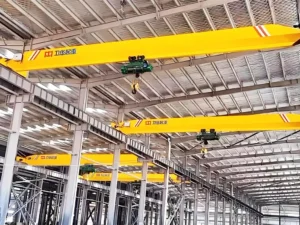
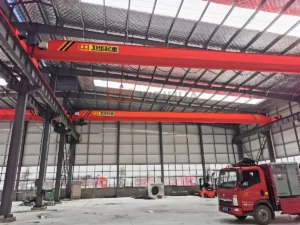
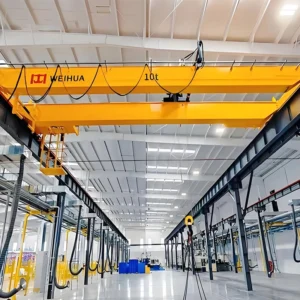
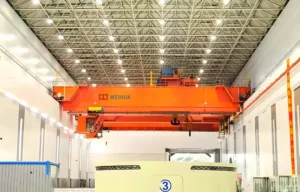




Selecting the right wind turbine manufacturing crane is not a single decision — it is a series of decisions made workshop by workshop, because tower section rolling, blade mould handling, nacelle assembly, and yard logistics each require a fundamentally different crane configuration. The dominant types are heavy-duty double-girder overhead cranes for indoor production, large-span gantry cranes and straddle carriers for outdoor yard operations, and in some cases multi-hoist goliath systems for final tower closing. Getting the type wrong — or specifying the right type at the wrong duty class — creates production bottlenecks that are expensive to fix once a building is commissioned.
What complicates procurement is that a single wind turbine component plant can require three or four distinct crane configurations under one roof. The workshop that rolls and welds tower sections has a completely different lifting profile from the nacelle assembly bay next door. This guide walks through each major production stage, identifies which crane type fits that stage, and explains the key specifications to verify before you commit to a purchase order.
Table of Contents
Why Wind Turbine Manufacturing Places Unusual Demands on Cranes
Components Are Large, Heavy, and Structurally Sensitive
The loads a wind turbine manufacturing crane must handle are among the most demanding in the heavy-industry sector. Tower sections — the rolled steel cylinders that form the turbine’s supporting column — weigh between 60 and 150 tonnes each, with diameters exceeding 5 metres and lengths of 20 to 30 metres per section. Nacelles, the housing that contains the gearbox, generator, and main shaft assembly, range from 100 tonnes for onshore three-megawatt-class turbines to over 400 tonnes for large offshore platforms. Blades currently run to 80–100 metres on the largest commercial turbines and, while lighter per unit, are extremely long and prone to flex damage if lifted from the wrong pick points.
These are not standard heavy-workshop loads. The asymmetry of blades, the need to rotate and flip tower sections during welding, and the precision required when lowering a nacelle onto its drivetrain mean that even a crane with adequate rated capacity may be unsuitable if it lacks the right control features.
Synchronised Multi-Hoist Lifting Is a Factory-Floor Requirement
One specification that separates a crane configured for wind turbine manufacturing from a general-purpose heavy-lift crane is multi-hoist synchronised control. Tower sections need to be rotated and repositioned while suspended; a single hoisting point creates bending stress that can deform a freshly-welded section. Industry practice is to use two hoists running in coordinated control — keeping the suspended section level within millimetre tolerances regardless of load distribution shift during rotation.
This requirement immediately eliminates most single-trolley overhead crane configurations from the shortlist for tower production, and points specifically toward double-girder bridge cranes with VFD-controlled (variable frequency drive) twin trolleys, or large gantry systems with built-in multi-hoist controllers.
Why Duty Class Is the Most Underestimated Specification in Wind Factories
Duty class — the FEM / ISO 4301 classification that rates how intensively a crane will operate over its design life — is consistently underweighted in wind turbine manufacturing crane procurement. Tower section production lines commonly run two or three shifts, with the crane in near-continuous use throughout each shift. A crane specified at A5 may perform adequately in a general fabrication shop but will reach its design fatigue life well ahead of schedule under a continuous-production tower manufacturing regime.
For tower section rolling and welding stations, A6 is the practical minimum; flagship production lines justify A7. Blade mould handling, by contrast, involves infrequent but very precise lifts, and an A4–A5 crane with fine-speed creep control often makes more sense than a high-duty-class workhorse. Specifying duty class correctly at the outset avoids mid-contract retrofits and the associated production downtime.
Wind Turbine Manufacturing Crane Selection by Production Stage
Tower Section Rolling and Welding: Double-Girder Overhead Crane with Twin Trolleys
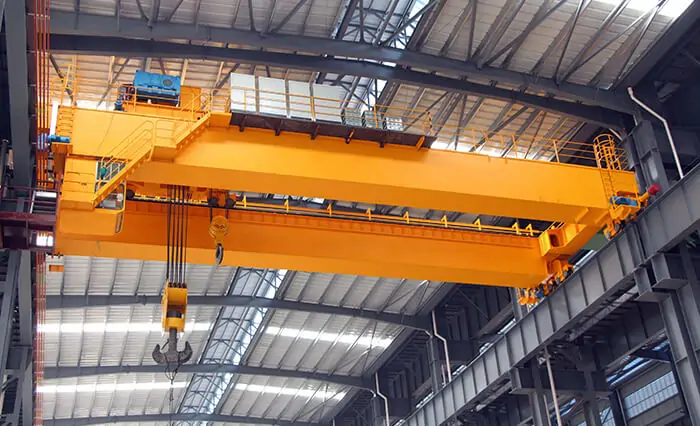

The tower section production workshop is the most crane-intensive area of any wind turbine component plant. Steel plate is rolled into cylindrical sections, welded at the seams, flanged, and assembled into multi-section tower segments — and the crane is active through every one of these stages across the full length of the building.
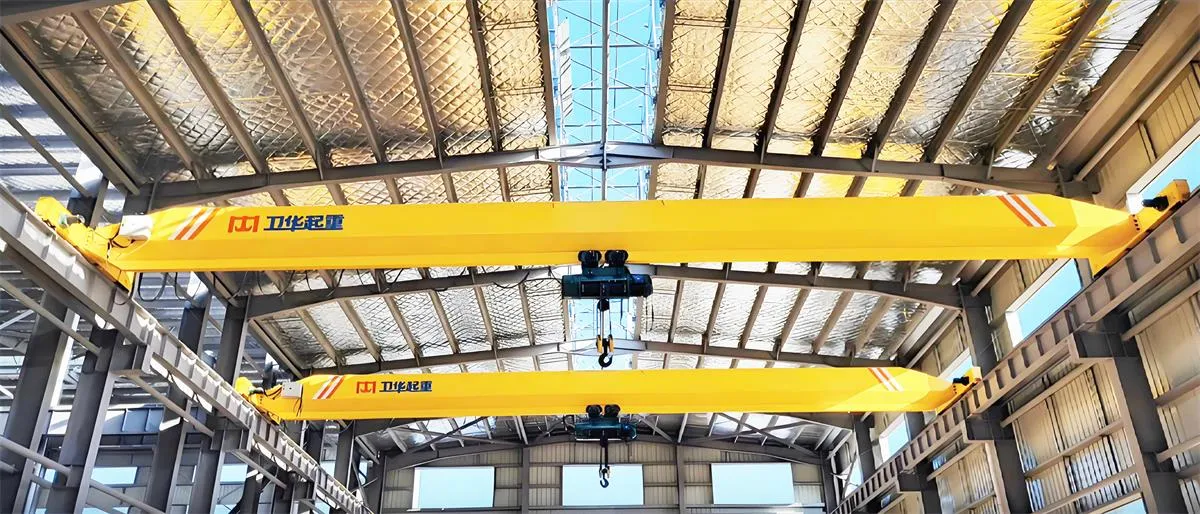
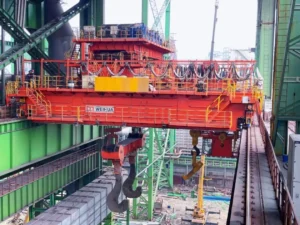
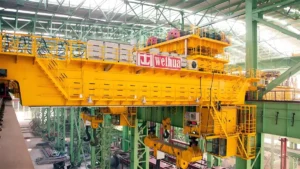
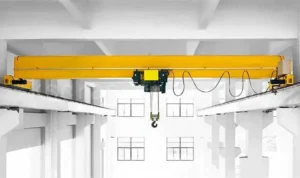
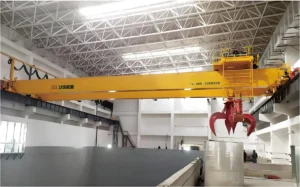
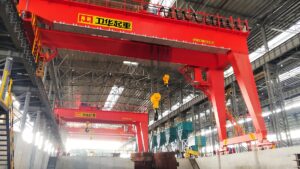
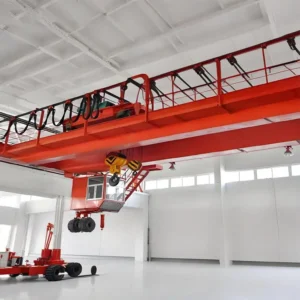
The correct wind turbine manufacturing crane for this workshop is a heavy-duty double-girder overhead travelling crane with twin trolleys in synchronised control, lifting capacity in the 80 to 350-tonne range, and duty class A6 to A7. The double-girder structure is non-negotiable at this scale: the hook path runs between the two main girders rather than below the lower flange, which recovers several hundred millimetres of hook height within the same building structure — a meaningful figure when lifting a 25-metre tower section in a building with limited headroom. Variable-frequency drives on all motions — hoist, trolley, and bridge travel — allow the precise positioning needed during flange alignment and section-closing operations.
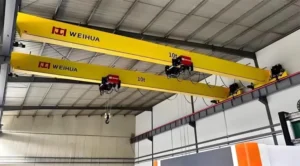
Weihua’s double-girder overhead crane range covers the capacity and duty class requirements for tower manufacturing, with available configurations for dual-trolley synchronised control and anti-sway systems. The wind power industry solutions page provides a summary of standard specifications across the full wind manufacturing product range.
Blade Production and Mould Handling: Extended-Span Overhead Crane with Fine-Speed Control
Blade manufacturing presents almost the opposite crane challenge from tower work: the loads are lighter — typically 10 to 30 tonnes per mould half — but the components are extremely long (40–80 metres for the mould alone), fragile relative to their span, and require controlled rotation through multiple process stages including infusion, curing, trimming, and finishing.
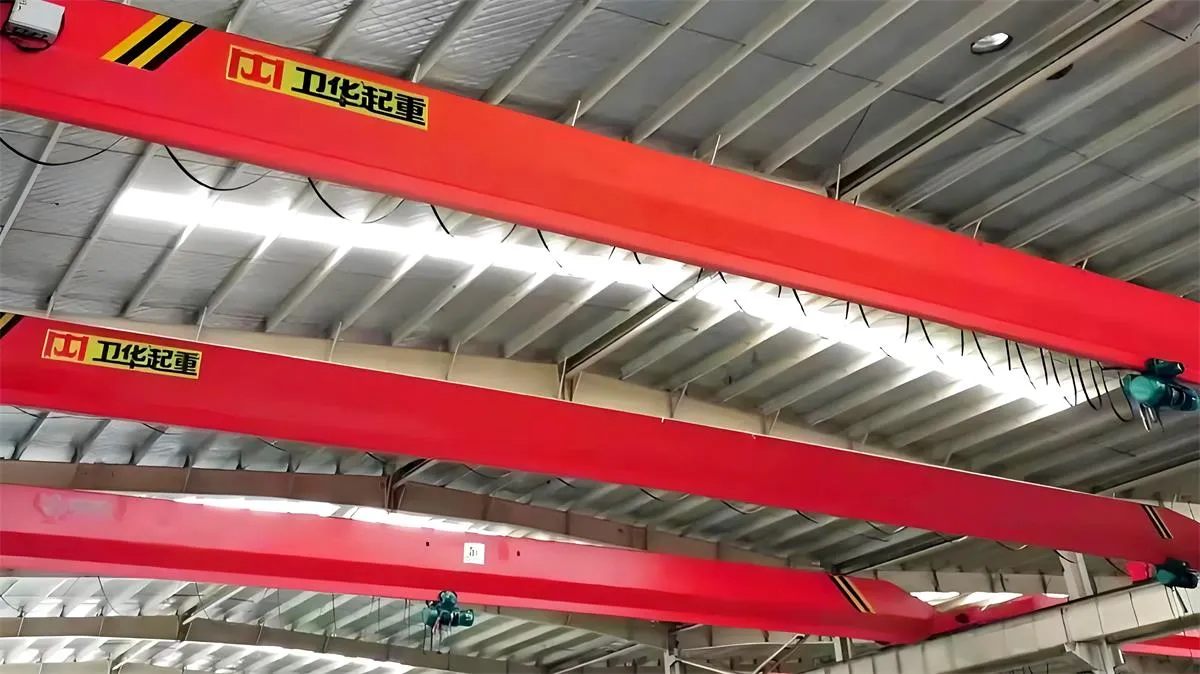
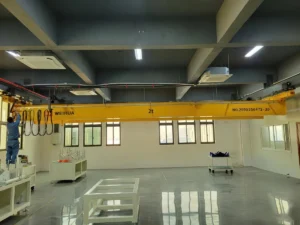
Two configurations are common in blade plants. For the main mould-handling operation running the production line, a single-girder or double-girder overhead crane with extended span — sometimes 30–40 metres to straddle two parallel mould bays — handles the primary lifting. For mould closing, where one mould half must be lowered precisely onto the other along its entire length simultaneously, a second lower-capacity crane or a tandem hook system on the same runway handles the controlled closing movement.
The critical specification here is not raw lifting capacity but fine-speed creep control at the lower end of hook speed range, and hook path clearance at the mould end wall. A trolley that cannot travel to within 300 mm of the end stop is a production constraint in a blade factory where the mould end geometry overhangs the runway by design.
Nacelle and Drivetrain Assembly: Heavy-Duty Overhead Crane with Cabin Control
Nacelle assembly workshops handle some of the heaviest precision work in the plant. Main shafts and main bearings can exceed 50 tonnes individually; completed nacelle assemblies on large offshore turbines exceed 400 tonnes. The assembly process involves sequential positioning of sub-assemblies onto a main frame, which means the crane spends a significant proportion of its operating time holding a heavy load stationary at a precise height while assembly work is carried out at floor level.
This duty cycle — frequent static holds at mid-travel, high positioning precision, moderate travel frequency — typically points to a double-girder overhead crane in the 100–350 tonne class, A5–A6 duty class, with a full-travel operator cabin rather than pendant or remote control. Anti-sway control is valuable at this scale because the hook-to-load distance on a large nacelle assembly crane is significant, and even modest bridge travel accelerations can induce swing that delays precision assembly operations.
Outdoor Yard Cranes: Tower Storage and Finished-Component Logistics


Heavy Gantry Cranes for Tower Section Yards
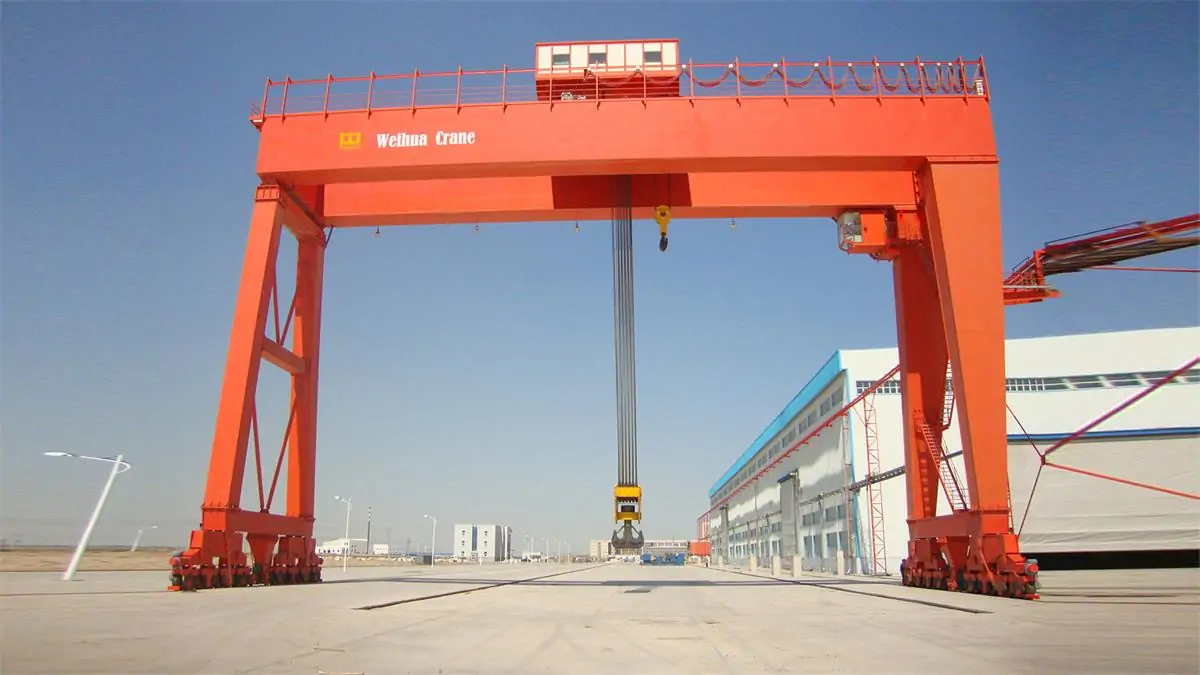
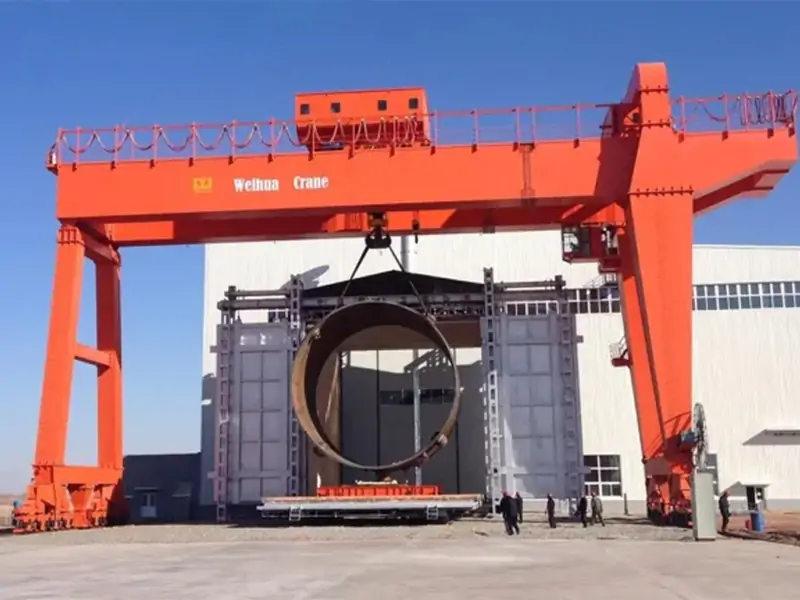
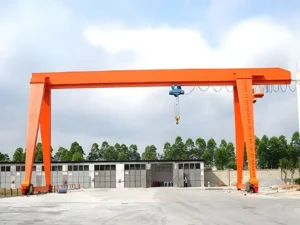
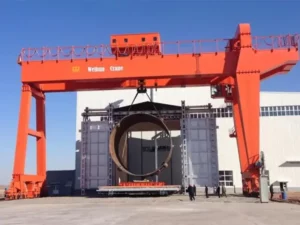
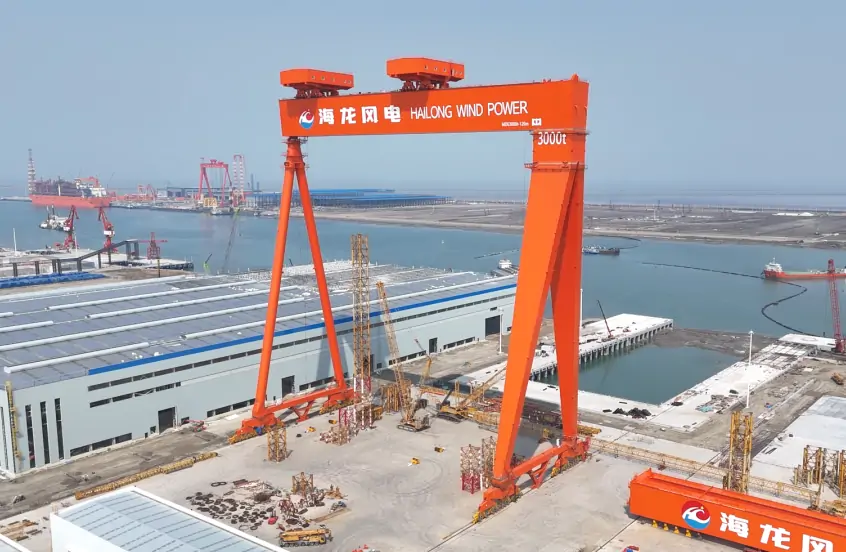
Completed tower sections move from the production building to outdoor storage yards, where they are grouped by order and held until transport dispatch. A wind turbine manufacturing crane for this environment must operate across the full yard width regardless of weather, handling sections that may weigh 80 to 150 tonnes each.
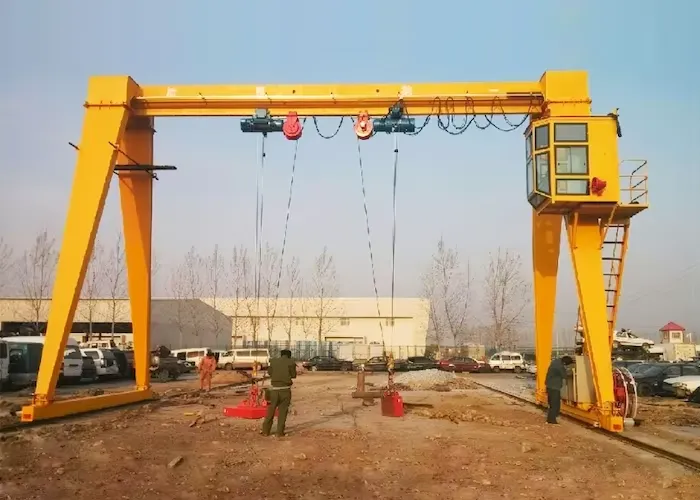
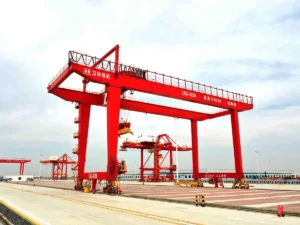
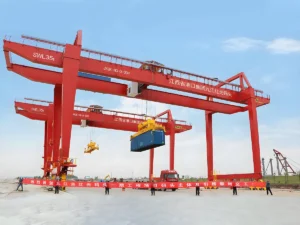
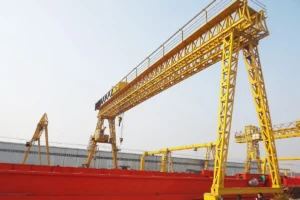
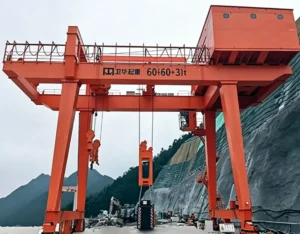
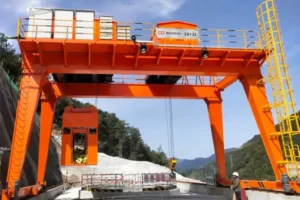
The standard selection is a double-girder gantry crane in the 50–200+ tonne class, rail-mounted with a span matched to the yard lane width. The rail footprint commits the storage layout permanently once installed, so span selection at the design stage matters: the rail gauge must accommodate the largest tower section diameter in your product range, plus working clearance on both sides, plus the wheel base of any ground-level transport that must cross the rail.
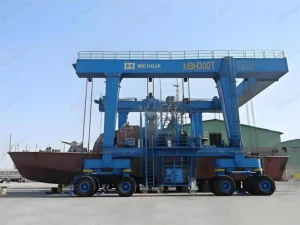
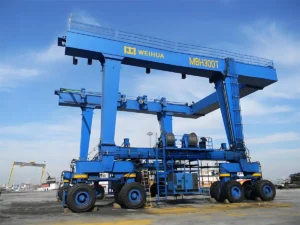
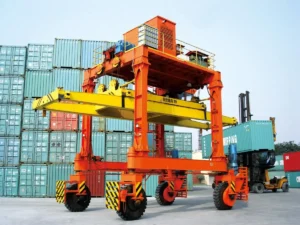
For plants that handle components of varying cross-section across different turbine platforms, or where yard layout needs to flex between production campaigns, a straddle carrier offers an alternative. Rubber-tyred and self-propelled, it accesses any point in the yard without requiring rail infrastructure. The practical trade-off is lower maximum capacity (most straddle carriers for wind components operate in the 35–200 tonne range) and a higher per-unit capital cost compared to a fixed gantry of equivalent span.
Blade Logistics: Gantry with Adjustable Spreader Attachment
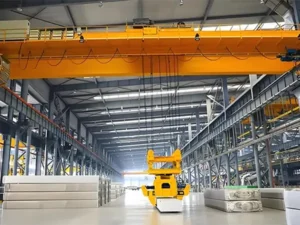
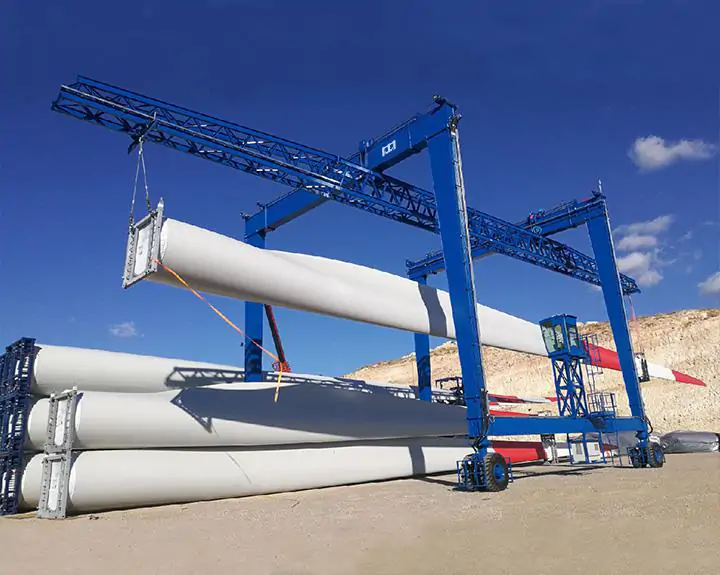
Blade yard handling introduces a specific challenge: the blade’s centre of gravity shifts progressively along its length from root to tip, which means a single-point lift creates unacceptable bending stress. Standard practice is to use a gantry crane equipped with a multi-point spreader bar whose pick points are pre-positioned to match the blade’s mass distribution profile for each turbine platform.
A large-span gantry in the 20–80 tonne class, combined with a blade-matched spreader designed for the specific blade length and chord profile being handled, covers the standard blade logistics requirement in most tower and blade component yards.
Quick Selection Reference
| Production Stage | Crane Type | Typical Capacity | Key Specification |
|---|---|---|---|
| Tower rolling & welding | Double-girder overhead, twin trolleys | 80–350 t | A6–A7, synchronised control |
| Blade mould handling | Double-girder overhead, extended span | 10–50 t | Fine-speed, end-stop proximity |
| Nacelle assembly | Double-girder overhead, cabin | 100–350 t | Anti-sway, A5–A6 |
| Tower section yard | Double-girder gantry or straddle carrier | 50–200+ t | Rail vs. rubber-tyre trade-off |
| Blade yard logistics | Gantry + spreader bar | 20–80 t | Adjustable pick points |
Specifying a wind turbine manufacturing crane for your facility? Send our engineers your workshop dimensions, section weights, production shift pattern, and building height — we’ll prepare a configuration recommendation.
Get Custom Quotation Now
Certifications and Standards to Verify Before Purchase
Which Standards Apply to Wind Turbine Manufacturing Cranes
Three documents should be on your pre-purchase checklist for any wind turbine manufacturing crane:
ISO 4301 / FEM duty class documentation confirms the crane has been designed and tested for the cycle frequency your production schedule demands. Request the duty class calculation sheet, not just a letter on the datasheet, and cross-reference it against your expected annual lift cycle count.
ISO 9001 certification from the crane manufacturer confirms quality management systems at the factory level. For cranes entering the European market under the Machinery Directive 2006/42/EC, an EC Declaration of Conformity and a risk assessment are mandatory. For projects with EAC market requirements, verify the supplier can provide EAC conformity certification.
Proof load test record at 125% of rated capacity (the European standard under EN 13001, or the equivalent local standard) provides verification of structural margins before the crane enters service. Wind turbine manufacturers commonly operate under OEM quality qualification schemes that require supporting test documentation for lifting equipment in the production line — obtaining these records at point of purchase is significantly easier than chasing them after delivery and installation.
How Procurement Teams Can Verify Compliance
Request the EC Declaration of Conformity, the ISO 9001 certificate, and the factory acceptance test (FAT) report at the quotation stage, before the purchase order is placed. If the supplier cannot produce draft versions of these documents at quotation stage, that is a reliable indicator of documentation risk in the project.

FAQ
Q1:What is the most common wind turbine manufacturing crane used in tower section production?
The industry standard for tower section rolling and welding workshops is a double-girder overhead crane with dual-trolley synchronised control, rated at 80–350 tonnes and duty class A6 or A7. The double-girder structure recovers hook height under the roof, and synchronised twin trolleys allow controlled rotation of long cylindrical sections without inducing bending stress. Single-girder configurations are not adequate for this application.
Q2:What duty class should a crane have for wind turbine manufacturing?
Duty class depends on the specific production stage. Tower section production on a two- or three-shift schedule typically justifies A6 as a minimum, with A7 on high-volume lines. Blade mould handling — infrequent but precision lifts — typically falls within A4–A5. Nacelle assembly, which involves frequent static holds at high load, sits at A5–A6. Specifying the wrong duty class is the single most common procurement mistake in wind factory crane projects.
Q3:Is a gantry crane or a straddle carrier better for a wind component storage yard?
A rail-mounted gantry crane suits high-volume, fixed-layout yards where the lane pattern can be committed at the design stage. A straddle carrier suits yards where layout flexibility is a priority — for example, facilities handling components of different sizes across multiple turbine platforms. The gantry is typically lower capital cost per tonne of handling capacity; the straddle carrier offers operational flexibility that a fixed gantry cannot match.
Q4:How much does a wind turbine manufacturing crane cost?
Wind turbine manufacturing cranes — particularly the heavy-duty double-girder bridge cranes used in tower and nacelle workshops — are project-engineered to specific building dimensions, load profiles, and duty requirements. Meaningful pricing requires confirmed specifications: lifting capacity, span, lifting height, duty class, control system, and building interface (runway beam design). Contact Weihua’s engineers via WhatsApp +8613781917315 with your project parameters to receive a project-specific quotation.
Q5:What certifications should a wind turbine manufacturing crane supplier provide?
At minimum: an ISO 9001 certificate for the manufacturing facility, the EC Declaration of Conformity (CE, Machinery Directive 2006/42/EC) for European market cranes, the duty class calculation sheet per ISO 4301 or FEM, and a factory acceptance test report confirming proof load testing at 125% of rated capacity. Request these at quotation stage, not after delivery.