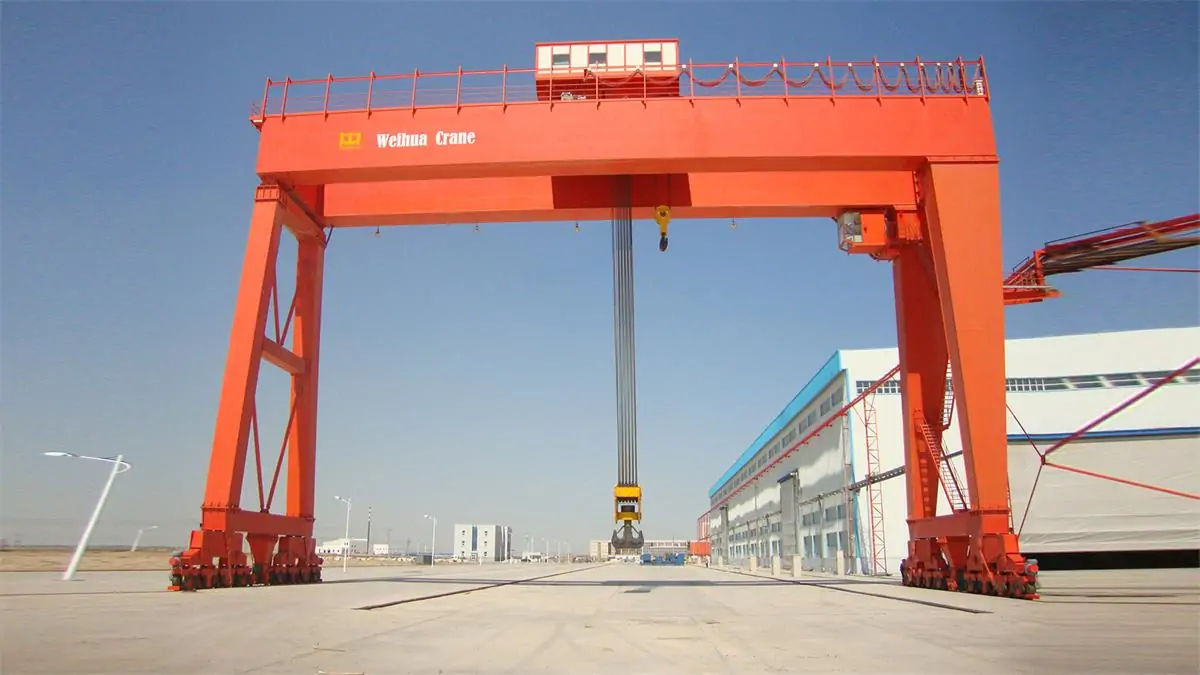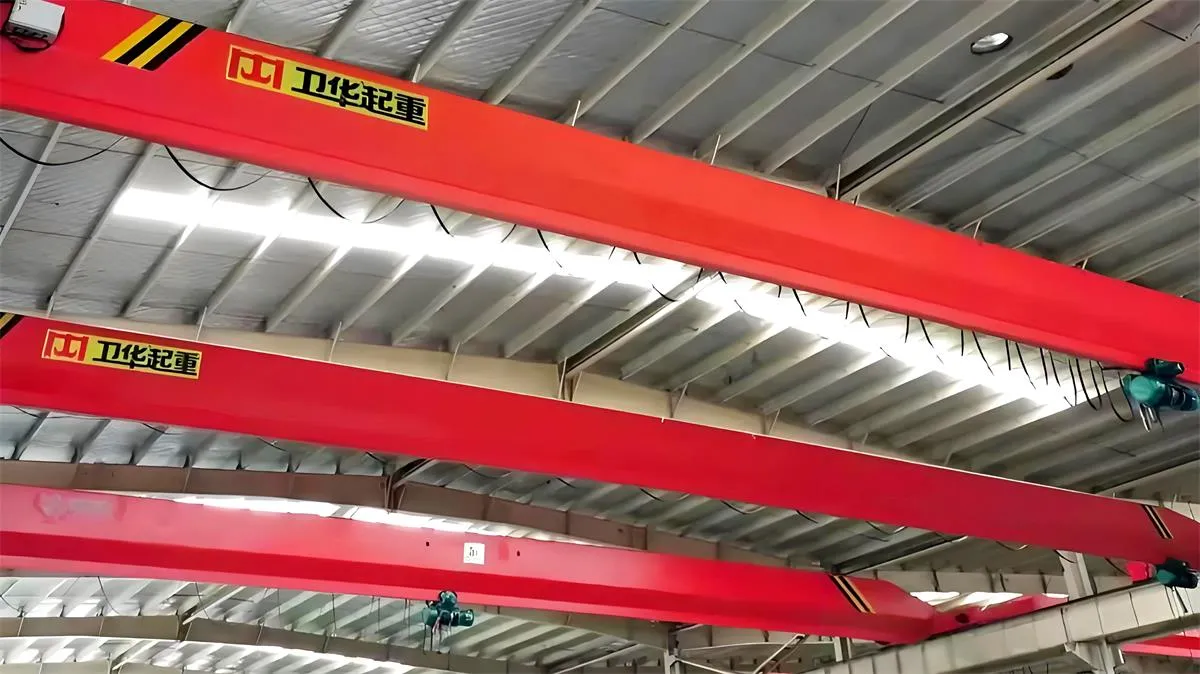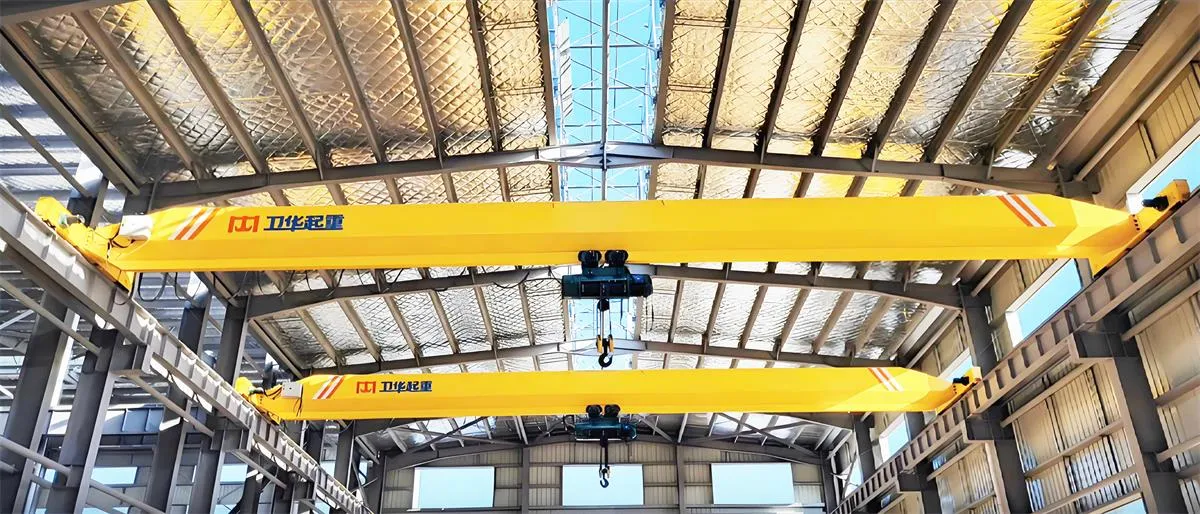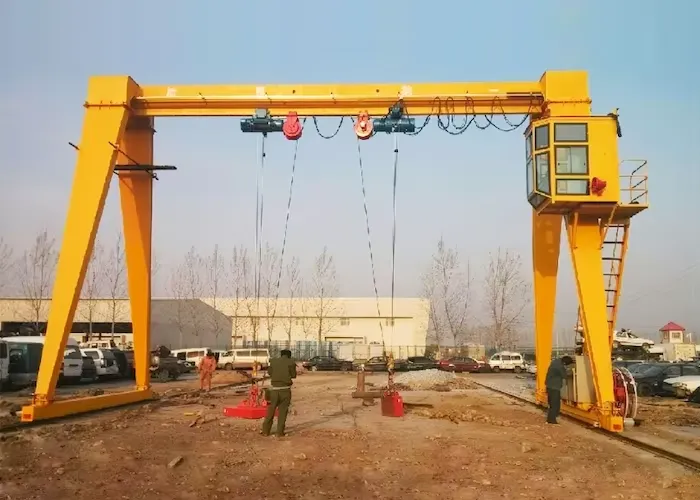

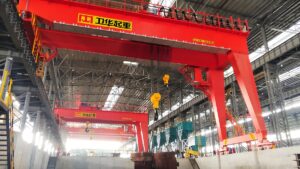








A procurement manager at a steel yard once asked us why their newly installed box girder crane kept triggering the anemometer and halting operations — the site was coastal, open on three sides, and nobody had accounted for wind load during the spec phase. That single oversight added months of downtime and a costly retrofit.
If your yard faces similar conditions — long spans, outdoor exposure, heavy loads — a truss gantry crane is likely the right starting point. The question is which configuration, at what capacity, and what to verify before you sign a purchase order.
This guide covers exactly that: how truss gantry cranes work, how to choose between single and double girder configurations based on your actual lifting requirements, what to budget, and what certification documents to request before shipment.
Truss Gantry Crane: Quick Reference
| Parameter | Single Girder Truss (MH Type) | Double Girder Truss (A Type) |
|---|---|---|
| Lifting Capacity | 5 / 10 / 16 tons | 120–300 tons |
| Span | 14–30 m | Up to 40 m |
| Lifting Height | 6 m / 9 m | 12 m (customizable) |
| Working Duty | A3 | A3 (M3) |
| Hoist Type | CD / MD electric hoist | Heavy-duty hook hoist |
| Power Supply | 380V / 50Hz / 3-phase | 380V / 50Hz / 3-phase |
| Typical Application | Steel yards, ports, outdoor storage | Engineering projects, heavy lifting |
| Market Price Reference | ~$18,000–$75,000 | ~$80,000–$380,000+ |
| Certifications to Request | CE, ISO 9001 | CE, ISO 9001; EAC if CIS destination |
Price ranges reflect market reference levels from Chinese manufacturers. Final pricing depends on span, capacity, control system, and destination. Contact Weihua Crane for a site-specific quotation.
Get Custom Quotation NowWhat Is a Truss Gantry Crane?
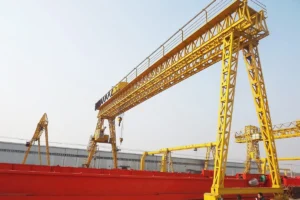
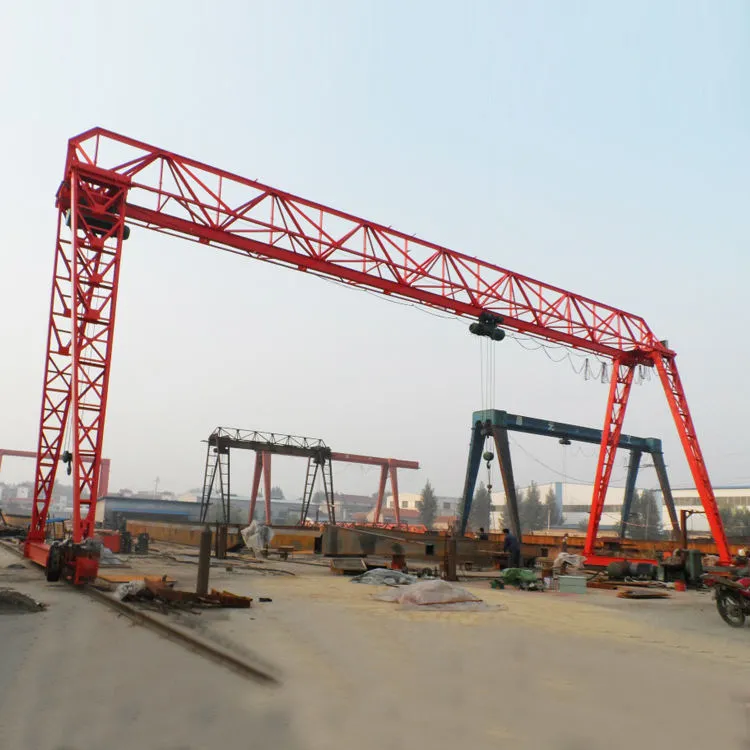
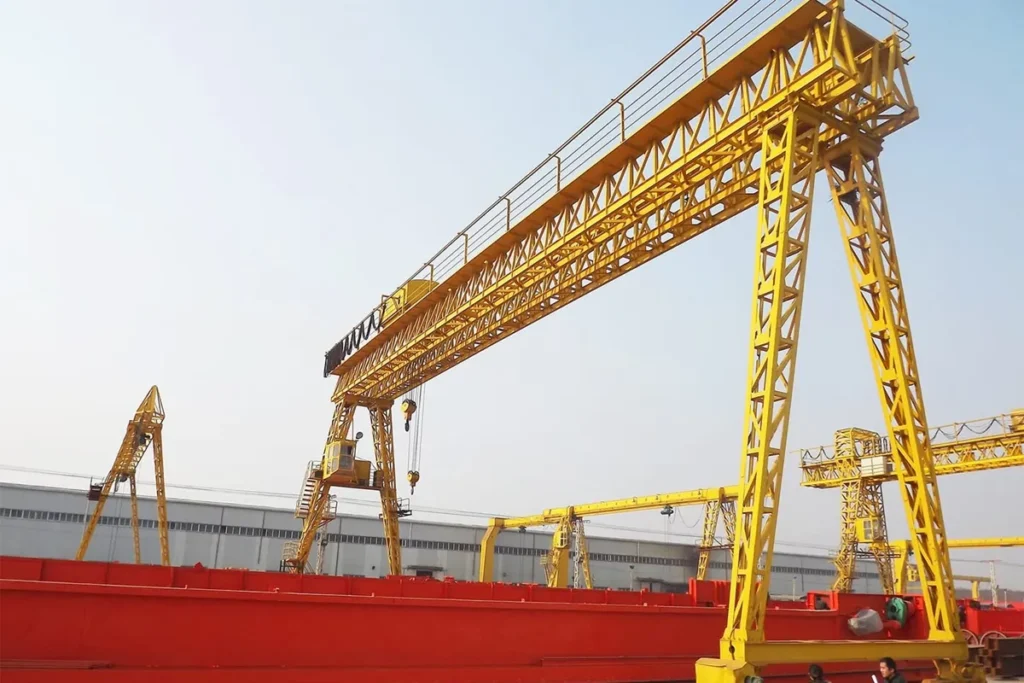
A truss gantry crane is a rail-mounted outdoor lifting system whose main beam is built as an open lattice framework — triangular or polygonal steel members welded together — rather than a solid box girder. This structure is classified under ISO 4301 and FEM 1.001 crane classification standards.
That structural choice is not cosmetic. The open lattice lets wind pass through rather than pushing against a solid face, which is why truss gantry cranes are the standard choice for high-wind outdoor sites. At the same time, the triangular geometry distributes stress efficiently, so the beam can span distances that would require a much heavier box structure to achieve the same load capacity.
Two primary configurations are available:
- Single girder truss (MH type) — 5 t, 10 t, and 16 t rated capacities; spans of 14–30 m; lifting heights of 6 m or 9 m; fitted with CD or MD electric hoists; working duty A3
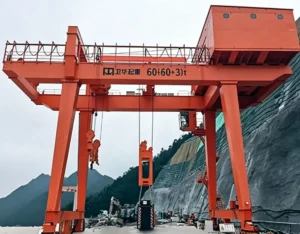
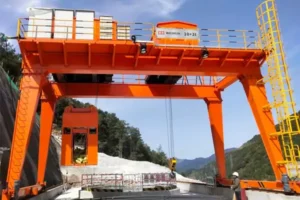
- Double girder truss (A type) — 120–300 t rated capacity (including combined hook configurations such as 150 t + 150 t); spans up to 40 m; lifting height 12 m standard; working duty A3 (M3); designed for engineering project use
Both configurations run on 380V / 50Hz / 3-phase power supply and are designed for outdoor or semi-outdoor operation.
Single Girder vs. Double Girder Truss Gantry Crane: How to Choose
Lifting Capacity Is the Primary Decision Driver
The selection between single and double girder is straightforward once you know your maximum required lift weight:
Single girder MH-type truss cranes are available in three standard capacities — 5 t, 10 t, and 16 t — across spans of 14 to 30 m. They are fitted with CD-type hoists at the lower end of the range and MD-type hoists for heavier or more frequent cycling requirements. Lifting height options are 6 m and 9 m. These cranes suit steel yards, outdoor storage facilities, port ancillary zones, and construction sites where loads are consistent and within the 16-ton ceiling. The lighter structure means lower foundation requirements and faster installation — a real advantage on sites where civil preparation costs are significant.
Double girder A-type truss cranes serve a fundamentally different load category: 120 t through 300 t, including combined configurations such as dual 150 t hooks operating in tandem. With a standard span of 40 m and a 12 m lifting height, these cranes are designed for engineering projects, large-scale outdoor construction, heavy component assembly, and any application where no single girder crane can come close to the required capacity. The dual-beam structure provides the rigidity and load distribution that tonnage in this range demands.
There is no overlap between configurations. Single girder tops out at 16 t; double girder starts at 120 t. If your lifting requirement falls between 17 t and 119 t, contact Weihua Crane’s engineering team to confirm the appropriate solution for your site.
Understanding Working Duty: A3 Across Both Configurations
Both the MH-type single girder and the A-type double girder truss cranes operate at working duty A3 (ISO 4301 classification), which corresponds to M3 under FEM 1.001. This duty class is designed for:
- Infrequent to moderate lift cycles — not continuous high-frequency operation
- Engineering projects and construction sites where cranes work intensively during active phases but are not running at or near rated load across every working hour
- Steel yards and port storage where lift frequency is regular but not extreme
This is an important clarification for buyers comparing specifications. A3/M3 does not mean the crane is lightly built — it means the fatigue design life and cycle assumptions reflect project-type and moderate industrial use rather than heavy continuous production. If your application requires sustained high-frequency cycling (shipyard hull assembly lines, heavy continuous manufacturing), discuss A6 or A7 duty-rated configurations with the engineering team before specifying.
Hoist Selection: CD vs MD for Single Girder Units
Single girder MH-type cranes are supplied with either CD-type or MD-type electric hoists depending on span and duty requirements:
- CD-type hoists — standard configuration for shorter spans and lighter duty cycling; suitable for 5 t and 10 t applications in typical storage and yard use
- MD-type hoists — recommended for longer spans (22 m and above) and applications requiring more robust cycling characteristics; standard for the full 5 t and 10 t range at larger spans, and across the 16 t range
Hoist selection is confirmed during quotation based on your specified span, capacity, and operating frequency.
Speed Reference (Single Girder MH Type)
| Configuration | Ground Control | Cabin Control |
|---|---|---|
| Traveling speed (5 t, span 14–18 m) | 20 m/min | 20 m/min |
| Traveling speed (5 t, span 22–30 m) | 20 m/min | 30–45 m/min |
| Traveling speed (10 t, span 14–18 m) | 20 m/min | 30 m/min |
| Traveling speed (10 t, span 22–30 m) | 20 m/min | 40 m/min |
| Hoist lifting speed (CD type, 5 t) | 8 m/min | — |
| Hoist lifting speed (MD type, 5 t) | 0.8 / 8 m/min (dual speed) | — |
| Hoist lifting speed (10 t) | 7 m/min (CD) / 0.7/7 m/min (MD) | — |
Speeds shown are reference values from standard catalog configurations. Confirm with engineering team for your specific span and hoist selection.
Double Girder A-Type Speed Reference
| Parameter | Value |
|---|---|
| Main hoist lifting speed | 0.67 m/min |
| Crab (trolley) traveling speed | 0–7.5 m/min |
| Gantry traveling speed | 0–9 m/min |
The low lifting speed on the double girder A-type reflects the precision-positioning requirements of large-tonnage engineering lifts — controlled descent and placement of loads at 120–300 t demands slow, precise movement rather than speed.
Full Technical Specifications
Single Girder Truss Gantry Crane (MH Type) — 5 t
| Span (m) | 14 | 18 | 22 | 26 | 30 |
|---|---|---|---|---|---|
| Lifting Height (m) | 6 / 9 | 6 / 9 | 6 / 9 | 6 / 9 | 6 / 9 |
| Hoist Type | CD₁ | CD₁ | MD₁ | MD₁ | MD₁ |
| Lifting Speed (m/min) | 8 | 8 | 0.8/8 | 0.8/8 | 0.8/8 |
| Motor — Ground Power (kW) | 11.3 | 11.3 | 12.7 | 12.7 | 12.7 |
| Working Duty | A3 | A3 | A3 | A3 | A3 |
| Recommended Rail | P24 | P24 | P38 | P38 | P38 |
| Power Supply | 380V / 50Hz / 3-phase |
Single Girder Truss Gantry Crane (MH Type) — 10 t
| Span (m) | 14 | 18 | 22 | 26 | 30 |
|---|---|---|---|---|---|
| Lifting Height (m) | 6 / 9 | 6 / 9 | 6 / 9 | 6 / 9 | 6 / 9 |
| Hoist Type | CD₁ | CD₁ | MD₁ | MD₁ | MD₁ |
| Lifting Speed (m/min) | 7 | 7 | 0.7/7 | 0.7/7 | 0.7/7 |
| Motor — Ground Power (kW) | 19 | 19 | 22.6 | 22.6 | 22.6 |
| Working Duty | A3 | A3 | A3 | A3 | A3 |
| Recommended Rail | P38 | P38 | P38 | P43 | P43 |
| Power Supply | 380V / 50Hz / 3-phase |
Double Girder Truss Gantry Crane (A Type) — 120–300 t
| Parameter | Specification |
|---|---|
| Lifting Capacity | 300 t (150 t + 150 t combined hook) |
| Span | 40 m |
| Lifting Height (main hook) | 12 m |
| Working Duty | A3 (M3) |
| Main Hoist Lifting Speed | 0.67 m/min |
| Crab Traveling Speed | 0–7.5 m/min |
| Gantry Traveling Speed | 0–9 m/min |
| Limit Dimensions L1 | 3,500 mm |
| Limit Dimensions C1 / C2 | 2,300 mm |
| Overall Height H | 17,900 mm |
| Power Supply | 380V / 50Hz / 3-phase |
All parameters are reference values from standard catalog configurations. Custom spans, lifting heights, and capacity combinations are available — confirm with Weihua Crane engineering team.
Price Reference
Single girder MH-type truss gantry cranes (5–16 t) typically fall in the $18,000–$75,000 market reference range, depending on span, lifting height, hoist type, and control configuration.
Double girder A-type truss cranes (120–300 t) generally range from $80,000 to $380,000 and above for large custom configurations.
These figures reflect Chinese manufacturer pricing levels. Destination freight, installation, and foundation costs are separate. We recommend requesting an itemized quotation that breaks out the crane structure, electrical system, hoist assembly, rail and foundation requirements, and site commissioning — each line item can vary substantially by project.
Get Custom Quotation NowCertification and Compliance: What to Verify Before Shipment
Certification is the area where import buyers most often face surprises at customs or during insurance claims. Request the following documents before signing a purchase order.
Applicable Standards by Destination
| Destination | Required Standard |
|---|---|
| European Union | CE marking under EU Machinery Directive 2006/42/EC; structural design per FEM 1.001 and ISO 4301 |
| CIS Countries (Russia, Kazakhstan, etc.) | EAC certification required |
| United States | OSHA crane regulations; ASME B30.16 safety standard framework |
| All export destinations | ISO 9001 quality management system certification |
Documents to Request Before Final Payment
- EC Declaration of Conformity — confirms the crane meets applicable EU directives
- ISO 9001 quality management certificate — confirms the manufacturing facility operates under a certified quality system
- Load test certificate — proof the crane was tested at rated load prior to shipment; do not accept verbal assurance in lieu of this document
- Material certificates for primary structural steel members
- Safety systems documentation — overload protection, travel limit switches, anti-collision devices, and load display must appear explicitly in the technical documentation; if listed as optional, confirm in writing whether they are included in your configuration
Why This Matters for Import Buyers
Missing or incomplete certification creates two specific risks: customs clearance delays at destination ports, and insurance claim complications if a lifting incident occurs. The most common oversight is not the absence of CE marking but the absence of the load test certificate — request it before final payment, not after shipment.
Application Scenarios
Steel mill material yards and outdoor storage — MH-type single girder cranes at 5 t, 10 t, or 16 t handle the majority of billet, plate, and structural steel transfer operations; spans of 14–30 m cover most standard yard widths
Port and dock ancillary zones — salt air and wind exposure are the two primary environmental challenges; the open-lattice truss structure addresses wind load directly, while corrosion-resistant specifications handle marine atmosphere
Large-scale engineering and construction projects — the A-type double girder at 120–300 t is the standard choice for bridge construction, precast element positioning, and large equipment installation where no single girder alternative is rated for the required load
Outdoor component assembly — wind turbine assembly, modular industrial construction, and similar applications where the combination of large span, heavy capacity, and modular transport sections all favor the truss over the box girder
For more information on precast gantry cranes used in highway bridge construction, see: Precast Gantry Crane for Bridge Beam Handling and Precast Construction
Buying from Weihua Crane
Weihua Crane has manufactured lifting equipment for over 37 years and holds CE and ISO 9001 certifications. Truss gantry cranes can be customized across lifting capacity, span, lifting height, hoist type, control method, and wind and corrosion protection specifications. A one-year warranty covers the equipment post-delivery; installation guidance and on-site technical support are provided.
To receive an accurate quotation, provide the following at inquiry:
- Maximum lifting capacity (tons)
- Site span (meters)
- Required lifting height (meters)
- Control preference — ground pendant, remote, or cabin
- Site location — for wind zone and corrosion class determination
- Power supply specification

Conclusion
If your site is outdoor, your spans exceed 14 meters, and you are lifting anywhere from 5 to 300 tons on a regular cycle, a truss gantry crane is the structural type to evaluate first — not because it is the cheapest option, but because its open-lattice design handles wind load in ways that box girder cranes cannot match at comparable cost.
Between single and double girder, the decision is clear-cut:
- 5 t, 10 t, or 16 t with spans of 14–30 m → MH-type single girder with CD or MD hoist, working duty A3
- 120 t to 300 t with spans up to 40 m → A-type double girder, working duty A3/M3, engineered for project-type heavy lifting
- Between 17 t and 119 t → contact the engineering team; this range requires direct configuration discussion
Both configurations share A3 working duty, which suits steel yard, port, outdoor storage, and engineering project applications. If your operation demands sustained high-frequency cycling beyond what A3 is designed for, specify this requirement upfront — duty class is the variable that determines long-term reliability, and it must match your actual operating profile before the order is placed.
Request the CE Declaration of Conformity and load test certificate before final payment, and you will avoid the two most common and costly mistakes in truss gantry crane procurement.
Frequently Asked Questions
Q1: What is the difference between a truss gantry crane and a box girder gantry crane?
The main beam construction differs. A truss gantry crane uses an open lattice of steel members; a box girder uses a closed solid-walled beam. Truss cranes are lighter per meter of span, exert lower wind load on the structure, and transport more easily in sections — which is why they dominate outdoor, large-span, high-wind applications. Box girders offer a smoother trolley travel surface and are generally preferred for indoor use or high-precision positioning work.
Q2: What capacities are available for single girder truss gantry cranes?
Standard MH-type single girder truss cranes are available in 5 t, 10 t, and 16 t rated capacities, across spans of 14 to 30 m, with lifting heights of 6 m or 9 m. CD-type hoists are fitted for standard configurations; MD-type hoists are recommended for longer spans and more demanding cycle requirements.
Q3: What does the double girder A-type crane handle, and what is the span?
The A-type double girder truss crane is rated for 120 t to 300 t, including combined hook configurations such as 150 t + 150 t. The standard span is 40 m with a 12 m lifting height. Working duty is A3 (M3), making it appropriate for engineering projects, large construction sites, and heavy outdoor assembly operations.
Q4: What is working duty A3, and is it suitable for my application?
A3 (equivalent to M3 under FEM 1.001) is an infrequent-to-moderate duty class. It is appropriate for steel yards, port storage, outdoor construction, and engineering project use — where lifting cycles are regular but not continuous at or near rated load. If your application involves sustained high-frequency cycling across every working shift, discuss A6 or A7 duty configurations with the engineering team before specifying.
Q5: Is there a capacity gap between single and double girder models?
Yes. Standard single girder MH-type cranes top out at 16 t; standard double girder A-type cranes start at 120 t. If your lifting requirement falls between 17 t and 119 t, contact Weihua Crane’s engineering team directly — custom configurations may apply, and this should be confirmed before specification is finalized.
Q6: What certifications should I request when importing a truss gantry crane?
At minimum: CE Declaration of Conformity (for EU destinations), ISO 9001 certificate for the manufacturing facility, and a load test certificate issued prior to shipment. For CIS destinations, also request EAC certification. Request all documents before making final payment — they are significantly harder to obtain after the equipment has shipped.
Q7: Can a truss gantry crane be configured for extreme outdoor environments?
Yes. Truss gantry cranes can be specified with windproof braking systems, anti-corrosion coatings for coastal or marine environments, low-temperature steel grades for cold-climate operations, and additional structural bracing for high-wind zones. Specify your site’s wind classification and ambient temperature range at the time of inquiry.