







A plant manager once ordered a standard double-girder EOT crane for a trim-and-final assembly bay — reasonable choice on paper, until it arrived and the hook path sat 600 mm above the overhead conveyor. Three weeks of shutdown, a structural reinforcement contract, and a replacement crane order later, the real lesson landed: in automotive manufacturing, specifying the wrong EOT crane for the wrong production stage costs far more than the crane itself.
Automotive plants are demanding environments. Three-shift schedules, precision die changes, explosive paint-booth atmospheres, and sub-tonne ergonomic lifts in final assembly all happen under one roof — and no single crane configuration handles all of them. Procurement managers who lead with tonnage alone routinely end up with equipment that either fails prematurely from duty class mismatch or physically cannot fit the installation point.
This guide maps each major production stage to the correct EOT crane type, gives you market-reference pricing in USD, covers the compliance requirements your supplier must document, and tells you exactly which questions to ask before signing a purchase order. Use the quick-reference table below as your first filter, then read the relevant sections for the full selection rationale.
Tabla de contenidos
Quick Reference: EOT Crane by Automotive Production Stage
| Production Stage | Recommended Crane Type | Typical Capacity | Key Requirement | Market Price Reference |
|---|---|---|---|---|
| Steel coil / blanking | Double-girder EOT + C-hook or coil tong | 10–32 t | FEM M5 duty class; coil tong rated to EN 13155 | $35,000–$120,000 |
| Stamping / die shop | Double-girder EOT with VFD + anti-sway | 16–50 t | Micro-speed ≤0.5 m/min; positioning ±2 mm | $60,000–$200,000+ |
| Body-in-white (BIW) welding | Single- or double-girder EOT | 5–20 t | Inverter-drive trolley; PLC integration option | $18,000–$75,000 |
| Paint shop | Explosion-proof overhead crane | 1–10 t | ATEX Zone 1/2 (IEC 60079); full Ex-system cert | $25,000–$90,000 |
| Powertrain / engine assembly | Underslung (underhung) overhead crane | 1–10 t | Low headroom; smooth VFD travel | $12,000–$55,000 |
| Final assembly / trim line | European-style EOT or underslung crane | 1–5 t | Compact end-truck; low dead-weight; push-travel option | $8,000–$40,000 |
Prices are market reference ranges for Weihua factory-direct supply; final figures depend on span, lift height, and options. Contact us to confirm.
Obtenga una cotización personalizada ahoraEOT Crane Applications Across the Automotive Production Line
Steel Coil Handling and Blanking
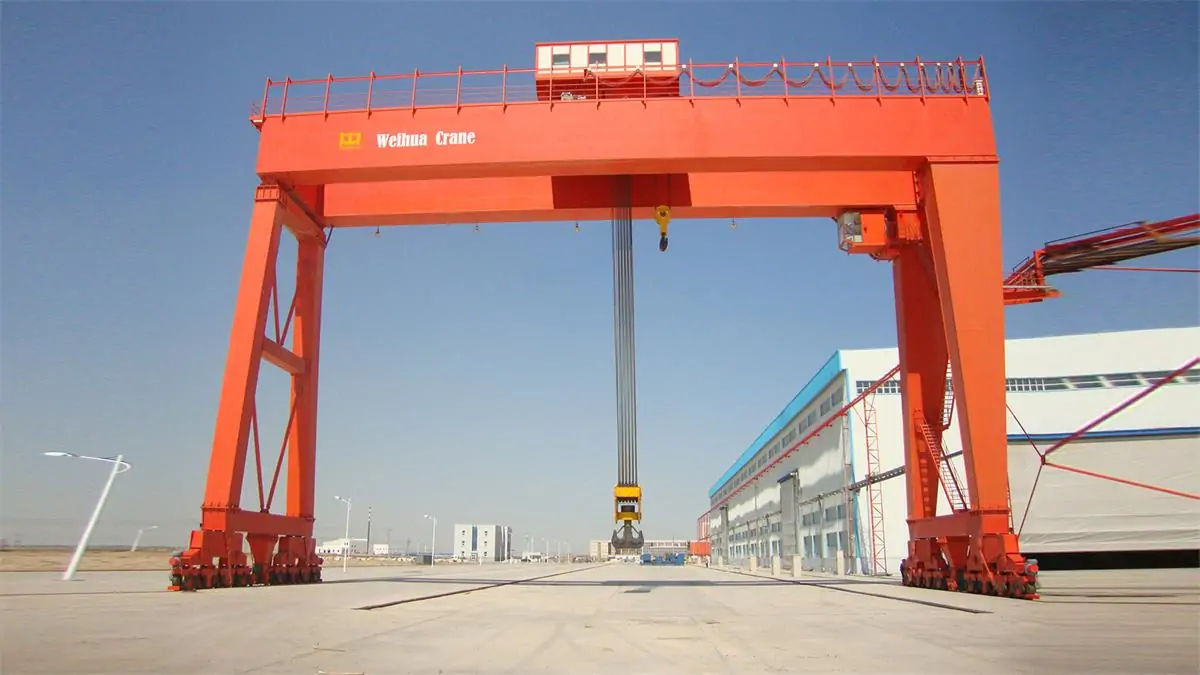
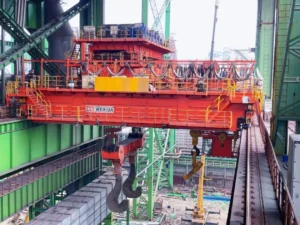
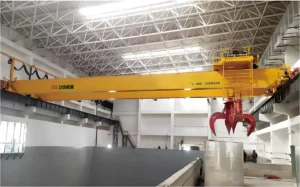
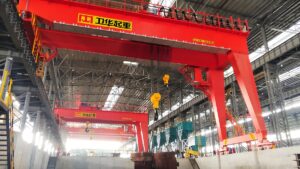
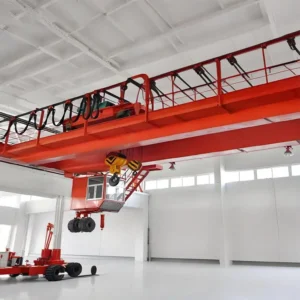
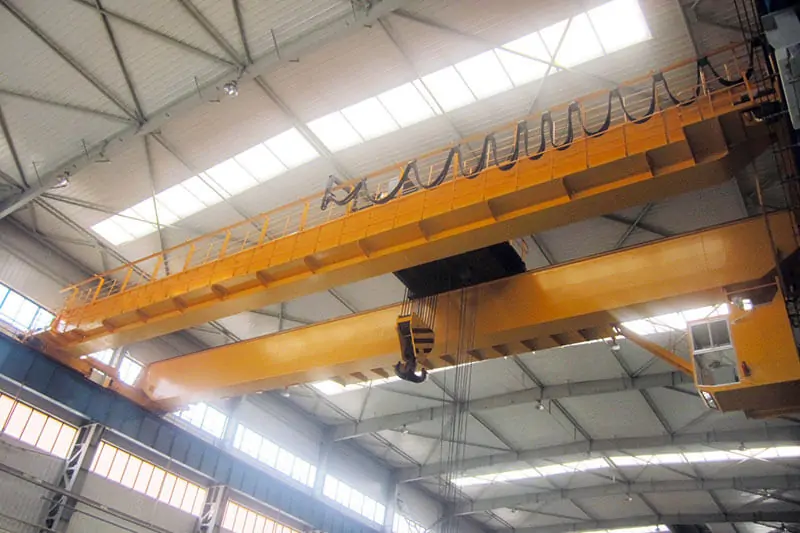
Double-girder EOT cranes with C-hooks are the standard configuration for moving steel coils from warehouse storage to blanking lines, and for this application we recommend specifying FEM 1.001 duty class M5 as a minimum. Steel coil weights in typical automotive stamping operations range from roughly 5 to 25 tonnes, and the crane span normally matches the bay width — commonly 18–28 m. The C-hook or coil tong must carry its own rated certification under EN 13155 for below-the-hook lifting devices; it’s a separate document from the crane’s CE declaration and is frequently missing from first-draft supplier quotations.
The common mistake at this stage is under-specifying duty class. A crane rated M3 or M4 running three-shift coil movements will typically exhaust its design life in 30–40% of its rated service period, because the actual lift cycle count far exceeds what M3 was designed for. High-volume plants running continuous blanking should be looking at M6.
Stamping and Die Shop
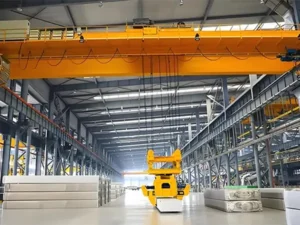
Die-handling cranes carry the highest technical specification demand of any application in the plant, and the tolerance margin is zero. Large body-panel dies weigh 15–40 tonnes, die change cycles on a World Class Manufacturing line must complete in under 10 minutes, and placement accuracy must land within ±2 mm of the press bed centerline. Standard hook speeds cannot achieve this — variable-frequency drives (VFDs) providing micro-speed positioning at ≤0.5 m/min are required, and anti-sway control (electronic closed-loop or mechanical damping) is not optional.
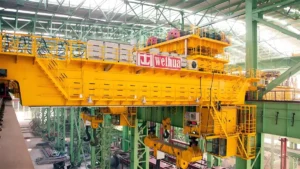
We also recommend a spreader beam or adjustable die gripper matched to the die’s lifting lug geometry rather than a standard hook, because hook-to-lug engagement on asymmetric dies introduces uncontrolled swing at the point of placement. The crane itself should be double-girder with a capacity of 20–50 t depending on the heaviest die in the press schedule. Market reference pricing for a fully specified stamping die crane with VFD, anti-sway, and positioning encoder runs $60,000–$200,000+, depending on span and capacity.
Body-in-White Welding Cells
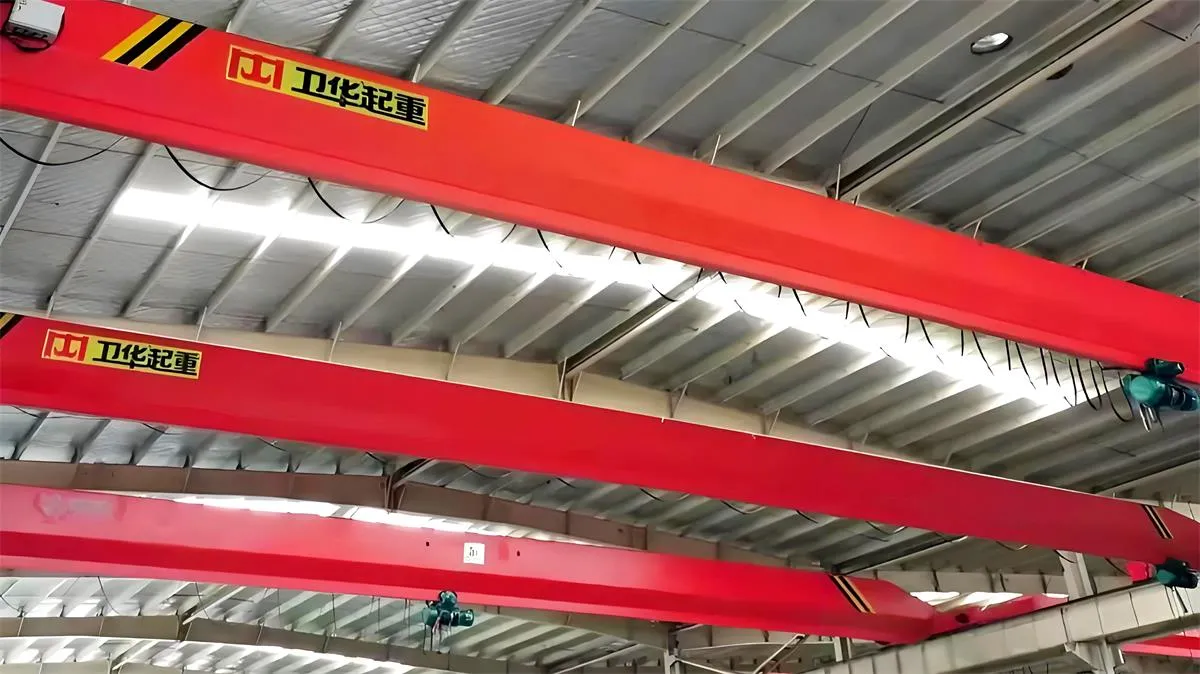
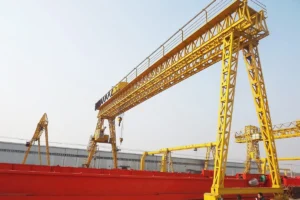
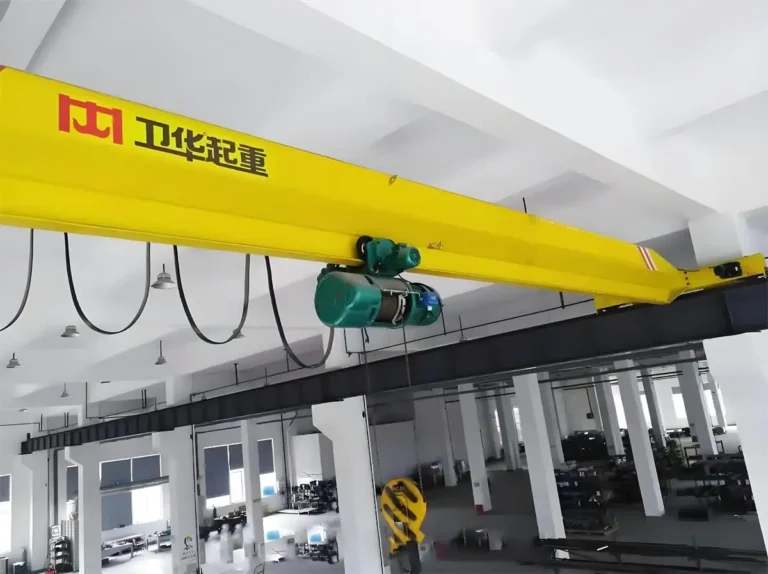
Single-girder EOT cranes (5–16 t) cover most BIW welding bay movements — transferring body assemblies between fixture stations, repositioning welding fixtures, and supporting die-maintenance access. Inverter-driven trolleys are important here because jerk-free starts protect freshly welded assemblies from stress at the joint while the metal is still cooling. In robotic welding cells, the crane is increasingly integrated into the plant automation network via PLC, with encoders and limit switches confirming load position before the robot cycle begins. Weihua’s single-girder and double-girder EOT cranes support standard fieldbus interfaces (PROFINET, Modbus TCP) for this integration.

Explosion-Proof Cranes in Paint Shops
Paint booths and primer application areas are classified as ATEX Zone 1 or Zone 2 under IEC 60079-10-1 — and standard EOT cranes cannot legally or safely operate in these zones. Weihua’s explosion-proof overhead cranes are built with Ex-rated hoists, spark-proof brake assemblies, dust-tight electrical enclosures (IP55 minimum), and non-sparking hook materials. Critically, the ATEX certification must cover the entire installed system — hoist unit, control pendant, runway conductors, and end-trucks — not just the hoist in isolation. A supplier offering ATEX certification on the hoist alone while fitting a standard pendant is non-compliant.
Capacities in paint shops are typically modest (1–10 t), but the compliance requirement is absolute regardless of tonnage. Operating a non-certified crane in an explosive atmosphere voids insurance coverage and creates direct liability exposure in the event of an incident.
Underslung and European-Style EOT Cranes for Assembly Operations
Underslung Overhead Cranes for Low-Headroom Assembly Bays
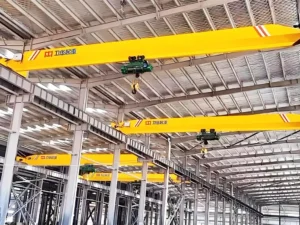
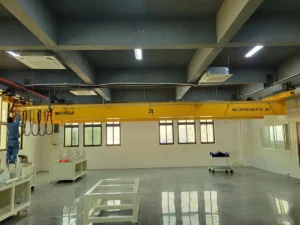
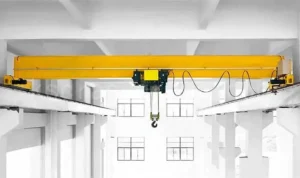
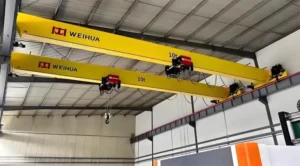
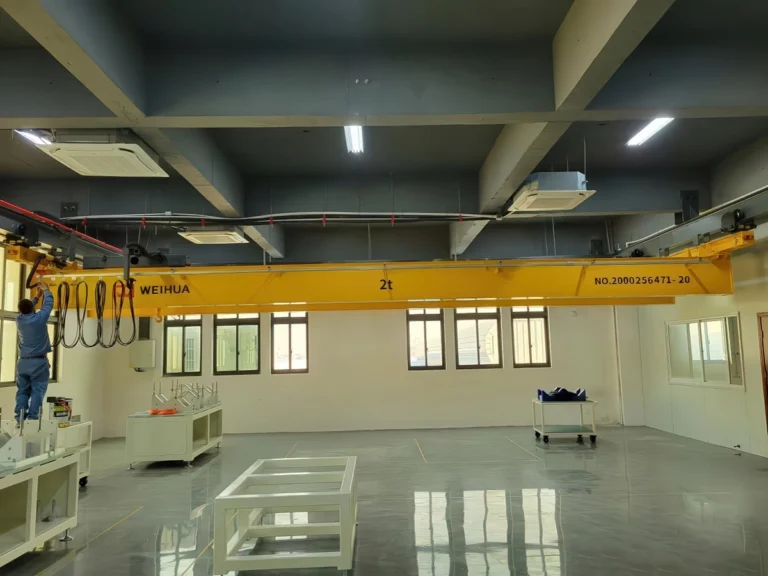
El underslung (underhung) overhead crane runs suspended from the lower flange of existing building steel rather than on top of rails, which delivers a meaningfully lower hook path — typically 400–800 mm lower than an equivalent top-running crane in the same building. For automotive final assembly and powertrain areas, where overhead conveyor systems, ventilation ducts, and lighting grids can leave as little as 3.5 m of usable working height, this headroom recovery is often the difference between a crane that physically fits and one that doesn’t.
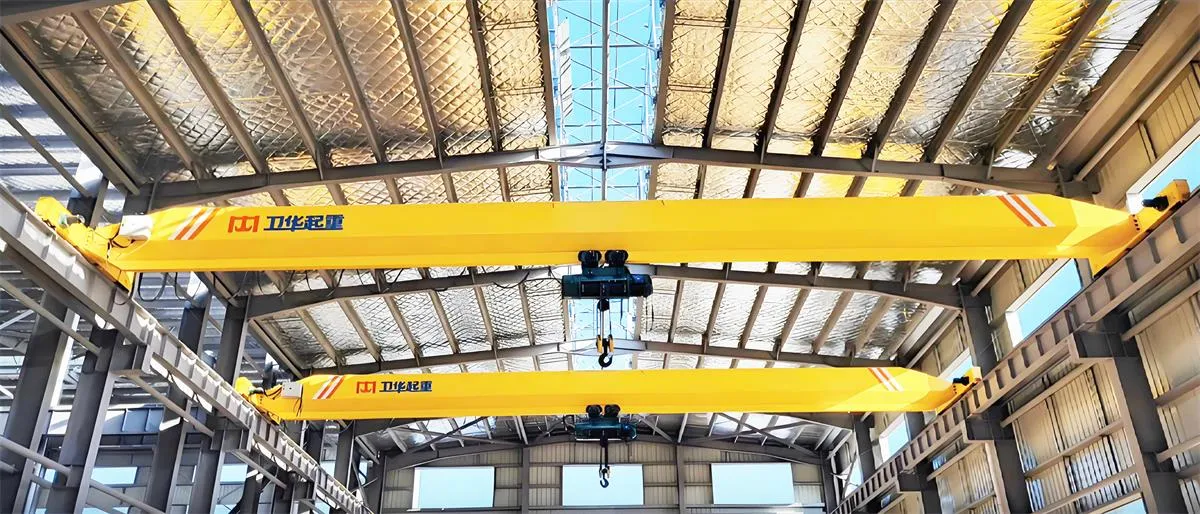
Weihua’s underslung overhead cranes are available from 1 to 10 t, which covers the full range of powertrain and trim-line lifting tasks. The smooth single-girder profile also makes them well suited to multi-crane bays where multiple underslung units share the same runway, covering overlapping service areas without inter-crane clearance penalties.
European-Style EOT Cranes for Final Assembly
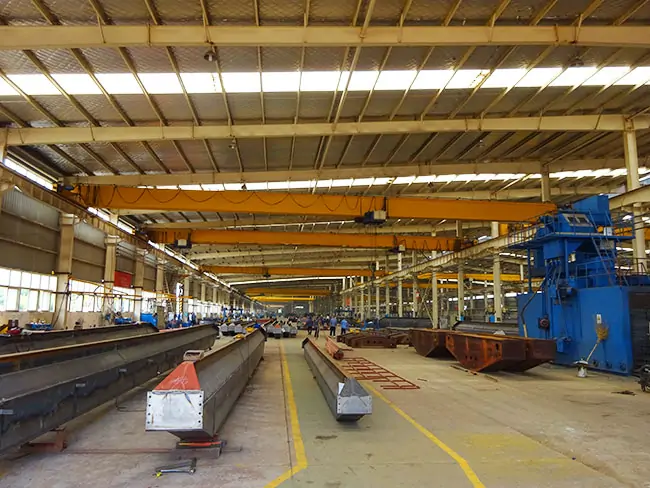
European-style EOT cranes use compact, low-profile end-trucks and lightweight structural profiles that reduce the crane’s own dead-weight compared to a conventional Chinese-standard single-girder. In final assembly, where load cycles are frequent but individual lifts are light (125 kg–5 t for seats, instrument panels, door assemblies, and trim components), the European-style crane’s lower self-weight reduces runway beam loading — which matters in older plant buildings or leased facilities with limited structural reserves. These cranes are available with push-travel operation, where the operator walks the load to the vehicle body without powered travel, preserving fine tactile control in the last metre of positioning.
How to Select the Right EOT Crane for Your Automotive Plant
Four Inputs You Must Confirm Before Contacting a Supplier
Specifying an EOT crane for automotive use correctly requires four confirmed inputs — without them, any quotation is a best-guess that will likely need revision:
- Maximum single lift load in tonnes, including the heaviest fixture or tooling attached to the part, not the part weight alone. Die grippers and spreader beams add 500 kg–2 t to the load side.
- Duty class (FEM 1.001 or ISO 4301/1), calculated from daily lift cycles and annual operating hours. Automotive production cranes are typically M4–M6; maintenance area cranes are M3.
- Environment classification: standard, wash-down (IP54+), explosive atmosphere (ATEX Zone 1 or 2), or cleanroom.
- Positioning accuracy: General material movement tolerates ±50 mm. Die placement, robot-integrated cells, and some BIW operations require ±1–5 mm, which means VFD drives, anti-sway, and encoder feedback are mandatory.
The Supplier Document Checklist
When evaluating EOT crane suppliers for an automotive plant, we recommend requiring these documents before issuing a purchase order — not after delivery:
| Document | Why It Matters |
|---|---|
| CE Declaration of Conformity (EN 13001 series) | Required for EU-market facilities; increasingly required by global OEMs as supply-chain standard |
| ISO 9001:2015 certificate (supplier’s quality system) | Confirms systematic quality control, not one-off production |
| FEM 1.001 duty class confirmation in writing | Locks the design life expectation; verbal confirmations are unenforceable |
| 125% SWL static load test certificate (ISO 9927-1) | Mandatory pre-commissioning; some suppliers ship without this and expect the buyer to arrange it locally |
| ATEX system certificate (paint shop cranes only) | Must cover hoist, pendant, conductors — not hoist alone |
| Below-the-hook device certificate (EN 13155) | Required if C-hooks, coil tongs, or die grippers are part of the order |
Certification and Compliance Requirements
Standards That Apply to Automotive EOT Cranes
Every EOT crane for automotive industry use must meet a baseline set of international standards, and procurement managers importing from China should require compliance documentation against these, not just the Chinese national standard (GB/T 3811). The primary compliance framework includes:
Design and safety: EN 13001-1 / EN 13001-2 (crane design, general principles and load actions) and FEM 1.001 (duty class definition and design life). These govern structural adequacy and expected service life.
Inspection: ISO 9927-1 (initial static and dynamic load test at 125% SWL) and ISO 9927-3 (periodic inspection by a competent person). We recommend building annual inspection into the supply contract as a documented obligation.
Explosive atmospheres: IEC 60079-10-1 (area classification) and IEC 60079 series (Ex equipment requirements), underpinning the ATEX marking system for paint shop cranes.
Quality management: ISO 9001:2015 at the supplier manufacturing facility — not a product certification, but a process one that indicates whether the factory’s production controls are systematically managed.
How to Verify Compliance
Require the supplier to provide original-issue certificates with issuing body name, certificate number, and expiry date. Cross-check CE declarations against the specific directive cited (Machinery Directive 2006/42/EC for cranes). For ATEX certificates, confirm the notified body number is on the EU notified body database. A certificate with no issuing body details or an unverifiable notified body number should be treated as unconfirmed until the supplier provides a traceable original.
Conclusión
Selecting an EOT crane for automotive industry applications is a stage-by-stage decision, not a single-capacity exercise. Double-girder cranes with VFD drives and anti-sway handle stamping and BIW; explosion-proof systems are mandatory in paint shops regardless of tonnage; underslung and European-style cranes solve the headroom constraints that trip up final assembly specifications. Get the stage mapping and duty class right before engaging any supplier — those two inputs determine whether the crane you buy lasts 15 years or 5.
Weihua’s automotive crane range covers the full production-line scope: single-girder, double-girder, European-style, underslung, and explosion-proof overhead cranes, all CE-certified and available with FEM duty class documentation. Submit your production stage, maximum lift load, daily lift cycle estimate, and environment classification — our engineering team returns a full specification and factory-direct pricing within 48 hours.
Preguntas frecuentes
Q1: What type of EOT crane is required in an automotive paint shop?
An explosion-proof overhead crane certified to ATEX Zone 1 or Zone 2 under IEC 60079-10-1 is mandatory in paint booths and primer areas where solvent vapors create explosive atmospheres. Standard EOT cranes are non-compliant in these zones. The ATEX certification must cover the complete installed system — hoist, pendant, runway conductors, and end-trucks — not the hoist unit alone. Typical capacities range from 1 to 10 t, but the compliance requirement applies regardless of load.
Q2: What duty class should I specify for an EOT crane running three-shift automotive production?
For cranes running continuous three-shift production — stamping, coil handling, BIW welding — we recommend FEM 1.001 duty class M5 as the minimum, with M6 for the highest-cycle applications. Under-specifying duty class is the most common cause of premature gearbox and hoist motor failure in high-volume plants. Maintenance area cranes that lift infrequently are typically M3. Confirm the duty class in writing from the supplier before ordering — verbal assurances are not enforceable at the warranty stage.
Q3: How much does an EOT crane for automotive industry use typically cost?
Market reference pricing for automotive EOT cranes runs from roughly $8,000–$40,000 for light-duty underslung or European-style assembly cranes, up to $200,000+ for a fully specified stamping die crane with VFD, anti-sway control, and precision positioning. Explosion-proof cranes for paint shops typically fall in the $25,000–$90,000 range. Final pricing depends on span, lift height, duty class, and options. These are Weihua factory-direct reference figures; contact us with your specification for a confirmed quotation.
Q4: What is the difference between an underslung crane and a standard top-running EOT crane for assembly areas?
An underslung (underhung) overhead crane runs suspended from the lower flange of existing building steel, recovering 400–800 mm of headroom compared to a top-running crane on the same runway. In automotive final assembly and powertrain areas with dense overhead infrastructure, that headroom difference is often decisive. The underslung configuration also works well in multi-crane bays because multiple units can share a runway with overlapping coverage. The trade-off is a lower maximum capacity — underslung cranes are generally practical up to about 10 t, while top-running double-girder cranes scale to 500 t and above.
Q5: Which certifications should I require from an EOT crane supplier for an automotive plant?
Require at minimum: CE Declaration of Conformity (EN 13001 series), FEM 1.001 duty class confirmation in writing, 125% SWL static load test certificate per ISO 9927-1, and ISO 9001:2015 certification for the supplier’s manufacturing facility. For paint shop cranes, add full ATEX system certification per IEC 60079 series. If below-the-hook devices (C-hooks, die grippers, coil tongs) are part of the order, require a separate EN 13155 certificate for each device. Ask for originals with issuing body details — a certificate without a traceable notified body number should not be accepted as confirmed.