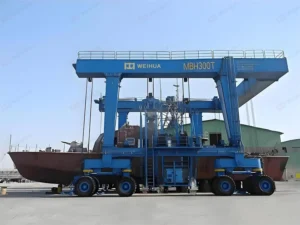
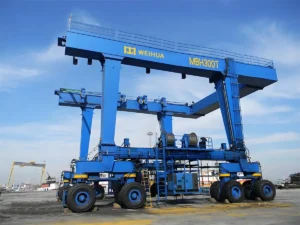

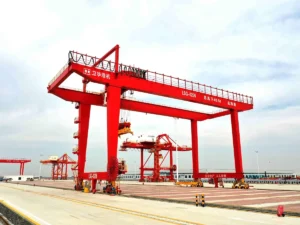
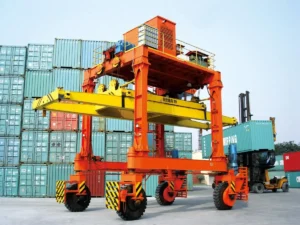








Equipment procurement teams at container terminals and industrial yards frequently encounter the same problem: a straddle carrier arrives on site, passes the rated capacity check on paper, and then fails to operate efficiently because the yard surface cannot support the ground pressure, the aisle width is 1.5 metres too narrow for the turning radius, or the power system is incompatible with the local grid infrastructure. Rated lifting capacity is the first figure buyers examine, but in most procurement errors, it is not the figure that causes the problem.
This guide covers the seven specifications that determine whether a straddle carrier will actually perform as required in your facility — not just on a specification sheet. Each specification includes the technical rationale, the typical value range for reference, and the verification action buyers should complete before submitting a purchase order.
Table of Contents
Specification Summary Table
| Specification | Typical Reference Range | Common Oversight | |
|---|---|---|---|
| 1 | Lifting capacity (gross load) | 30–66 t (port); up to 100 t+ (industrial) | Rigging weight not included in load calculation |
| 2 | Stacking configuration | 1-over-2 or 1-over-3 (3 or 4 high) | Ground bearing not checked against taller mast loads |
| 3 | Ground bearing capacity & aisle geometry | ≥15 t/m² (30 t+ units); aisle ≥8–10 m | Yard surface reinforcement cost not budgeted |
| 4 | Drive system | Diesel / hybrid / battery-electric | Grid capacity or charging infrastructure not verified |
| 5 | Spreader type & container compatibility | 20 ft / 40 ft / 45 ft telescopic; single or twin-lift | High-cube or 45 ft container compatibility not checked |
| 6 | Control system & TOS integration | Manual / semi-auto / fully automated | TOS interface compatibility not confirmed in writing |
| 7 | Certification & compliance documentation | CE (2006/42/EC), ISO 9001, FEM 1.001, EN 13001-1 | Declaration of Conformity requested without full CE technical file |


Spec 1: Lifting Capacity — Size to Gross Load, Not Payload Alone
The rated lifting capacity of a straddle carrier defines the maximum weight the machine can safely handle, but buyers frequently apply this figure incorrectly. The correct reference point is gross load: the sum of the container weight (or cargo weight), the spreader assembly, any lifting frames, shackles, and slings. In standard ISO container handling, a 30.5-tonne container gross weight combined with the spreader and rigging typically reaches an effective handling load of 34–36 tonnes. Specifying a machine rated to exactly 30.5 tonnes for this application creates an immediate overload condition.
The engineering practice recommended across most container handling specifications is to size the machine at a minimum of 1.25 times the maximum gross load. For a terminal regularly handling 36-tonne gross loads, the practical capacity floor is approximately 45 tonnes. For heavy-lift applications — oversized industrial modules, precast concrete elements, or energy storage containers with offset centres of gravity — the margin requirement increases further because lateral load shifts during travel create dynamic forces that exceed the static capacity figure on the data sheet.
Buyer verification action: Request the supplier’s load calculation worksheet. Confirm that the rated capacity figure accounts for spreader weight, rigging, and any safety margin applied. Do not use the ISO container gross weight alone as the input figure for capacity selection.
Spec 2: Stacking Configuration — Match to Yard Density Requirements
Straddle carriers are typically available in two stacking configurations: 1-over-2 (three containers high, including the one being lifted) and 1-over-3 (four containers high). The configuration determines the machine’s structural height, mast design, lifting system specification, and ground bearing load distribution. These are not interchangeable after manufacture.
The 1-over-3 configuration achieves higher yard storage density per square metre, which is the primary reason high-throughput terminals select it. The trade-off is a taller mast structure that increases unit cost, raises the machine’s centre of gravity in unladen travel, and concentrates higher point loads on the yard surface. The ground bearing requirements for a 1-over-3 machine are therefore more demanding than for a 1-over-2 unit at the same rated capacity. A terminal that specifies a 1-over-3 configuration without first confirming that its pavement design supports the axle loads of a taller, heavier machine will encounter structural pavement damage during operations.
For terminals handling a mixed container type — including 45-foot units or high-cube containers — the spreader compatibility and internal clear height of the frame must also be confirmed against the tallest container type in the fleet, not the most common one. A machine dimensioned for standard 20/40-foot units may lack the internal frame clearance to lift a 45-foot high-cube container, even if the rated capacity is sufficient.
Buyer verification action: State the required stacking height (1-over-2 or 1-over-3) in the enquiry document. Confirm internal frame clear height against the tallest container type in the terminal’s cargo mix. Request ground pressure data for the proposed configuration and check against the civil engineering specification for the yard pavement.
Spec 3: Ground Bearing Capacity and Aisle Geometry — The Two Site Parameters That Override Everything Else
Ground bearing capacity and yard geometry are the two site parameters most frequently absent from straddle carrier procurement processes, and they are the two parameters most likely to create problems after delivery. Most straddle carriers rated at 30 tonnes and above require a minimum ground bearing capacity of approximately 15 tonnes per square metre on a level, compacted surface. Machines at higher capacities or in 1-over-3 configurations typically require 18–20 t/m² or more, depending on axle configuration and tyre layout.
Existing port and industrial yards are not always designed to these load levels, particularly in facilities built for lighter equipment. Where reinforcement is required, the civil engineering cost is a separate project budget item that is not included in equipment pricing. This frequently creates budget shortfalls when the ground condition assessment is not completed before the equipment order is placed.
Yard geometry introduces a second constraint. A straddle carrier requires a minimum aisle width of approximately 8–10 metres between container rows to complete turns and travel at operating speed. Below this threshold, cycle times increase significantly as operators must execute multi-point manoeuvres that reduce throughput. Terminals with aisles designed for trailer traffic or reach stackers frequently fall short of this dimension and require layout modifications before straddle carrier operations can function at design throughput.
The machine’s own travel height is a third dimension to verify. A standard port straddle carrier in the 40–66-tonne class typically stands 12–14 metres in its unladen travel position. Facilities with gate structures, overhead utilities, or bridge crossings along the travel path must verify that the machine’s unladen height clears all obstructions along every route it will use.
Buyer verification action: Commission a geotechnical report or pavement assessment for the intended operating area before finalising the equipment specification. Measure all aisle widths, gate clearances, and overhead obstructions along the planned travel route. Provide these figures to the equipment supplier as part of the enquiry package.

Spec 4: Drive System — Match to Site Infrastructure and Duty Cycle
Three drive configurations are commercially available: diesel, hybrid (diesel-electric with regenerative braking and battery buffer), and battery-electric. The decision affects not only operating cost and emissions performance but also the site infrastructure required to support daily operations.
Diesel straddle carriers deliver the highest operational independence. They require no fixed electrical infrastructure, refuel in minutes, and support continuous multi-shift operations in locations without stable grid access. The disadvantages are higher fuel and maintenance costs over the machine’s service life, emissions output that disqualifies diesel-only machines from operating in zero-emission port zones, and increasing regulatory pressure in the European Union and other markets with active decarbonisation targets.
Hybrid configurations are currently the most widely ordered drive type in new port equipment contracts. By combining a diesel generator with a battery buffer and regenerative braking, hybrid machines reduce peak generator load by approximately 30–40% compared with conventional diesel-electric units. This reduction brings most hybrid models within current emissions regulations without requiring full charging infrastructure. Hybrid machines are a practical transition option for terminals with established diesel operations that need to reduce emissions without committing to the full charging infrastructure investment required by battery-electric systems.
Battery-electric straddle carriers produce zero point-of-use emissions and offer the lowest energy cost per operating cycle in facilities with reliable grid access. The operational constraint is charging time and infrastructure. Continuous 24-hour operations require either a battery swap protocol or fast-charge capability scheduled around shift changes. The electrical installation — transformer capacity, cable distribution, charging stations — represents a capital cost that is separate from the machine price and must be included in the total project budget.
Buyer verification action: Confirm whether the operating area falls within an emissions-controlled zone. Assess available grid capacity and the cost of electrical infrastructure before specifying battery-electric. For hybrid or electric specifications, request the supplier’s charging infrastructure requirements and confirm grid capacity with the facility’s electrical engineer before finalising the specification.
Spec 5: Spreader Type and Container Compatibility
The spreader is the interface between the straddle carrier and the container. Its specification determines which container sizes the machine can handle, the lifting method, and the safety of the lifting operation. Spreader compatibility errors — selecting a machine with a spreader dimensioned for standard ISO containers when the terminal also handles 45-foot units — are among the most common source of fleet underperformance in mixed-cargo terminals.
Standard port straddle carriers are fitted with telescopic spreaders that adjust between 20-foot and 40-foot ISO container lengths. Many suppliers offer extension to 45-foot capability as a configuration option. Terminals that handle a mix of 20-foot, 40-foot, and 45-foot containers should specify telescopic spreader range explicitly, not assume it is included in the standard specification.
Twin-lift spreaders, which allow the simultaneous handling of two 20-foot containers, increase throughput in high-volume terminals where 20-foot units represent a large proportion of the cargo mix. They also require higher rated capacity — the machine must lift two fully loaded containers simultaneously — and impose wider internal frame clearance requirements. Buyers specifying twin-lift capability should confirm that both the capacity rating and the internal frame dimensions of the proposed machine support this configuration.
For non-container applications — precast concrete elements, industrial modules, steel structures — the spreader is replaced or supplemented by custom lifting attachments. In these cases, the centre of gravity of the load is frequently offset from the geometric centre of the object, creating asymmetric loading on the spreader and the lifting system. Machines specified only for symmetric ISO container loads may not be designed for the lateral moments generated by asymmetric industrial loads. Buyers in non-container applications should confirm that the spreader and lifting system specification explicitly covers the load geometry of the actual cargo.
Buyer verification action: State all container sizes handled (20 ft, 40 ft, 45 ft, high-cube) in the enquiry document. Confirm whether twin-lift capability is required and verify that the machine’s rated capacity and frame dimensions support it. For non-container cargo, provide load geometry and centre-of-gravity data to the supplier and request written confirmation that the proposed spreader and lifting system design accommodates asymmetric loads.
Spec 6: Control System and Terminal Operating System Integration
The control system specification determines how the straddle carrier receives movement instructions, communicates container status, and interfaces with the terminal’s operating environment. For manual operations, the primary considerations are operator ergonomics and onboard safety systems. For semi-automated or fully automated operations, the integration with the Terminal Operating System (TOS) is a critical procurement item that must be confirmed in writing before the contract is signed.
In automated straddle carrier deployments, the TOS dispatches movement instructions to the machine, tracks container locations in real time, and manages fleet allocation across the yard. The integration between the machine’s onboard automation platform and the terminal’s TOS is not a standard plug-and-play connection. Different TOS vendors use different data protocols and interface architectures. A terminal operating an existing TOS from one vendor and procuring automated straddle carriers from a supplier whose automation platform uses an incompatible interface must either replace the TOS or develop a custom middleware solution — both of which involve significant additional cost and schedule impact.
Buyers should request, as a mandatory pre-contract deliverable, written confirmation from the equipment supplier that the proposed automation platform will interface with the existing TOS without requiring TOS replacement. Where the terminal is procuring both the TOS and the straddle carrier automation system simultaneously, the interface specification should be included in both contracts and subject to acceptance testing before final delivery.
Onboard safety systems — overload protection, anti-collision sensors, tyre pressure monitoring, emergency stop logic, and operator presence detection — should be confirmed as standard inclusions, not optional add-ons. Buyers should request the list of standard safety features and verify that the specification meets the requirements of applicable standards (see Spec 7 below).
Buyer verification action: For automated specifications, obtain written confirmation from the supplier of TOS interface compatibility before signing the contract. Request the full list of standard onboard safety systems. If the machine will operate in a facility with other automated equipment, confirm that the anti-collision system covers interactions with all vehicle types in the operating area.
Spec 7: Certification and Compliance Documentation
Straddle carriers sold for port and industrial use in most export markets are subject to mandatory certification requirements. Certification is not a formality — it is the legal basis for operating the machine in the facility, for insurance validity, and for import customs clearance in many jurisdictions. Buyers who receive a machine without complete certification documentation face the possibility of equipment that cannot legally operate, insurance policies that will not cover incidents involving uncertified equipment, or customs clearance delays at the port of import.
For equipment sold into the European Union and many other markets, the applicable framework is the Machinery Directive 2006/42/EC, which requires CE marking. Structural design is typically validated against EN 13001-1 (general principles for crane safety) and the FEM 1.001 rules for the design of hoisting appliances. The manufacturer’s quality management system is normally required to comply with ISO 9001. For port applications in facilities covered by international maritime standards, IACS (International Association of Classification Societies) guidelines may also apply.
A critical distinction for buyers importing from manufacturers in non-EU countries is the difference between a CE Declaration of Conformity and a complete CE technical file. The Declaration of Conformity is a single document in which the manufacturer asserts compliance. The technical file is the underlying engineering documentation — structural calculations, component specifications, test reports, risk assessment — that supports the declaration. Requesting only the Declaration of Conformity provides limited assurance. Buyers should request the full technical file and verify that it has been compiled to the standard required by the Machinery Directive.
For markets outside the EU, buyers should confirm the applicable national standards for lifting equipment in the destination country and verify that the supplier’s documentation covers those requirements. Local emissions standards for diesel engines — such as Tier 4 Final in the United States — may also apply and should be confirmed with the supplier before the specification is finalised.
Buyer verification action: Request the CE Declaration of Conformity and the full CE technical file. Confirm ISO 9001 certification for the manufacturing facility. Verify compliance with applicable local emissions standards for the drive system. Require the supplier to include all certification documentation in the shipping package and confirm that clearance documentation will be available at the port of import.
Conclusion
Straddle carrier procurement decisions fail most often not because of capacity miscalculation, but because buyers complete the capacity check and stop there. The seven specifications in this guide — gross load capacity, stacking configuration, ground bearing capacity and aisle geometry, drive system infrastructure, spreader compatibility, control and TOS integration, and certification documentation — define whether the machine will actually perform as required in the facility from day one of operations.
Completing verification on all seven before placing an order eliminates the most common causes of post-delivery operational failure. The enquiry package sent to suppliers should include the buyer’s confirmed values for each specification, not leave them as open questions to be resolved after the contract is signed.
For technical consultation on straddle carrier configuration for your facility, contact the Weihua engineering team to discuss your site parameters and handling requirements.
FAQ
Q1:What is the difference between 1-over-2 and 1-over-3 straddle carrier configurations?
A 1-over-2 configuration places containers in stacks three high, while 1-over-3 places them four high. The 1-over-3 option achieves higher yard density but requires a taller mast, greater lifting capacity — typically 40–50 tonnes — and a pavement structure designed to support higher point loads. The correct configuration depends on the terminal’s throughput target and the confirmed ground bearing capacity of the yard surface.
Q2:How do buyers calculate the correct lifting capacity for a straddle carrier?
Buyers should calculate gross load — container weight plus spreader, lifting frame, shackles, and slings — and size the machine at a minimum of 1.25 times that figure. Using the container payload alone, without accounting for rigging weight and a safety margin, is the most common cause of under-specification in straddle carrier procurement.
Q3:What ground bearing capacity does a straddle carrier require?
Most straddle carriers rated at 30 tonnes and above require a minimum ground bearing capacity of approximately 15 t/m² on a level, compacted surface. Higher-capacity units and 1-over-3 configurations typically require 18–20 t/m² or more. Buyers should commission a pavement assessment before finalising the equipment order, as surface reinforcement costs are not included in equipment pricing.
Q4:What certifications should buyers request from a straddle carrier supplier?
For equipment destined for EU markets, buyers should request a CE Declaration of Conformity, the full CE technical file (structural calculations and test reports), and ISO 9001 certification for the manufacturing facility. The CE technical file — not just the Declaration — provides meaningful assurance of structural compliance with the Machinery Directive 2006/42/EC and relevant standards including EN 13001-1 and FEM 1.001.
Q5:How is TOS integration confirmed before an automated straddle carrier order is placed?
Buyers should request written confirmation from the equipment supplier that the machine’s automation platform will interface with the existing Terminal Operating System without requiring TOS replacement. This confirmation should be obtained before the contract is signed. TOS interface incompatibility, discovered after delivery, is one of the most disruptive and costly problems in automated container handling projects.