








An STS crane purchase is one of the most capital-intensive decisions a port authority or terminal operator will make. Prices range from $5 million for a standard single-lift unit to over $25 million for a high-outreach, twin-lift configuration—and the wrong specification can bottleneck your terminal for the next 25 years. Before you issue an RFQ, you need clarity on three things: the vessel classes your berth must serve, your throughput targets, and the rail gauge your civil structure supports.
Port procurement teams frequently encounter the same pressure point: container ships keep getting larger, but budgets and berth geometry are fixed. A crane specified for a 13-row vessel cannot efficiently handle a 24-row ultra-large container vessel (ULCV) without costly modification—or replacement.
This guide gives you a structured framework to match STS crane specifications to your port’s actual operating conditions. You’ll find a specification comparison table, a parameter-by-parameter selection checklist, manufacturer evaluation criteria, and pricing benchmarks—everything your engineering team needs to build a technically sound RFQ.
Table of Contents
Quick Reference: STS Crane Types & Price Benchmarks
| Configuration | Outreach | Lifting Capacity | Typical Application | Indicative Price (FOB Factory) |
|---|---|---|---|---|
| Standard Single-Lift | 40–50 m | 40–50 t under spreader | Feeder / regional terminals | $5M – $10M |
| High-Outreach Single-Lift | 55–65 m | 50–65 t under spreader | Post-Panamax vessels | $10M – $16M |
| Twin-Lift ULCV | 65–72 m | 65–85 t under spreader | ULCV / mega terminals | $16M – $25M+ |
| Low-Profile STS | 40–55 m | 40–55 t under spreader | Air-draft restricted berths | $7M – $14M |
Price data: indicative market reference, FOB factory, subject to steel index and project scope.
To understand how STS crane lifting capacity matches specific applications, see: STS Crane Capacity Guide: How Much Can a Ship-to-Shore Crane Lift?
The outreach radius of an STS crane directly determines whether the crane can fully cover the cargo being handled. For a detailed comparison of size specifications, see the article: STS Crane Outreach Explained: How to Match Crane Size to Container Ships?
Need a specification-matched quote? Share your vessel class and throughput target → Get a Quote
What Is an STS Crane and Why Specification Matching Matters
Defining the Ship-to-Shore Crane
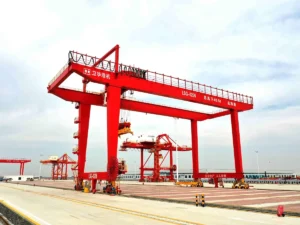
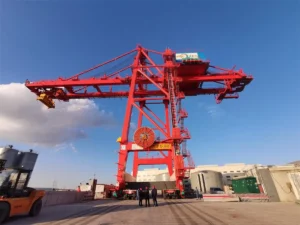
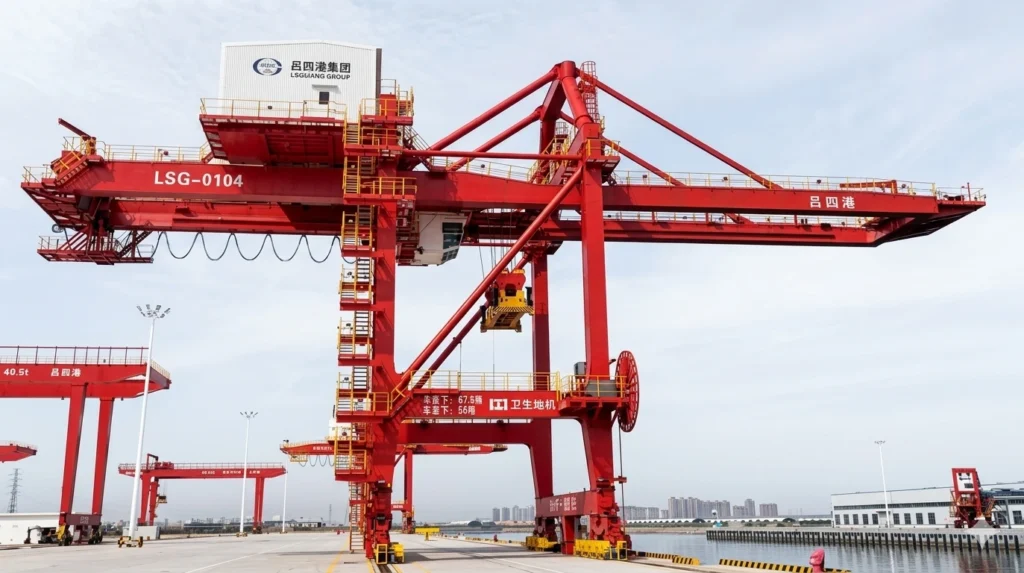
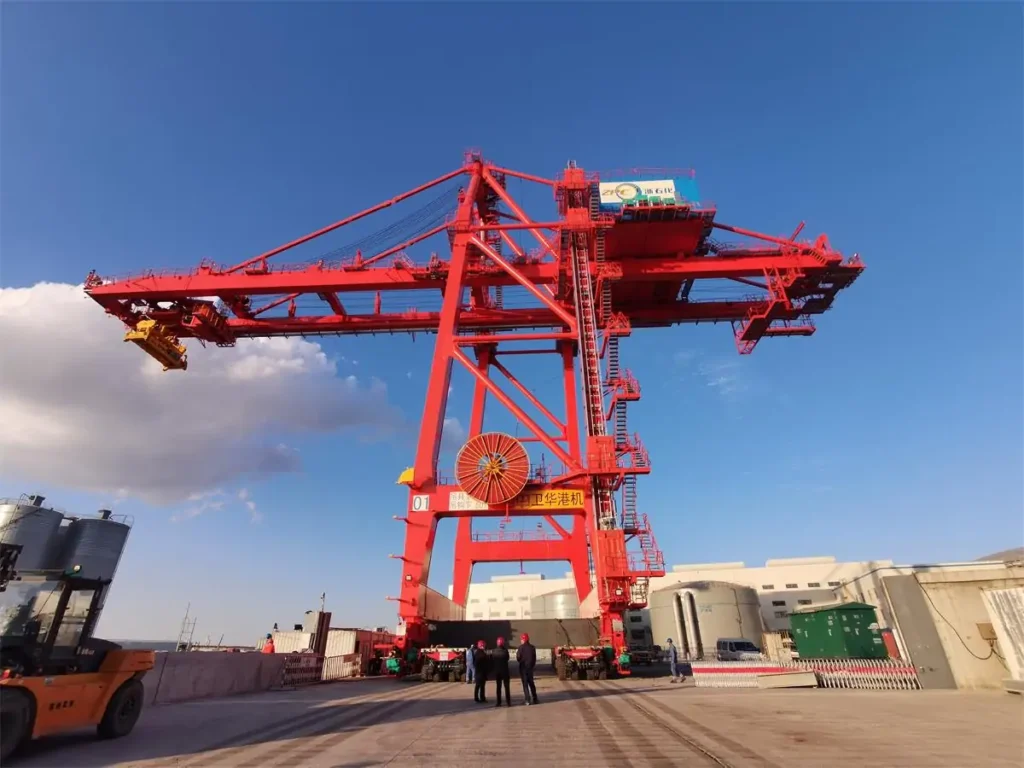
A ship-to-shore (STS) crane—also called a container crane or quayside gantry crane—is a rail-mounted portal structure designed to transfer containers between vessel and quay at rates of 25–40 moves per hour per crane. Unlike mobile harbor cranes, STS cranes are fixed assets integrated with your berth’s civil foundation and power supply infrastructure. The structural commitment is permanent; the specification decision is therefore irreversible at low cost.
STS cranes operate under a family of international standards: FEM 1.001 for crane classification, ISO 4301 for load cycle grouping, and EN 13001 for structural calculation. CE marking is mandatory for European port deployments; many Asian and African terminals additionally require compliance with GB/T 14406 (China) or ASME B30.2 (US).
The Vessel-Generation Gap Problem
Container shipping has undergone three capacity step-changes since 2000: the introduction of Post-Panamax vessels (18 rows), then New Panamax (22 rows), then ULCVs of 24+ rows. Each generation requires a longer outreach. A crane specified at 50 m outreach in 2010 is operationally marginal against today’s 400 m LOA vessels. Port authorities that did not build in a 10–15% outreach buffer are now managing productivity penalties or facing early crane replacement.
The practical implication: always specify for the vessel generation you expect to receive in year 10 of the crane’s operational life, not year 1.
Key STS Crane Specifications Explained
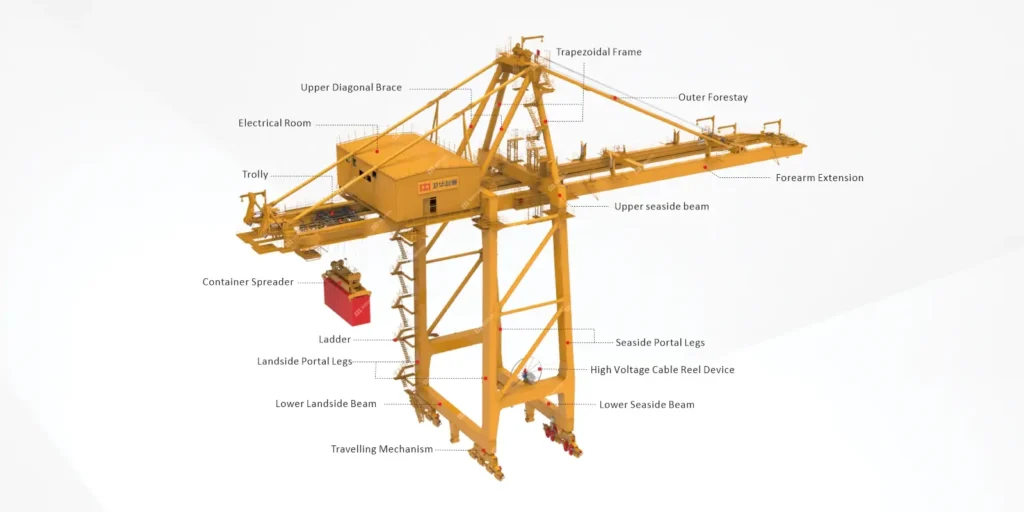
Outreach: The Most Critical Parameter
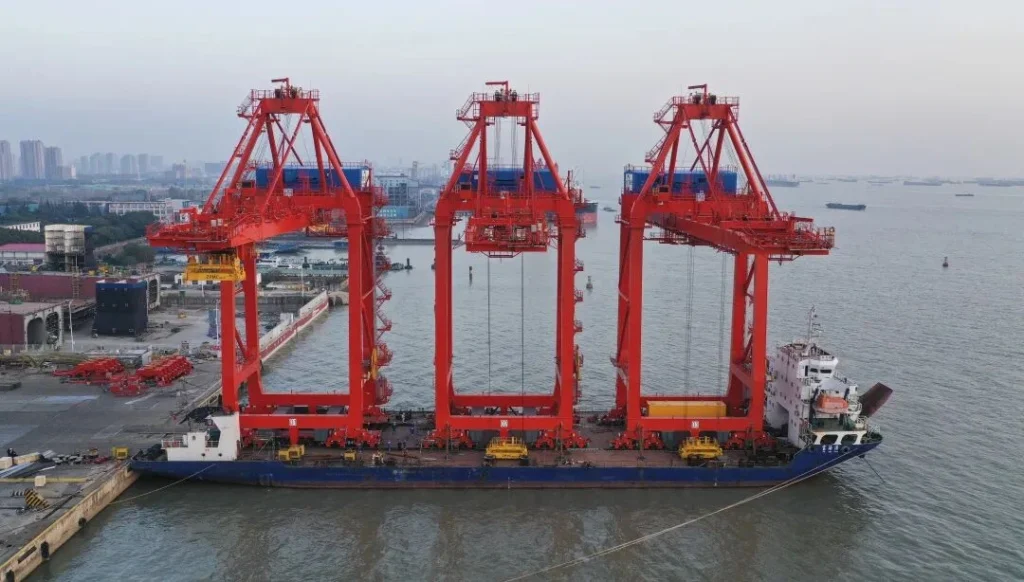
Outreach is the horizontal distance from the sea-side rail to the end of the boom, measured in meters. It determines the maximum vessel beam your crane can serve. The calculation is straightforward:
Required outreach = vessel beam + 2 m safety margin + spreader overhang allowance
| Vessel Class | Typical Beam | Minimum Required Outreach |
|---|---|---|
| Panamax | 32 m | 40 m |
| Post-Panamax | 43 m | 50 m |
| New Panamax | 49 m | 58 m |
| ULCV (24,000+ TEU) | 61 m | 68–72 m |
Source: PIANC Working Group 135, Container Terminal Design, 2022 revision
Lifting Capacity and Spreader Configuration
Lifting capacity is quoted in two figures: under spreader (the working load) and under hook (gross capacity). For container operations, the under-spreader figure governs your specification. Standard 20’/40′ containers loaded to ISO gross mass limits require 40–50 t. Overweight reefer and project cargo moves push this to 65 t.
Twin-lift spreaders—which pick two 20′ containers simultaneously—double theoretical productivity but require 65–85 t under-spreader capacity and a more robust trolley and rope system. For terminals targeting 30+ moves per hour per crane, twin-lift is the productivity multiplier that justifies the price premium.
Rail Gauge, Wheel Load, and Civil Integration
STS cranes run on two parallel rails. Standard gauge options are 30.48 m (100 ft), 30 m, and 35 m. Your selection is constrained by your quay apron width and existing or planned civil works. Wheel loads—typically 700–1,100 kN per wheel—must match your quay deck design bearing capacity. Mismatches require costly quay reinforcement.
Confirm these civil parameters before issuing any RFQ:
- Rail gauge and rail type (A100, A120, A150)
- Wheel load limit (kN)
- Power supply voltage and frequency (6.6 kV / 10 kV, 50 Hz or 60 Hz)
- Air draft restriction (if any overhead obstruction exists)
Hoisting Speed and Cycle Time
Hoisting speed directly affects moves-per-hour productivity. Benchmark figures from FEM classification:
| Operation | Standard Speed | High-Performance Speed |
|---|---|---|
| Hoisting (loaded) | 60–90 m/min | 120–150 m/min |
| Hoisting (empty) | 120–150 m/min | 180–210 m/min |
| Trolley travel | 150–180 m/min | 210–240 m/min |
| Gantry travel | 25–45 m/min | 45–60 m/min |
High-speed configurations require more powerful drive systems (variable frequency drives, regenerative braking) and carry a 15–25% price premium over standard-speed units. For terminals with vessel turnaround time KPIs below 24 hours, this premium is typically recovered within 3–5 years of operation.
How To Choose the Right STS Crane: A 5-Parameter Decision Framework
Step 1 — Define Your Design Vessel
Your design vessel is the largest ship class your berth is designed to handle at full productivity. Contact your shipping line customers to identify their fleet deployment plans for your port over the next 10–15 years. If a major alliance partner is deploying ULCVs on your trade lane within 5 years, your outreach specification must accommodate them—even if today’s calls are Post-Panamax.
Step 2 — Set Your Throughput Target
Calculate your annual throughput target and divide by planned crane count and operating hours to derive the required moves-per-hour per crane. The formula:
Required MPH = Annual TEU ÷ (Crane count × Annual operating hours × TEU per move × Utilization rate)
This figure determines whether you need standard-speed or high-speed hoisting, and whether twin-lift is justified. A terminal targeting 800,000 TEU/year with 3 cranes operating 6,000 hours/year at 75% utilization needs approximately 22–24 MPH per crane—achievable with standard single-lift. At 1.5M TEU/year with the same crane count, you need 45+ MPH per crane, which requires high-speed twin-lift.
Step 3 — Confirm Civil and Power Constraints
Before approaching any STS crane manufacturer, you must have confirmed:
- Quay bearing capacity and rail gauge (from your civil engineering report)
- Available electrical supply (MVA, voltage, frequency)
- Air draft restrictions (bridge clearance, overhead cable proximity)
- Seismic zone classification (affects structural design standard)
These four items are non-negotiable inputs. Any manufacturer quoting without this data is providing a number, not a specification.
Step 4 — Evaluate Automation Readiness
STS cranes are increasingly specified with semi-automation or automation-ready packages: anti-sway control, laser-based container position sensing, and remote operator interfaces. These features add $500,000–$2,000,000 per crane but are significantly cheaper to install at manufacturing stage than to retrofit. If your terminal has a 5–10 year automation roadmap, specify automation-ready architecture now.
Step 5 — Assess Manufacturer Capability
Not all STS crane manufacturers have the engineering depth to handle complex site conditions or custom specifications. Evaluate on:
- Reference list: ask for 3–5 projects with similar outreach and capacity delivered in the last 5 years
- Class society approval history: DNV, BV, or Lloyd’s Register approvals indicate structural calculation rigor
- After-sales infrastructure: parts lead time, local service engineers, training programs
- Delivery lead time: industry standard is 18–36 months from contract to commissioning
Ready to define your specification? Share your design vessel class, throughput target, and rail gauge with our engineering team for a detailed technical proposal.
For details and considerations regarding STS crane selection, refer to the article: How To Choose The Right STS Crane For Your Port?
Get Custom Quotation Now
STS Crane Manufacturers: What to Look For
Technical Qualification Criteria
The global STS crane market is served by a small number of established manufacturers and a growing tier of regional suppliers. When evaluating STS crane manufacturers, apply the following minimum qualification criteria:
- ISO 9001:2015 quality management system certification
- Structural design compliance with EN 13001 or ASME B30.2
- Finite element analysis (FEA) documentation available for structural review
- Factory acceptance test (FAT) protocol aligned with your classification society requirements
Avoid manufacturers who cannot provide calculation packages or who resist third-party structural review. At this price point and asset life, engineering transparency is non-negotiable.
Delivery and Commissioning Considerations
STS cranes are typically shipped in major sub-assemblies (portal, boom, machinery house) and erected on-site. Erection typically requires 6–12 weeks with a specialist erection team. Confirm that your RFQ includes:
- Transportation engineering (abnormal load routing if required)
- Erection supervision and equipment provision
- Commissioning and load testing per FEM/ISO protocols
- Operator and maintenance training (minimum 40 hours recommended)
For more solutions for port gantry cranes, visit the page: Port Gantry Crane Manufacturer for Container Handling and Port Operations
Conclusion
Choosing the right STS crane comes down to three non-negotiable inputs: your design vessel’s beam, your throughput target, and your civil infrastructure constraints. Get these three parameters right, and the specification follows logically. Skimp on any one of them, and you risk a $10M+ asset that underperforms from day one.
Three actionable steps before your next procurement meeting:
- Commission a vessel forecast study from your port authority or shipping line contacts—define your design vessel for year 10, not year 1.
- Obtain your quay civil report and confirm bearing capacity, rail gauge, and power supply availability in writing.
- Prepare a technical brief covering the five parameters in this guide before approaching any manufacturer—it will sharpen every proposal you receive.
Get a factory-direct STS crane proposal tailored to your port specifications. Our engineering team reviews your parameters and responds with a detailed technical and commercial proposal within 5 business days.
Get Custom Quotation Now
FAQ
Q1: What is the typical price range for an STS crane in 2026?
STS crane prices vary significantly by configuration. A standard single-lift crane with 40–50 m outreach is typically priced between $5M and $10M (FOB factory). High-outreach units for Post-Panamax and ULCV service range from $10M to $25M+, depending on capacity, automation features, and structural requirements. These figures are market reference prices for Q1 2026 and exclude shipping, erection, civil works, and commissioning—which typically add 15–25% to the total installed cost. Always request a fully-scoped EXW or CIF price from your shortlisted manufacturers to enable accurate budget comparison.
Q2: How long does it take to manufacture and deliver an STS crane?
Industry-standard lead time from contract signature to port commissioning is 18–36 months, depending on manufacturer capacity, the complexity of your specification, and your port’s site readiness. Highly customized configurations (ULCV outreach, full-automation packages, seismic zone design) typically sit at the longer end of this range. Factor this lead time into your terminal development schedule—procurement initiated too late is one of the most common causes of terminal opening delays.
Q3: What certifications should I require from an STS crane manufacturer?
At minimum, require CE marking (for European ports), ISO 9001:2015 quality system certification, and structural design compliance with EN 13001 or equivalent (ASME B30.2 for US deployments). For high-value projects, require class society approval from DNV, Bureau Veritas, or Lloyd’s Register—this provides independent structural calculation review. Additionally, confirm that the manufacturer’s electrical systems comply with IEC 60204 and that the crane’s crane classification follows FEM 1.001 or ISO 4301 load grouping standards.
Q4: Can an STS crane be upgraded to handle larger vessels after installation?
Boom extension upgrades are technically possible but are rarely cost-effective. Extending outreach by 5–10 m typically requires structural reinforcement of the portal and boom, recalculation of wheel loads (which may exceed quay capacity), and modifications to the trolley rope system—combined costs can reach 30–50% of a new crane’s price. The correct approach is to specify for the vessel generation you expect in year 10, with a 5–10% outreach buffer built into the original design. Discuss future-proofing provisions with your manufacturer during the specification stage, not after contract award.
Q5: What is the difference between STS crane specifications for container terminals and bulk terminals?
STS cranes are purpose-built for containerized cargo and are not suitable for bulk material handling. Bulk terminal quayside equipment—bucket chain unloaders, grab cranes, ship unloaders—operates under a completely different set of design standards and load cycle requirements. If your port handles both container and bulk operations, these are separate procurement streams with separate specifications. For container terminal crane requirements specifically, outreach, lifting capacity under spreader, and twin-lift capability are the three parameters that drive the largest cost and productivity differences between models.