
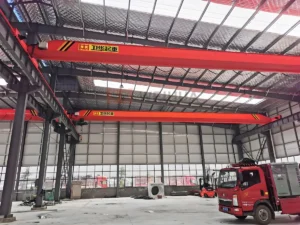
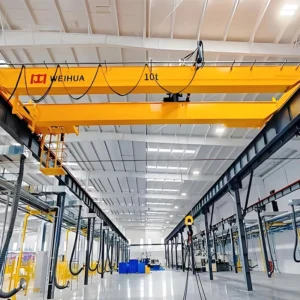
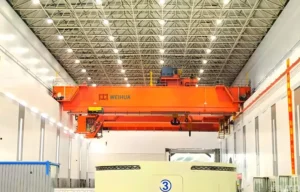
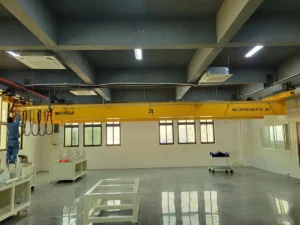
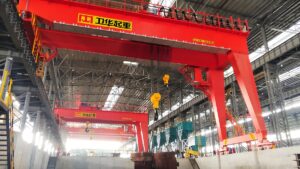
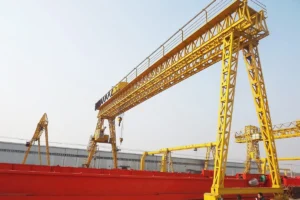

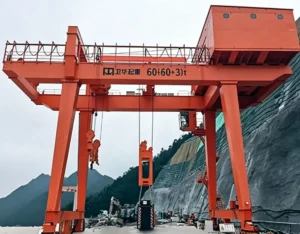
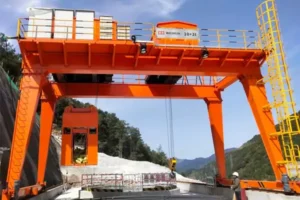







Picture a factory floor where one side of the building has a solid steel column line, but the other side opens to an outdoor yard — or was simply never reinforced for overhead runway loads. An overhead crane needs two runway structures. A full gantry crane needs two independent leg foundations. Neither fits the site cleanly, and the civil engineering cost of forcing either option in can dwarf the crane itself.
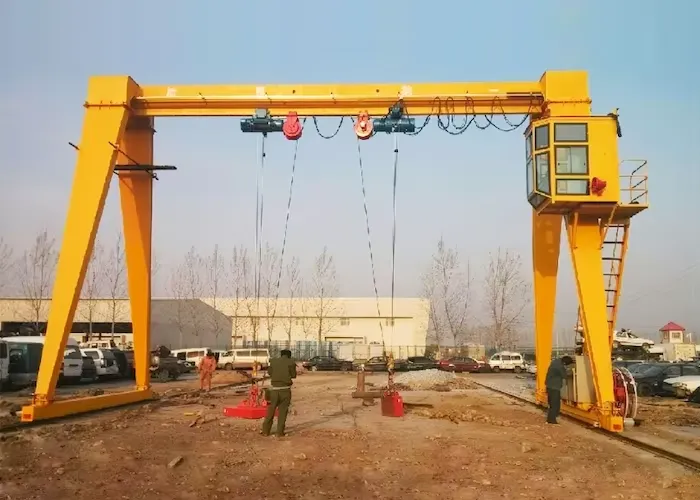
A semi gantry crane solves exactly this problem. One end of the bridge travels on a ground-level rail via a floor-mounted leg; the other end runs directly on an existing building beam, with no leg and no added foundation on that side. The result is a crane that covers the full working bay while the building carries half the structural load it was already designed to carry.
This guide covers what a semi gantry crane actually is, how it works, the main configurations available from Weihua, and — most usefully — a practical decision framework for figuring out whether it fits your site or whether an overhead crane or a full gantry crane would serve you better.
Tabla de contenidos
What Is a Semi Gantry Crane?
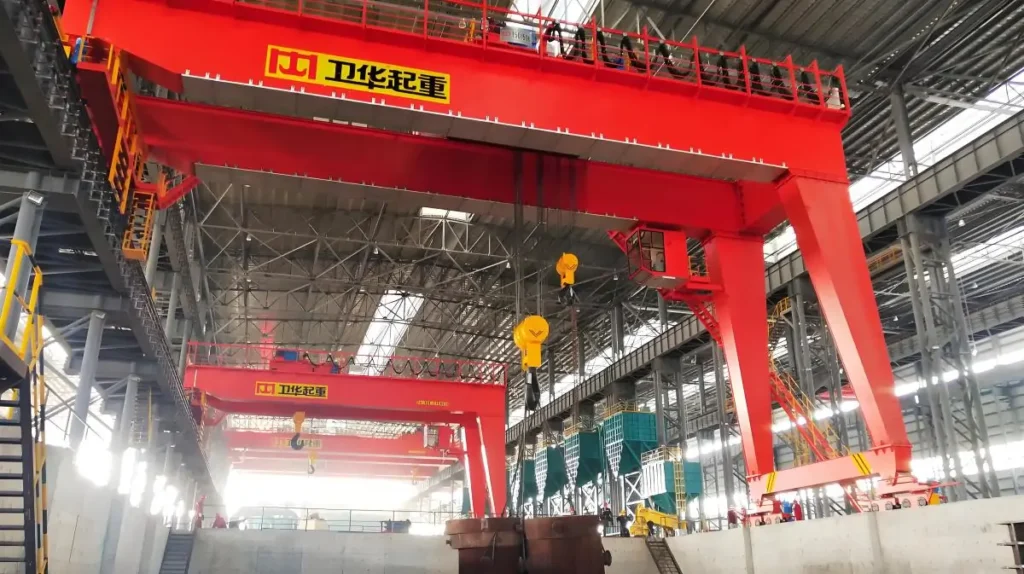
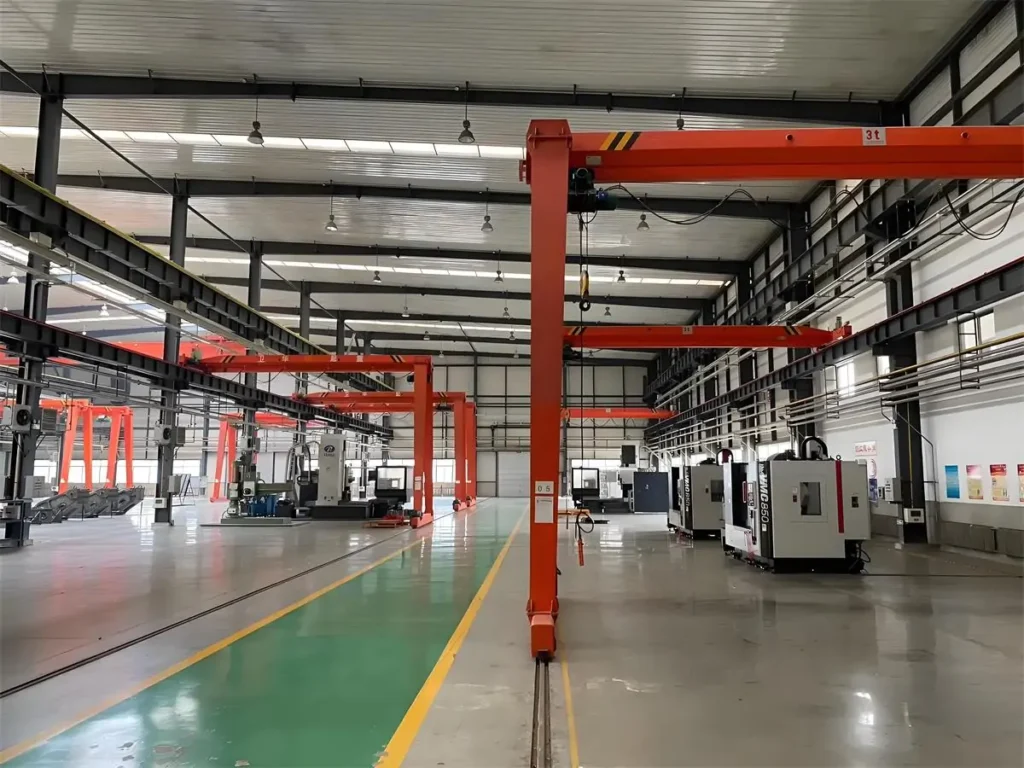
A semi gantry crane, also called a half gantry crane, is an overhead lifting device classified under ISO 4301 crane standards that combines a single ground-supported leg with one-side building-beam support, eliminating the need for a full two-leg portal structure or a dual-runway overhead system.
The definition matters less than the structural implication: this crane borrows support from the building on one side and stands independently on the other. That asymmetry is both its strength and its design constraint — and understanding it determines whether the crane is the right call for your project.
Where It Sits Between an Overhead Crane and a Full Gantry Crane
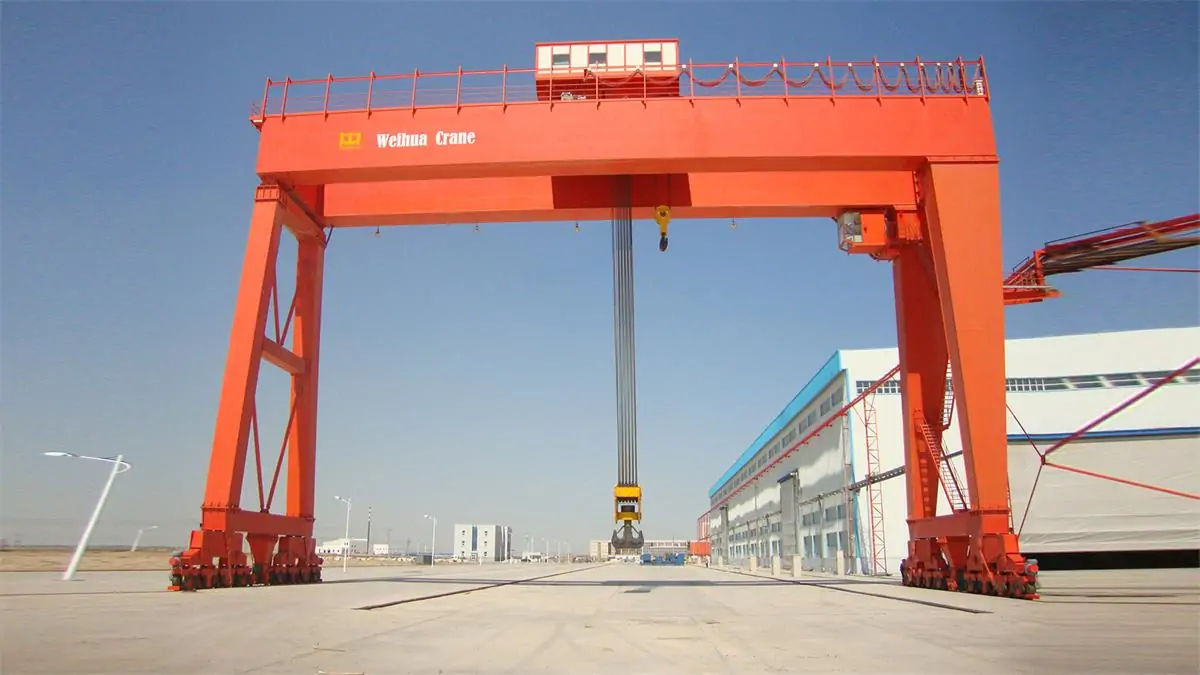
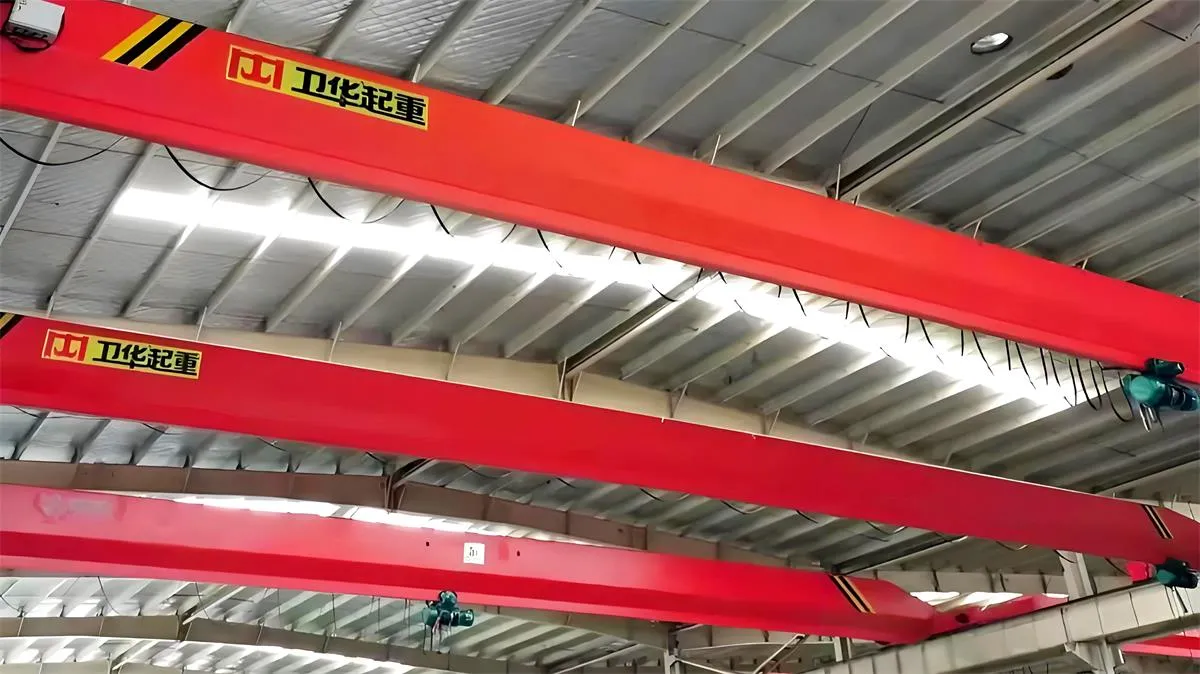
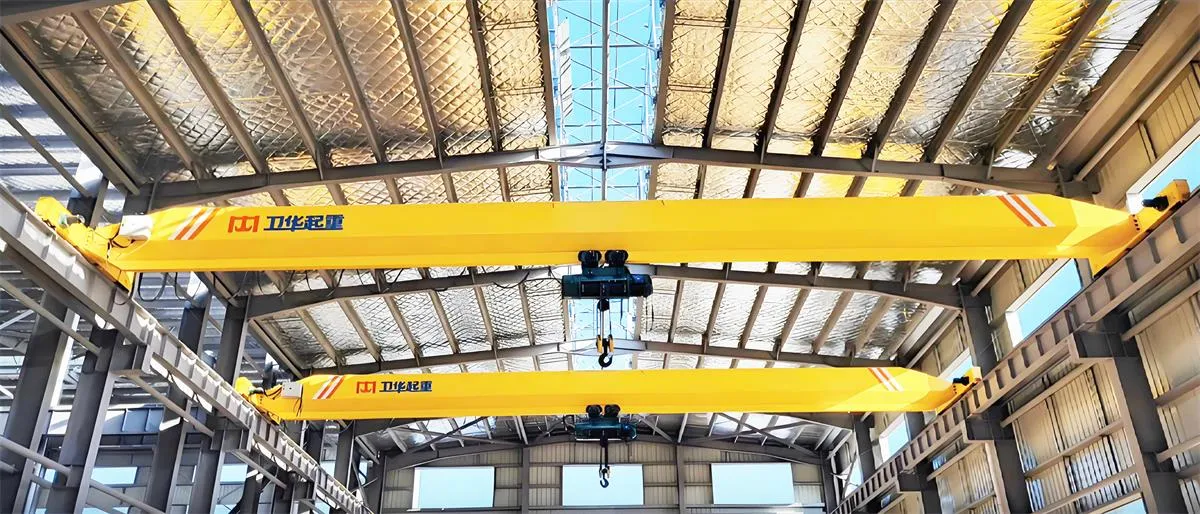
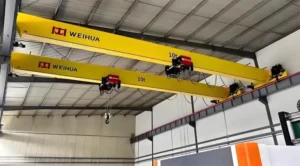
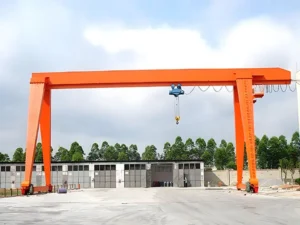
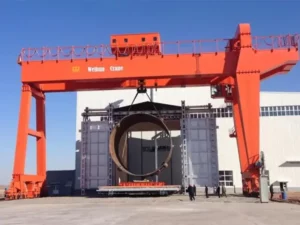
An overhead crane (bridge crane or EOT crane) hangs entirely from two elevated runway beams, one on each side of the workshop. It needs the building to carry the full dynamic load on both walls — which is often the bottleneck in retrofit or leased-space projects. A full gantry crane stands on two sets of independent legs and needs ground rails and concrete foundations on both sides, which is the right answer for open yards but excessive for buildings that already provide half the support.
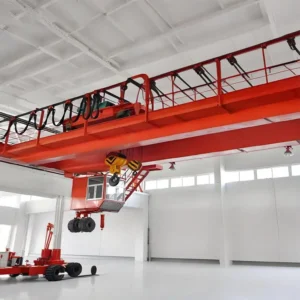
A semi gantry crane sits between: one side of the building carries the end beam load as it would for an overhead crane; the other side supports itself on ground rails as a gantry leg would. Less civil engineering than a full gantry. Less structural demand on the building than an overhead crane. That is the core trade-off, and it is why semi gantry cranes appear almost exclusively in retrofit projects and mixed indoor/outdoor applications.
How a Semi Gantry Crane Works
The working principle follows the same three-axis motion logic as all overhead lifting equipment, with one structurally important asymmetry.
Three Basic Motions
The hoist raises and lowers the load vertically. The trolley travels horizontally along the main girder, positioning the hook anywhere across the bay width. The crane bridge — leg on one side, building-beam runner on the other — travels longitudinally along the full length of the workshop, giving the crane its complete working envelope. Together, these three motions let the crane reach any point within a rectangular operating zone.
The Asymmetric Load Path
This is the detail most buyers skip, and it matters for installation planning. On the building-beam side, the end carriage exerts lateral forces and some vertical load onto the existing structure — exactly like one side of a conventional overhead crane. On the ground-rail side, the leg bears the dominant vertical load and transfers it straight to the floor. This means the ground-rail side does more structural work than it looks like it does, and the leg, wheel, and rail on that side need to be sized for the full dynamic load rather than treated as a simple floor runner. In our experience, undersizing the ground-rail assembly is the most common engineering oversight during specification — and one of the leading causes of premature wear.
Key Components
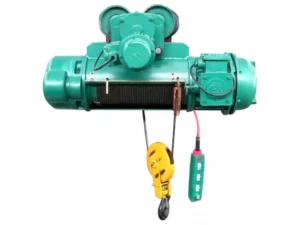
The main girder (single or double beam) spans the working bay and carries the trolley. The hoist mechanism — motor, gearbox, drum, wire rope, and brake — handles lifting. The leg-and-travel assembly grounds the independent side on steel rails. The electrical and control system ties it all together, with options for pendant control, radio remote control, or cabin operation depending on the duty level and visibility requirements.
Semi Gantry Crane Types
Weihua offers three principal configurations. Each maps to a different combination of load, frequency, and travel-path requirements — and choosing the wrong one for your duty cycle is more costly than choosing the wrong one for your tonnage.
Single Girder Semi Gantry Crane
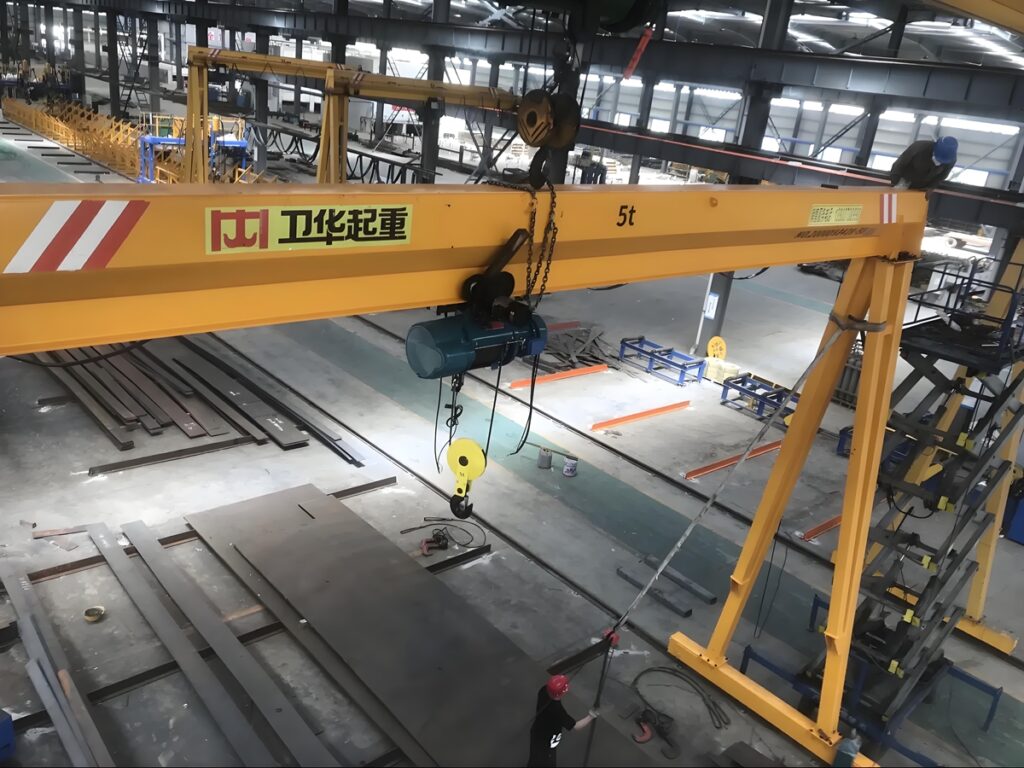
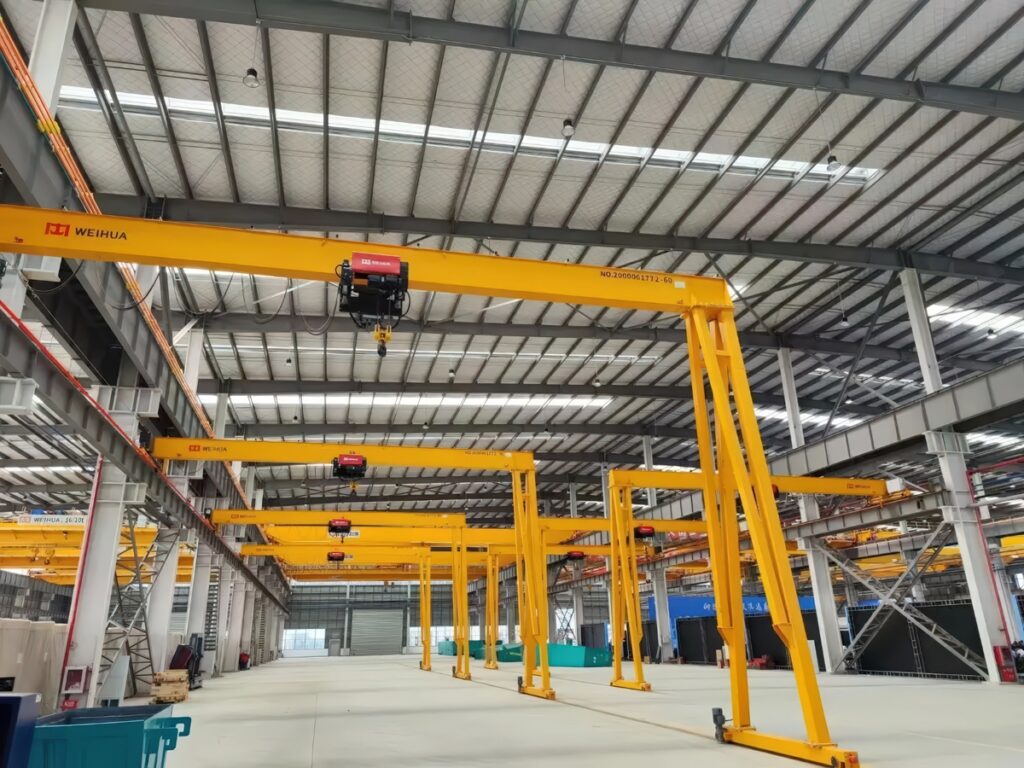
The single girder version is the default choice for light-to-medium applications: typically 1–20 tons of lifting capacity across spans of 6–20 meters, with working duty class A3–A5. It is compact, relatively light, and straightforward to install in an existing workshop without structural modifications. Maintenance access is simpler than on a double-girder machine, and the lower self-weight reduces the dynamic forces on the building beam.
The trade-off is deflection under load and fatigue resistance under high-cycle operation. Beyond roughly A5 duty, or where precision positioning at the hook matters (for example, placing components on a close-tolerance assembly fixture), the single girder’s deflection behavior starts to work against you. At that point, upgrading to a double girder is a better investment than pushing a single-girder crane past its design intent.
Double Girder Semi Gantry Crane
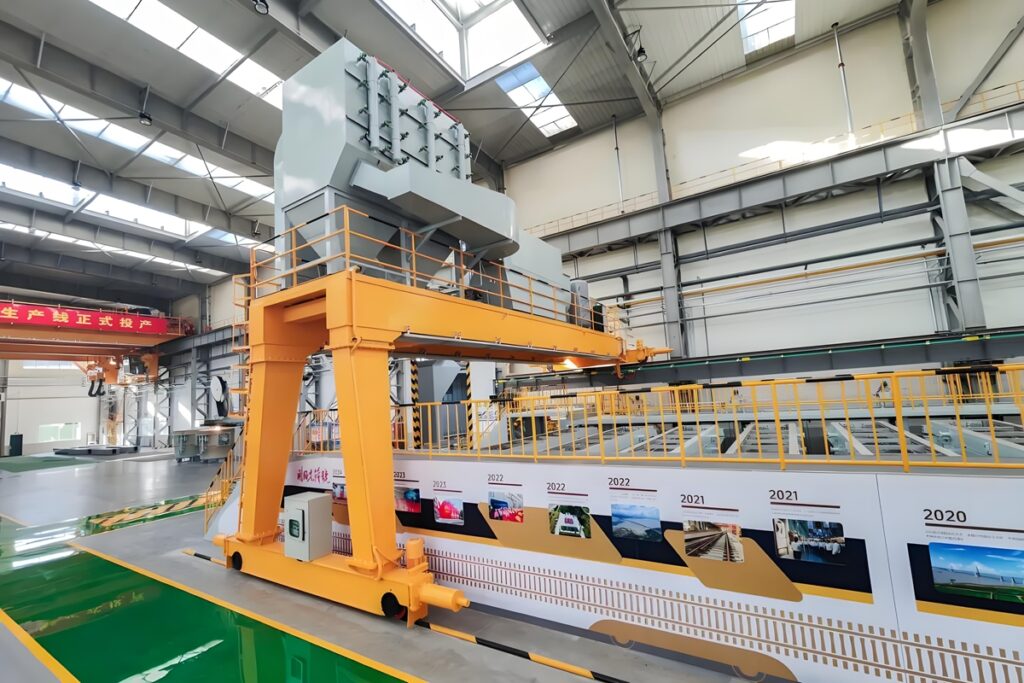
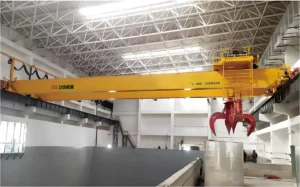
The double girder version handles 5–50 tons across 8–30 meter spans at working duty class A5–A6. The two-beam structure significantly reduces mid-span deflection under load, which matters both for hook accuracy and for long-term fatigue performance in high-cycle environments — production lines, process operations, or facilities running two or three shifts.
The higher upfront cost relative to a single girder unit is typically recovered through lower maintenance frequency and longer service intervals. For operations cycling the crane more than a few dozen times per shift, in our experience, the total-cost case for the double girder version becomes clear within the first two to three years of operation.
Rail-Mounted Semi Gantry Crane
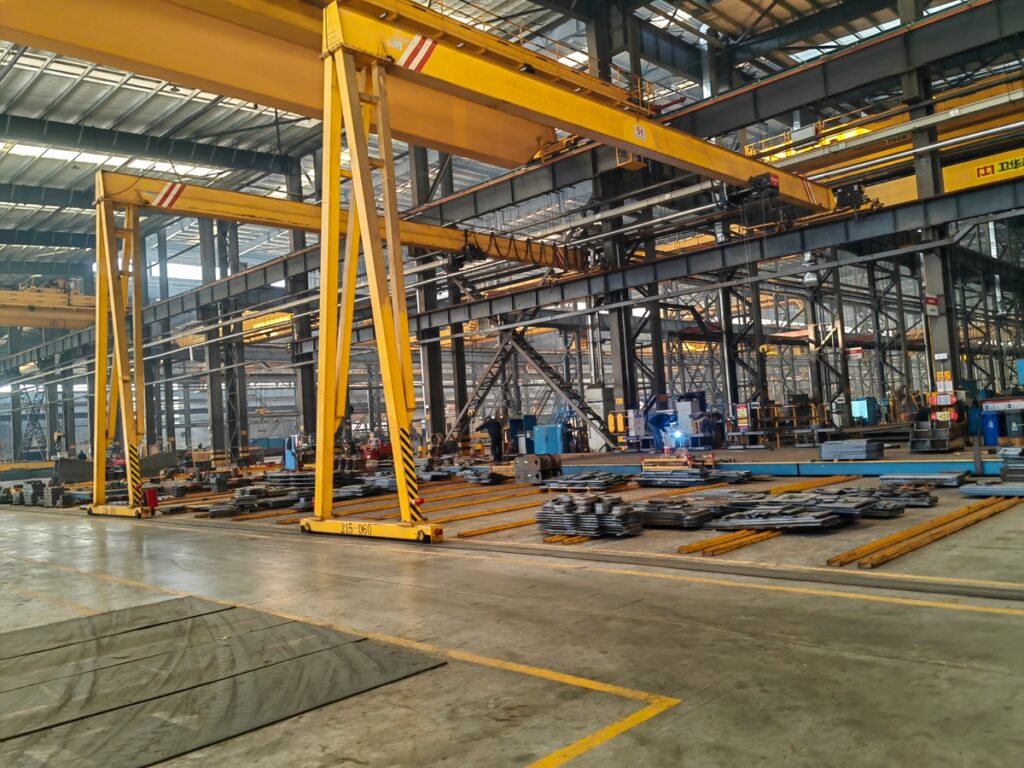
This variant specifies a rail-guided path on both the ground side and the building-beam side, prioritizing positioning repeatability over flexibility of coverage. It typically spans 6–25 meters at 3–32 tons, with duty class A4–A6. The fixed travel path makes it the right answer for operations where the crane services specific fixed points — a sequence of workstations, a loading bay with a fixed dock position, or a production cell with defined pick-and-place coordinates — rather than open-area material handling.
If your workflow requires the crane to travel freely to any point in a bay rather than follow a predetermined route, the standard single or double girder configurations are more appropriate.
How to Choose: A Practical Decision Framework
The selection question most buyers ask is “what tonnage do I need?” That is the right first question, but it is rarely the limiting one. The questions that actually determine which crane type fits your site are structural and operational.
Step 1 — Assess Your Building Structure First
Before specifying any crane, determine whether the existing building can support a runway beam load on one side, both sides, or neither. If the building can carry a runway on one side only: a semi gantry crane is the practical path. If it can carry a runway on both sides and floor space is not a constraint: a single or double girder overhead crane is likely the lower-cost, lower-complexity option. If neither side can carry a runway, or the site is partially or fully outdoors: a full gantry crane with independent legs is the correct starting point.
Forcing an overhead crane into a building that needs structural reinforcement to support both runways often costs more than the crane itself. That reinforcement cost is the hidden variable that makes semi gantry cranes look unexpectedly competitive in total-project terms.
Step 2 — Match Duty Class to Operating Frequency, Not to Tonnage
| Working Duty Class | Typical Use Pattern | Crane Type to Consider |
|---|---|---|
| A3 | Occasional use, light loads, long idle periods | Single girder semi gantry |
| A4 | Moderate use, intermittent operation | Single girder semi gantry |
| A5 | Regular use, moderate cycling | Single or double girder depending on tonnage |
| A6 | Heavy use, frequent cycling, production-line operation | Double girder semi gantry |
A crane specified only on maximum load and not on duty class is a specification that is incomplete. An A3-rated 10-ton crane and an A6-rated 10-ton crane share the same nameplate tonnage but are built to fundamentally different fatigue and thermal loading standards. Buying the A3 version for an A6 application — which happens more than it should — results in accelerated wear, earlier component replacement, and unplanned downtime.
Step 3 — Compare Total Project Cost, Not Listed Unit Price
| Grúa semiafalcada | Grúa puente | Full Gantry Crane | |
|---|---|---|---|
| Building structure required | Ground rail + one-side beam support | Dual elevated runway beams | None (independent) |
| Market reference price | $15,000 – $60,000 | $10,000 – $50,000 (if structure already qualifies) | $30,000 – $150,000+ |
| Civil engineering scope | Ground rail on one side only | Runway installation, both sides | Rail, foundation, and leg structures, both sides |
| Installation timeline | Short | Short to medium | Medium to long |
| Best-fit scenario | Retrofit, one-side beam available | New build with adequate structure on both sides | Outdoor yard, no building available |
The overhead crane column in this table carries a significant asterisk: the unit price is only the lowest option if the building is already capable of supporting both runways without modification. In retrofit projects where that condition is not met, a semi gantry crane at a higher listed price can represent the lower total project cost once civil engineering is priced in.
Certifications and Compliance
Certification is a hard procurement gate for most international buyers, not a nice-to-have. Confirming it early prevents clearance delays, insurance complications, and compliance exposure once the equipment is in operation.
Which Standards Apply
For buyers importing into Europe or specifying CE-marked equipment, the relevant framework is the EU Machinery Directive (2006/42/EC), which defines the essential health and safety requirements the crane must meet. Design and classification typically follow FEM 1.001 or the ISO 4301 crane classification series, which covers duty class, load spectrum, and fatigue life categorization. Manufacturing quality should be covered by ISO 9001 certification at the factory level. For imports into the Eurasian Customs Union region, EAC conformity is required. U.S.-based installations should confirm that operating procedures meet OSHA requirements applicable to overhead and gantry lifting equipment.
What to Request from the Supplier
Do not rely on certification statements in marketing materials. Before finalizing an order, request the actual documents: the EC Declaration of Conformity (for CE compliance), load test and overload test certificates, and the manufacturer’s current ISO 9001 certificate. Additionally, confirm in writing that the crane’s technical file covers key safety devices — overload protection, travel limit switches, and where relevant, anti-collision systems. These items should appear in the documentation, not just in a sales conversation.
Weihua’s semi gantry cranes are CE and ISO certified. Specific documentation is available on request through the engineering team.
Conclusión
A semi gantry crane earns its place when your building provides structural support on one side but not the other — the configuration eliminates half the civil engineering a full gantry requires while avoiding the dual-runway demand of a standard overhead crane. The selection decision comes down to three things in sequence: what your building can already support, what duty class your actual operating frequency demands, and what the total project cost looks like once civil works are included — not just the unit price.
If you are working through a retrofit project or evaluating lifting options for a new facility, our engineering team can assess your site conditions and recommend the right configuration. Contact Weihua Crane to discuss your requirements.

Preguntas frecuentes
Q1:What is the difference between a semi gantry crane and a full gantry crane?
A full gantry crane stands on two independent legs with ground rails and foundations on both sides, requiring significant civil engineering. A semi gantry crane uses one leg on a ground rail and one side supported by an existing building beam, cutting both structural work and cost roughly in half on the independent-support side.
Q2:How do I know if my building can support a semi gantry crane?
The key question is whether one side of your workshop has a steel beam or column structure rated to carry the lateral and vertical loads from an end carriage — essentially the same load a single runway of an overhead crane would impose. A structural engineer should confirm load capacity before specifying the crane; the beam span, section size, and connection details all factor in.
Q3:What working duty class should I specify?
Base the duty class on your actual operating frequency, not your maximum tonnage. Light, intermittent use (a few lifts per hour) maps to A3–A4. Moderate, regular use maps to A4–A5. High-frequency, production-line operation maps to A5–A6. Specifying too low a duty class for your real operating pattern is one of the most common — and most avoidable — causes of premature component failure.
Q4:What is the maximum lifting capacity for a Weihua semi gantry crane?
Standard configurations cover 1–50 tons, with single girder models typically up to 20 tons and double girder models extending to 50 tons. Span ranges from 6 to 30 meters. Both capacity and span are customizable based on site conditions and working duty requirements.
Q5:What certifications should I ask for before placing an order?
Request the EC Declaration of Conformity (CE), load and overload test certificates, and the manufacturer’s ISO 9001 certificate. For Eurasian Customs Union markets, confirm EAC compliance. Verify that overload protection, limit switches, and any site-specific safety devices are documented in the technical file, not just verbally confirmed.